Can You Drive a Rental Car From Croatia to Bosnia? 2026
Yes, if you flag it when booking: Bosnia needs a Green Card and a cross-border fee, often around EUR 10-15 a day. The 2026 rules, plus Neum exemption.
Short answer: yes, you can take a Croatian hire car into Bosnia, but you have to arrange it before you leave the lot, not at the border. Because Bosnia is outside the EU, your car’s third-party liability insurance must be valid in Bosnia, and the rental company has to give you written permission to cross. The insurance side is often still called a Green Card, though since 2021 a Croatian (EU) number plate is recognised in Bosnia on its own - so the paperwork the desk hands you may be a Green Card, or simply confirmation that your cover extends across the border. Most companies also add a cross-border fee, and the honest truth is that the amount is all over the place: it runs from roughly €10 to €50 depending on the company, sometimes framed as a per-day charge with a cap, sometimes a one-off per rental. The one universal rule is this: declare Bosnia when you book, get the cross-border authorisation written onto the paperwork, and you’ll roll through the crossing without drama. This guide covers what the Green Card actually is, what the fee really costs, which companies make it easy, and the Neum quirk that trips people up. If you would rather rent once you’re already over the border, that’s a different setup, and our car rental in Bosnia guide handles it.
What the Green Card is, and where Bosnia stands now
The Green Card isn’t a physical thing you have to chase down yourself. It’s an internationally recognised certificate confirming that your car’s third-party liability insurance stays valid outside the country it was hired in. Inside the EU your Croatian policy travels with you automatically. Bosnia sits just outside that zone, but since August 2021 it recognises EU number plates in the same way, so a Croatian-plated car’s cover is treated as valid on the plate alone - the classic paper Green Card is no longer the strict entry gate it once was. What matters in practice is that your third-party liability genuinely extends into Bosnia and that you can show it, which is exactly what the rental company arranges for you (as a Green Card or as written confirmation). Sort that at pickup and there is nothing at the frontier to trip over.
Here is the part people get wrong: whether you pay extra for it, and how much, is entirely down to your rental company. Some include the Green Card for free the moment you tell them you’re crossing. Others issue it only on request and add a small charge. A few bundle it into a chunkier cross-border fee. It’s almost always sorted at the pickup counter rather than online, which is exactly why you flag the trip at the booking stage, so nobody at the desk is surprised and no essential document is missing when you drive off.
The cross-border fee: a range, not a number
I’m not going to quote you a single figure, because anyone who does is either lucky or guessing. Across the major companies the cross-border charge for a non-EU country like Bosnia typically sits somewhere between €10 and €50, and the structure varies as much as the price:
- Some suppliers charge per day with a cap - so a short hop costs little, but the meter stops after a handful of days.
- Others levy a flat fee per rental, one payment whether you cross once or live in the car for two weeks.
- The same company can price Bosnia differently from Montenegro or Serbia, even though they are all non-EU.
As a rough guide from company terms in circulation at the time of writing: one large international quotes around €11 per day, capped near €56, and specifically exempts the Neum transit; another charges a flat €50 per rental that covers Bosnia, Montenegro, Albania, Serbia, Macedonia and Kosovo together; a third asks a fixed sum in the region of €80 for the cross-border insurance. Treat those as illustrations of the spread, not promises - the numbers move, and yours will be whatever your contract says. The takeaway is simply that Bosnia is normally at the cheaper end of the cross-border scale, and often cheaper than Montenegro.
One genuinely useful money move: declaring the crossing when you book is usually cheaper than paying at the counter. Walk-up cross-border charges tend to be the least favourable rate a company offers. If you already know Bosnia is on the itinerary, put it in the booking notes or pick a supplier that lets you add “cross-border” as a filter, and price it in from the start.
Which companies make it easy
Almost every serious rental company in Croatia will let you cross into Bosnia if you ask - this is a mainstream trip, not an exotic one. The internationals (Sixt, Avis, Enterprise, Hertz, Europcar) all have a documented cross-border policy for Bosnia; the difference is in the fee and the wording, not whether it’s allowed. Plenty of local Croatian agencies and aggregator-listed suppliers permit it too, sometimes on friendlier terms.
Where you do need to read carefully is the car itself. Some companies restrict their newer or premium models from leaving the country at all, even when the standard fleet is fine to cross. So if you have booked something flashy, or an upgrade lands you in one at the desk, confirm that specific car is cleared for Bosnia before you sign. The safe, cheap, cross-border-friendly choice is usually a plain economy or compact car, which is what you want for Bosnian mountain roads anyway.
The practical workflow that travellers report working smoothly, again and again: book, state clearly that you’re driving into Bosnia, and either have it added online or confirmed by email so the paperwork is ready at collection. People who rented in Dubrovnik and simply told the desk their plan found everything prepared and paid a modest fee. The horror stories almost always start with someone who assumed and never asked.
The Neum quirk that confuses everyone
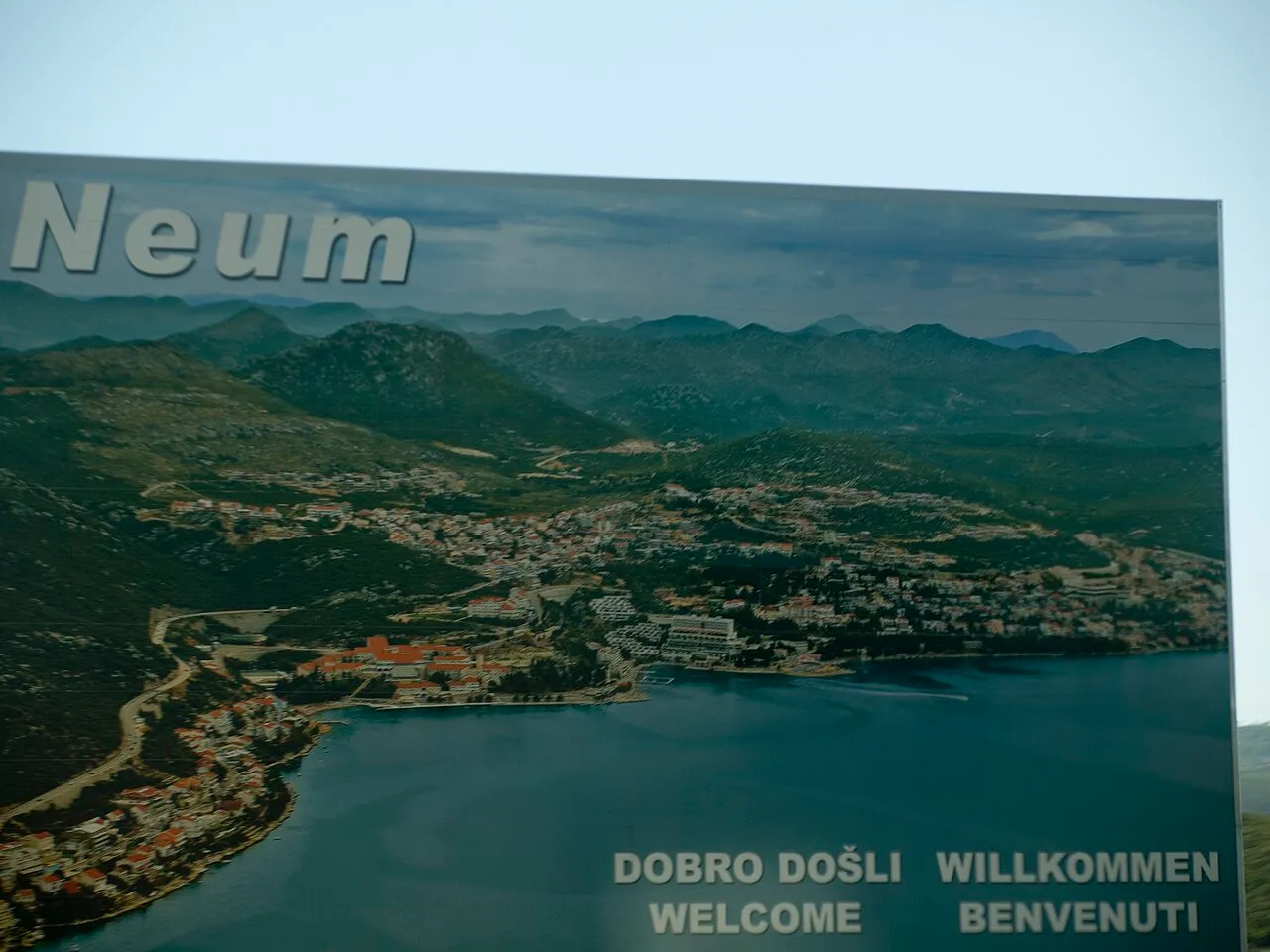
This is the detail that generates most of the confusion online, so it is worth getting straight. Neum is a roughly 20 km strip of Bosnian coastline that the old coastal road passes through between Split and Dubrovnik. For years, driving that road meant two quick border crossings in and out of Bosnia, purely in transit.
Many rental companies exempt that Neum transit from their cross-border fee - Hertz, for instance, has historically allowed the coastal crossings with a short time limit in Bosnia, and Sixt excludes Neum from its foreign-use charge. The logic is that you are just passing through the corridor to reach another part of Croatia, not touring the country.
Two things follow from this. First, since the Pelješac Bridge opened in 2022, the coastal drive can bypass Neum entirely, so for the Split-Dubrovnik run the whole question increasingly doesn’t arise. Second, and this is the important bit: a proper trip into Bosnia isn’t a Neum transit. If you’re driving inland to Mostar, Trebinje or Sarajevo to actually spend time there, the transit exemption doesn’t cover you. That’s a real border crossing, and you need the full Green Card and authorisation. Don’t let a “Neum is free” line lull you into skipping the paperwork for a genuine visit.
Documents for the people in the car
The insurance and authorisation sort out the car. Everyone inside it needs their own valid travel document, and the rule splits by nationality. EU, EEA and Schengen nationals can enter and stay up to 90 days in any 180 on a valid national ID card - no passport required. Everyone else, including UK, US, Canadian and Australian passport holders, needs a valid passport to cross. So before you leave the coast, do the quick headcount: an ID card for EU travellers, a passport for the rest, and make sure nobody has left theirs in the hotel safe.
Entry rules depend on your nationality and can change, so confirm the current position with the Bosnian Border Police or your own government’s travel advice before you go (checked 2026-07-08). Our full Croatia-Bosnia border crossing guide covers the queues, the passport stamps and which crossings back up in summer.
Insurance: mind the excess, not just the Green Card
It’s easy to hear “insurance” and think the Green Card has you covered. It doesn’t, at least not the way you want. The Green Card only proves your third-party liability is valid abroad - the cover for damage you do to others. It says nothing about the excess (deductible), which is the amount you’re on the hook for if your own car is scratched, dented or worse. That excess is often large, and the cheap headline rate almost always comes with the biggest one.
Two common gaps catch people out on a Bosnia run. Tyres, windscreen and the underside of the car are frequently excluded from the basic cover - and Bosnia’s two-lane roads, gravel edges and the occasional pothole are exactly where those get hit. And any car breakdown or medical mishap on the far side of the border is your problem to solve. You can buy the agency’s excess-reduction cover at the desk, or carry your own travel insurance plus a standalone excess policy, which usually works out cheaper. Just don’t double-pay or, worse, assume “fully insured” means what the salesperson implied.
Once you are across: driving in Bosnia
The crossing is the paperwork bit; the driving is the fun bit, but it has its own rhythm. Bosnia charges tolls, not a vignette, so there is no sticker to buy in advance the way Croatia and Slovenia work - you pay at a booth on the short A1 out of Sarajevo, in marks or euros, cards accepted. Most of the country is toll-free two-lane road shared with trucks: good tarmac, slow overtaking, beautiful scenery. The currency is the convertible mark (BAM / KM), pegged near 1.96 to the euro, and while cards work for fuel and tolls, the small stuff - a roadside cafe, parking at Kravice or Blagaj - wants cash in marks. Our guide to driving in Bosnia goes deep on the roads, the winter-tyre law, the Cyrillic signs in Republika Srpska and the frequent speed patrols.
The one-minute checklist
Getting a Croatian hire car into Bosnia comes down to a short list, and if you tick it off there’s genuinely nothing to worry about:
- Declare Bosnia when you book, not at the border - it is cheaper and avoids missing documents.
- Confirm the Green Card and cross-border authorisation are on your written contract.
- Ask the fee outright and whether it’s per day or per rental, so there are no surprises.
- Check your specific car is cleared to leave Croatia (premium models sometimes aren’t).
- Sort the excess, either at the desk or with your own travel and excess cover.
- Make sure every passenger has the right travel document - ID card for EU, passport for the rest.
Do that, and the drive from the polished Dalmatian coast to the Ottoman stone of Herzegovina is one of the easiest and most rewarding in the region. For the return situation - renting inside Bosnia and heading the other way - see our car rental in Bosnia guide; and if you are still weighing whether to drive at all, the driving in Bosnia guide and the wider car rental section fill in the rest.
Photos
Read also

Car rental · 8 min read
Car Rental in Sarajevo: Airport Pickup & Prices
Verified · August 8, 2026Car rental at Sarajevo Airport: real prices from two named operators, where the desks are, old town parking, and the drive out toward Mostar.

Car rental · 12 min read
Car Rental in Bosnia: Tips & Where to Book
Verified · August 9, 2026Do you need a car in Bosnia, where to book it, automatic vs manual, winter tyres, cross-border to Croatia and Montenegro, tolls, parking and driving rules.

What to see · 15 min read
Via Dinarica Bosnia: Huts, Stages & Logistics
Verified · September 12, 2026Plan the Via Dinarica White Trail in Bosnia: 12 stages, 334 km, hut booking, trailheads, closures and three workable section packages.

What to see · 10 min read
Jablanica: Neretva Bridge & Roast Lamb Stop
Verified · September 4, 2026Jablanica on the Sarajevo-Mostar road: Battle for the Wounded museum (5 KM), the 1943 bridge, roast lamb lunch. Hours, parking, how long to stop.