Eastern Bosnia: Drina Bridge & Sutjeska Wilderness (3 Days)
A 3-day loop from Sarajevo to the Drina bridge at Višegrad, Foča and Sutjeska National Park - distances, roads and where the Nobel story began.
Three days, one bridge whose story won a Nobel Prize, and a national park most visitors never reach. This loop runs east from Sarajevo to Višegrad for the Drina bridge and Andrićgrad, on to Foča for the river confluence, then into Sutjeska National Park before looping back on a different road. It covers roughly 365 km, needs your own car, and rewards the kind of traveller who’d rather stand where a story actually happened than tick off another old town.
Come between May and September. The high trails around Maglić are only realistic in summer, and the mountain roads on both legs are far more pleasant dry than in fog or snow. Bring cash in convertible marks (KM/BAM) - card machines thin out fast once you’re past Foča.
Day 1: Sarajevo to Višegrad, and the bridge that outlasted an empire
The drive is about 130 km on the M5, and here’s the thing worth knowing before you set off: online route calculators put this at under two hours, but that’s a flat-map fiction. The M5 winds hard through Rogatica and the hills beyond it, and a realistic estimate is two and a half to three hours each way. Budget the whole morning, not a quick errand.
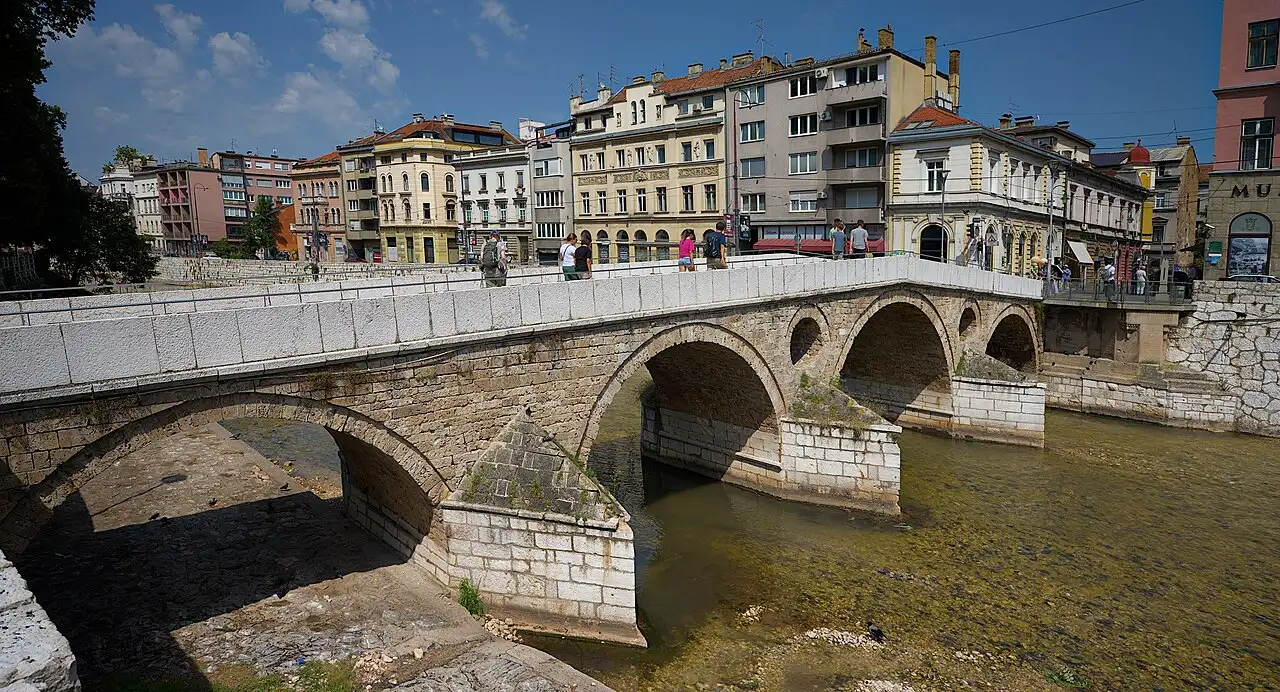
What you’re driving toward is the Mehmed Paša Sokolović Bridge, eleven stone arches spanning 179.5 metres across the Drina, built between 1571 and 1577 by Mimar Sinan, chief architect to the Ottoman court, on the order of the Bosnian-born Grand Vizier Mehmed Paša Sokolović. Don’t confuse Sinan with Mimar Hayruddin, who built Mostar’s Old Bridge - two bridges, two architects, same empire, same century. UNESCO inscribed it as a World Heritage Site in 2007 (criteria ii and iv): a geostrategic Ottoman masterpiece and a marker of cultural exchange across the Balkans. Three of the eleven arches were destroyed in the First World War and five damaged in the Second; both times it was rebuilt, most recently with a Turkish-funded restoration that ran from 2013 to 2015. It now carries foot traffic only.
Practical bridge visit. There’s no ticket booth and no timed entry - the span is a public pedestrian crossing, open around the clock, free to walk. Give yourself 20-40 minutes on the stone for photos and the view upstream, then more if you want to sit with a coffee on either bank. Street parking in the old town is usually easy and cheap; don’t try to drive onto the bridge itself. Bring a torch if you’ll be out after dark - the parapets aren’t lit like a tourist plaza.
That “everyone” includes a boy called Ivo Andrić, who was sent to Višegrad as a small child after his father died and who called the town, not his birthplace, “my real home.” He grew up within sight of this bridge, and in 1945 he published The Bridge on the Drina (Na Drini ćuprija), a novel that follows the structure and the town through four centuries, from the bridge’s construction to the outbreak of the First World War. In 1961 Andrić became the only writer from the former Yugoslavia to win the Nobel Prize in Literature, cited for “the epic force with which he has traced themes and depicted human destinies drawn from his country’s history.” Stand on the bridge with that in your head and it stops being a nice old crossing and becomes the spine of a book that made the Nobel committee sit up.
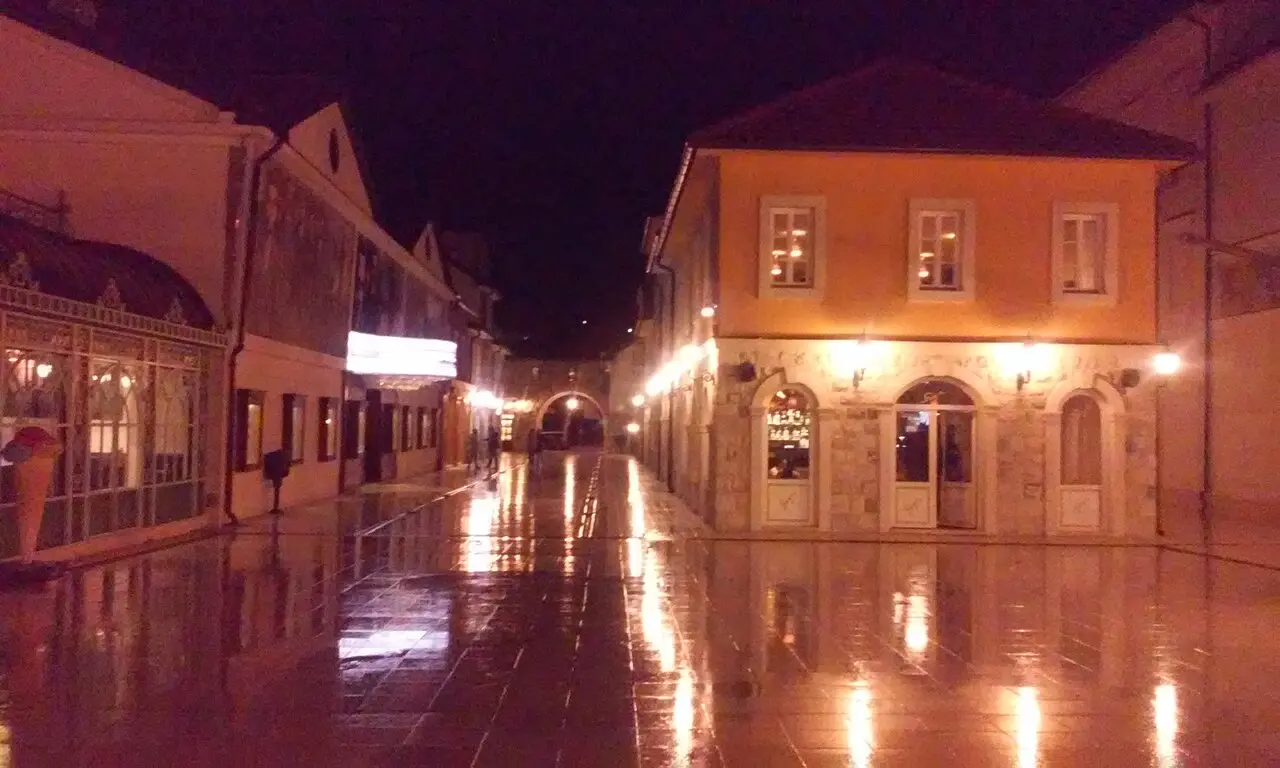
Beside the bridge is Andrićgrad, a stone-built quarter the film director Emir Kusturica raised on a peninsula between the Drina and the Rzav, construction starting in 2011 and the town officially opened on 28 June 2014. It’s not a museum piece behind a rope - it’s a working set, with a theatre, a hotel, a church, a cinema, and statues of Andrić alongside Nikola Tesla and the Ottoman vizier who ordered the bridge next door.
Practical Andrićgrad. The complex sits about a five-to-ten-minute walk from the UNESCO bridge along the river - most people do both in one afternoon. Walking the streets and squares costs nothing; you pay only for coffee, a meal, a cinema ticket or a guided visit inside a specific building. Cafés and restaurants typically run from morning into the late evening (often past 22:00 in summer). Follow the signs from the town centre, or park near the complex and walk. A quiet pattern that works: bridge first in softer morning light, Andrićgrad for lunch and a slower wander, then back to the river for golden hour. Boat rides on the Drina sometimes run in season from near the bridge (operators quote roughly €5-10 for a short hop; confirm on the quay, cash in KM).
Budget two to three hours if you’re only sampling, or the rest of the afternoon plus an overnight if you want the bridge without day-trip crowds. One honest note before you fall too far into the literary romance: Višegrad’s history in the 20th century was not kind. In the spring and summer of 1992 the town suffered some of the war’s most severe violence against its Bosniak population, including killings carried out on the bridge itself, a matter of record before international courts. It’s worth knowing as you stand there - not to dwell on, but not to pretend the story ends with a Nobel Prize either. Overnight in Višegrad; there are guesthouses and small hotels near the old town and the river.
Day 2: south to Foča through the Drina gorge
From Višegrad, drop down to the small junction at Ustiprača and pick up the M20, which runs south through Goražde and along the Drina gorge to Foča - roughly 72 km, about an hour and fifteen minutes. This stretch has a reputation among Bosnian drivers as one of the country’s better river-gorge drives: the road hugs the water for long sections with limestone rising on either side, and there’s rarely much traffic to rush you.
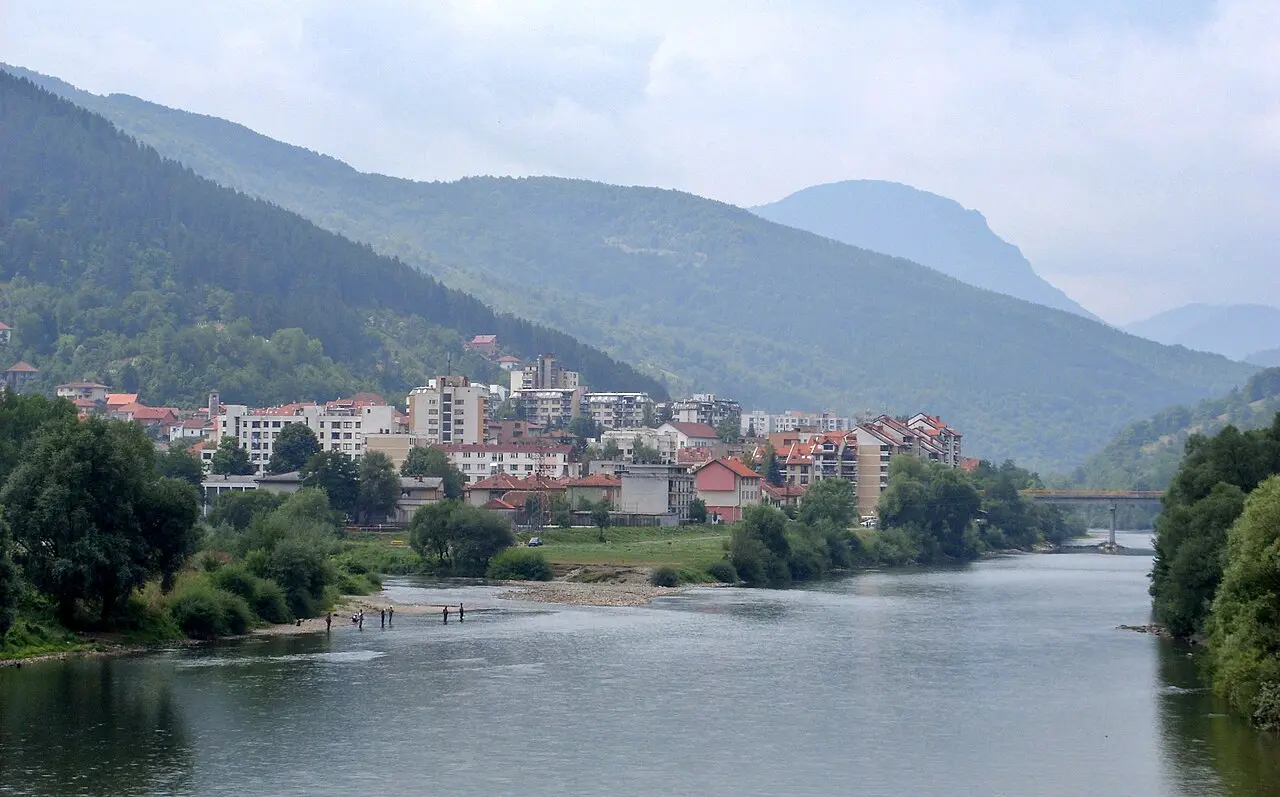
Foča sits at the confluence of the Drina and the Ćehotina, and its landmark is the Aladža Mosque, built in 1549 by the architect Ramadan-aga and known locally as the “coloured mosque” for its now-faded painted interior. It was destroyed on 2 August 1992 during the war, sat as rubble for over two decades, and was rebuilt between 2016 and 2018, reopening on 4 May 2019 - one of the more complete post-war restorations in the country. The old market quarter and the ruined Sokograd fortress on the hill above town are worth an hour if you have it, but don’t overplan this stop: Foča’s real job on this route is to be the last proper supply point (fuel, cash, a decent lunch) before the road narrows into the park.
Push on to Tjentište, another 29 km and roughly half an hour further into Sutjeska National Park, and settle in for the night either there or back in Foča if you’d rather sleep with better phone signal.
Day 3: Sutjeska National Park, and the road home
Sutjeska is Bosnia’s oldest national park, established in 1962, and it earns the title of “wilderness” more than most places that claim it. At its centre stands the Tjentište memorial, two vast concrete wings driven into a hillside to mark the Battle of the Sutjeska, a brutal 1943 breakout by encircled Yugoslav Partisans against a far larger Axis force. The sculptor Miodrag Živković designed it to look like a wound tearing open, and whatever you make of the politics behind it, it’s one of the strangest and most affecting pieces of monumental architecture in the former Yugoslavia.
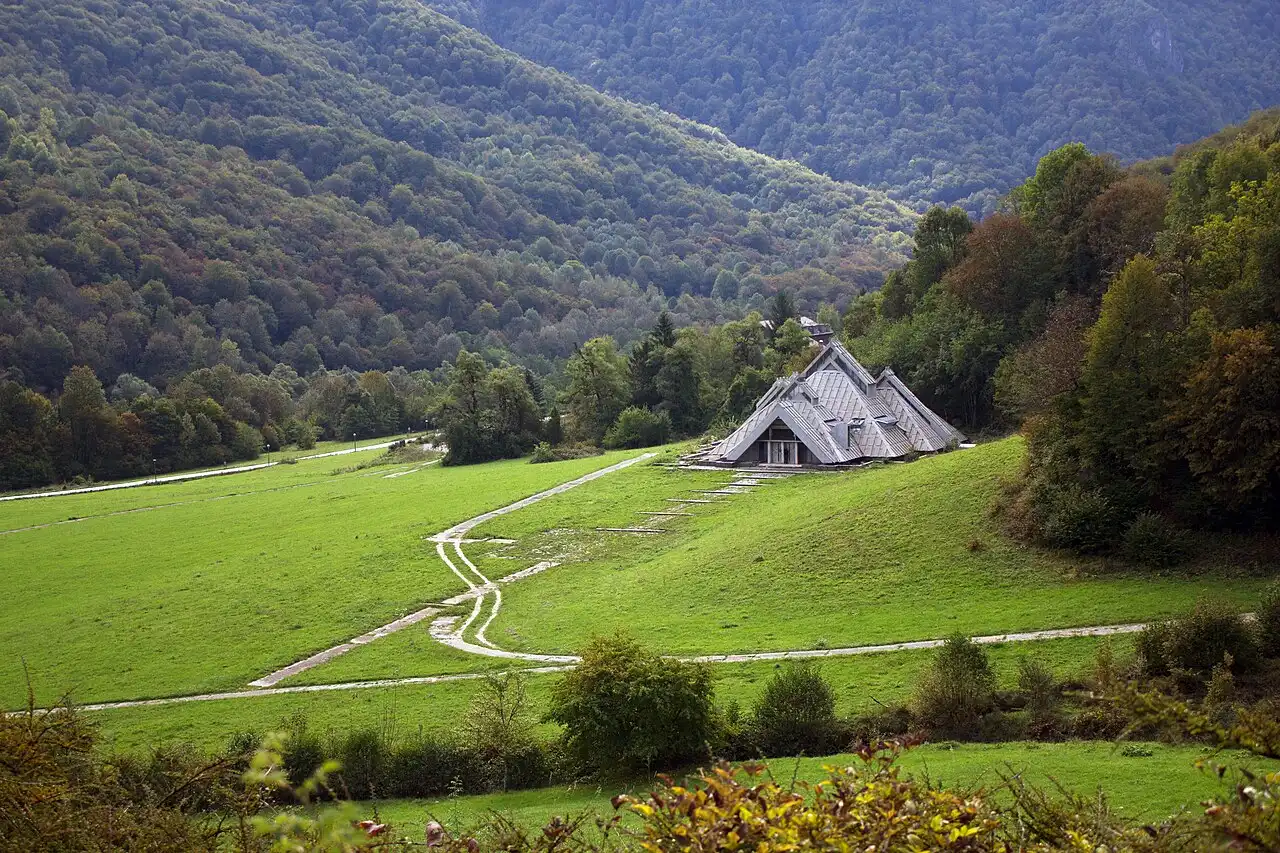
If you have the morning and the legs, the Vidikovac viewpoint looks out over Perućica, one of the last two primeval forests left in Europe - beech and fir that have never been logged, some of it around 300 years old. Walking into the reserve itself needs a park guide, arranged at the visitor centre, but the viewpoint alone gives you the scale of it without the paperwork. Hikers with more time push on toward Maglić, at over 2,386 metres the highest peak in the country, though that’s a full day’s undertaking rather than a stop on a drive-through morning. Park entry runs somewhere around 5 KM (roughly €2.50) per the operators who publish a figure, though this isn’t an official rate card - confirm what the gate is charging when you arrive, and bring cash regardless.
Our fuller Sutjeska National Park and Maglić guide covers the trails, the guided forest visit and the season in more depth if this stop turns into a longer stay. Foča is also the Bosnian put-in for rafting the Tara, the deepest canyon in continental Europe, so if you’re tempted to add a fourth day rather than head home, that’s the way to spend it.
From Tjentište, you backtrack the 29 km to Foča on the same road you drove in on, then the route changes: pick up the M18 north through Trnovo, a different road from the M5/M20 you took out from Sarajevo, so the loop as a whole doesn’t retrace itself. All in, reckon on roughly 135 km and two and a half to three hours from Tjentište back to the capital. It’s a mellow enough drive to close on, following the Drina and Bistrica valleys most of the way, with Sarajevo’s ring of hills rising ahead of you by the final stretch. If you’d rather keep going south instead of looping home, the same valley road continues through Gacko and Bileća: that’s the inland Sarajevo to Trebinje run, not a detour off this loop.
Making the loop work
A few things worth getting right before you leave:
- Trust the two-and-a-half-hour figure for Sarajevo-Višegrad, not the calculator’s ninety minutes. The M5 is a real mountain road, and rushing it on a first visit is how people miss what the drive is actually for.
- Cash in convertible marks, not euros. Park gates, Andrićgrad food stalls and village cafés along the M20 want KM; card machines are patchy east of Foča.
- Sleep in Višegrad, not just pass through. The bridge and Andrićgrad are genuinely better in the evening once the day-trip minibuses from Sarajevo have gone home.
- Don’t try to add Mostar or the coast to this loop. Eastern Bosnia and the south are different directions entirely; if you want both, look at a longer trip like our 10-day Bosnia road trip instead of bolting them onto three days.
- A 4x4 isn’t necessary. Every road on this route, including the M20 gorge stretch, is sealed. What you actually want is a car with decent brakes and a driver who isn’t in a hurry.
Three days is enough to do this properly without feeling rushed, and it’s the kind of loop that rewards slowing down more than covering ground: one bridge with a Nobel Prize attached to it, one town that rebuilt its most beautiful mosque, and one park that most people who’ve been to Bosnia have never actually seen. If a single day trip from the capital is more your pace, our day trips from Sarajevo guide covers Višegrad as a shorter out-and-back rather than a full loop - useful to compare against before you commit to the extra two days.
Route day by day
- Days on the road
- 3
- Distance
- ≈365 km
- Budget from
- 80 EUR
- Best season
- May, June, July, August, September
The route at a glance
-
Sarajevo
Route startstop ≈0 min
Start here and pick up the hire car the morning you leave. The road east is a genuine mountain drive, not a motorway hop, so give it a full day rather than a rushed half.
Photo: Miha Peče / Wikimedia Commons, CC BY-SA 4.0 ( source) -
Višegrad
130 km from the startstop ≈1440 min
The Drina bridge and Andrićgrad. Reckon on a genuine two and a half to three hours each way on the winding M5, not the flat 130 km on paper. Overnight here.
Photo: Upotrebi klikere / Wikimedia Commons, CC BY-SA 4.0 ( source) -
Foča
202 km from the startstop ≈90 min
About 72 km and 1h15 south on the M20 through the Drina gorge via Goražde. A confluence town - the rebuilt Aladža mosque and the meeting of the Drina and Ćehotina - and the last supply stop before the park.
Photo: Julian Nyča / Wikimedia Commons, CC BY-SA 3.0 ( source) -
Tjentište, Sutjeska National Park
231 km from the startstop ≈1440 min
A further 29 km, about 30-35 minutes. The Tjentište war memorial, Perućica primeval forest viewpoint and, for hikers, Maglić. Overnight near Tjentište or Foča, then roughly 135 km and two and a half to three hours back to Sarajevo via Foča and the M18 through Trnovo.
Photo: Kathinka / Wikimedia Commons, CC BY-SA 4.0 ( source)
Route map
The map with stops loads on click - to keep the page lightweight.
The map didn’t load. Check your connection and refresh the page.