Sarajevo on Foot: Baščaršija to Latin Bridge, 3h
A 3-hour walk of about 1.4 km from the Sebilj through Baščaršija to Vijećnica and the Latin Bridge, with a coffee stop built in.
Three hours on foot cover Sarajevo’s old-town spine: about 1.4 km from the Sebilj through Baščaršija, across the Meeting of Cultures line, into Vijećnica, and downriver to the Latin Bridge. You’ll stay on flat cobbles and a short riverbank stretch - no cable car, no car, no tickets required unless you go inside the city hall or the 1914 corner museum.
Three hours for barely more than a kilometre sounds slow, and it is - on purpose. Walking time alone is under twenty minutes. Everything else - the slow coffee, the Vijećnica atrium, the corner museum - is stops, not steps. Start by 09:00 on a weekday and you’ll beat the loudest tour groups at the Sebilj and still catch Vijećnica’s atrium before the midday queue.
How the morning is paced
| Stop | Stay | Money |
|---|---|---|
| Sebilj | 20 min | Free |
| Kazandžiluk + coffee | 35 min | Coffee a few KM; shopping optional |
| Meeting of Cultures | 15 min | Free |
| Vijećnica | 45 min | Outside free; atrium adult 10 KM |
| Latin Bridge | 40 min | Bridge free; museum adult 5 KM |
Totals sit near three hours with one coffee and both interiors. Skip the coffee and both interiors and you’re close to the ninety-minute version below instead of the full three-hour version - fine for a layover, thin for a first day. Carry convertible marks (BAM / KM); the museum desk and many café tills prefer cash, and euros are hit-and-miss in the bazaar.
You’ll want shoes that forgive uneven stone. July and August get hot on the open square by late morning; April-May and September-October are kinder. Winter isn’t off-limits - the cobbles themselves have no seasonal barrier - but shorter daylight means starting earlier, and the Latin Bridge museum runs shorter hours in the cold months and stays shut on Sundays year-round.
Stop 1: Sebilj on Baščaršija Square
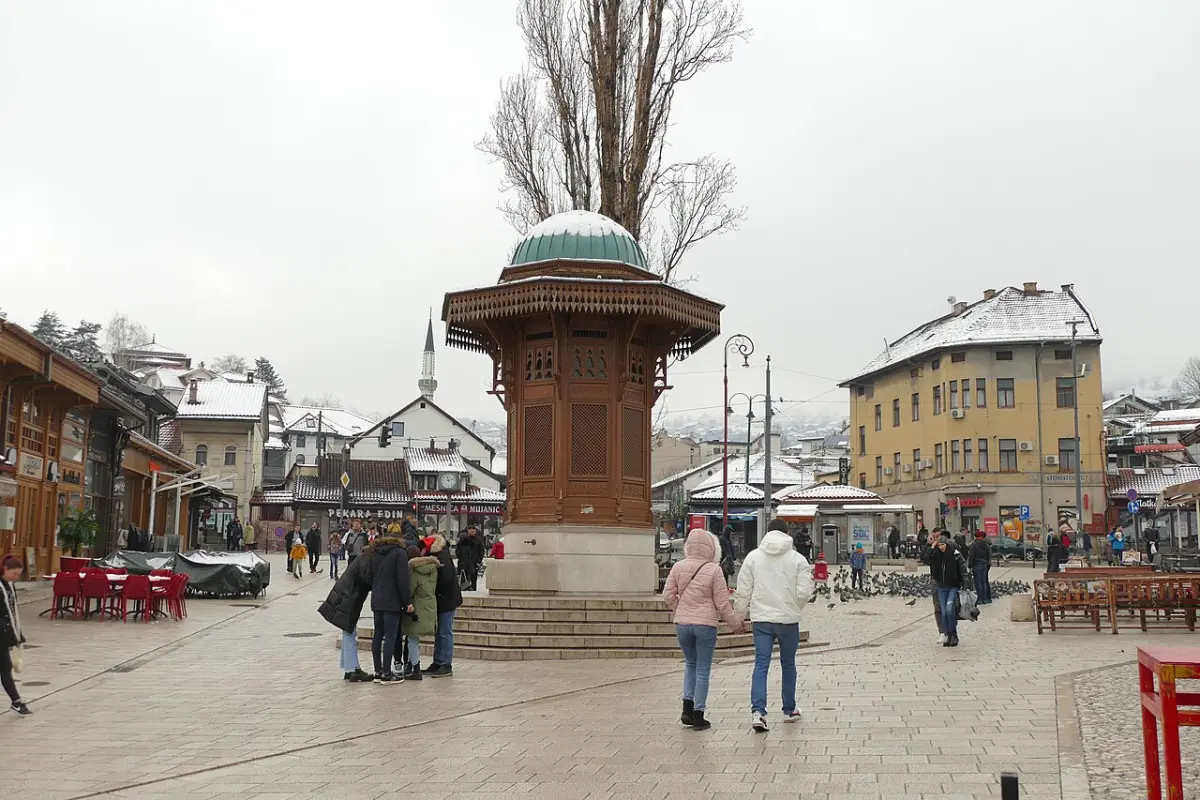
Plant yourself at the Sebilj, the octagonal wooden fountain that local photographers treat as Sarajevo’s logo. The first Sebilj here went up in 1753 under Mehmed-paša Kukavica and burned in 1852; what you see is the Austro-Hungarian rebuild by architect Alexander Wittek - sources put the rebuild in the 1890s (often 1891), though some tourist material gives 1913, so hold any single year loosely. Locals will tell you that drinking from it binds you to come back - take or leave the legend, but fill a bottle if the spout is running.
Twenty minutes is enough: photos, a slow circle of the square, a sense of how the bazaar lanes radiate outward. Don’t linger for the souvenir pitch yet. The deep dive on shops, the mosque complex and festival nights lives in our Baščaršija guide; this walk only borrows the square as a starting pin.
Stop 2: Kazandžiluk and the coffee pause
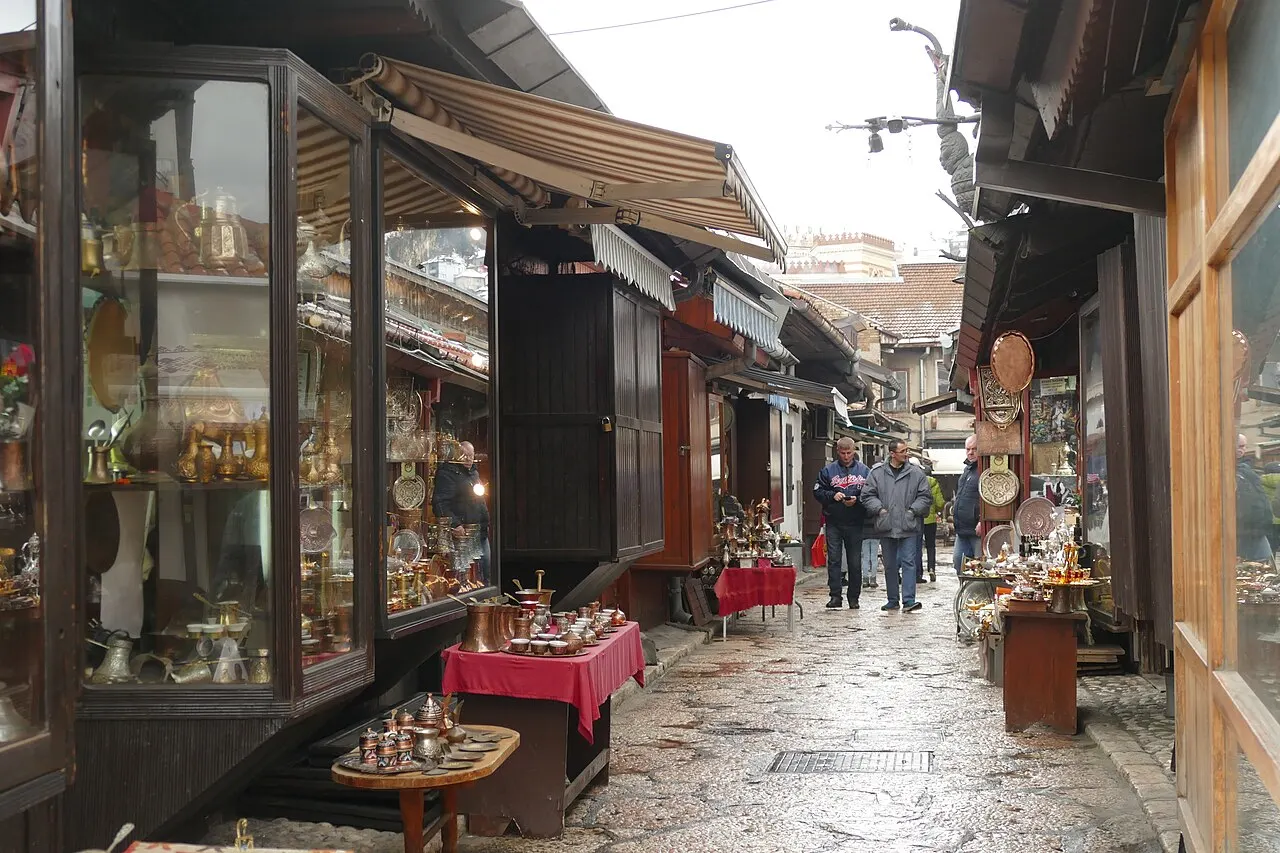
Duck one lane into Kazandžiluk, the coppersmith street, where trays and džezve still hang in doorways. Five minutes of looking is honest; twenty minutes of browsing is how mornings disappear. Pick one small object or none - the street will still be here after the museums.
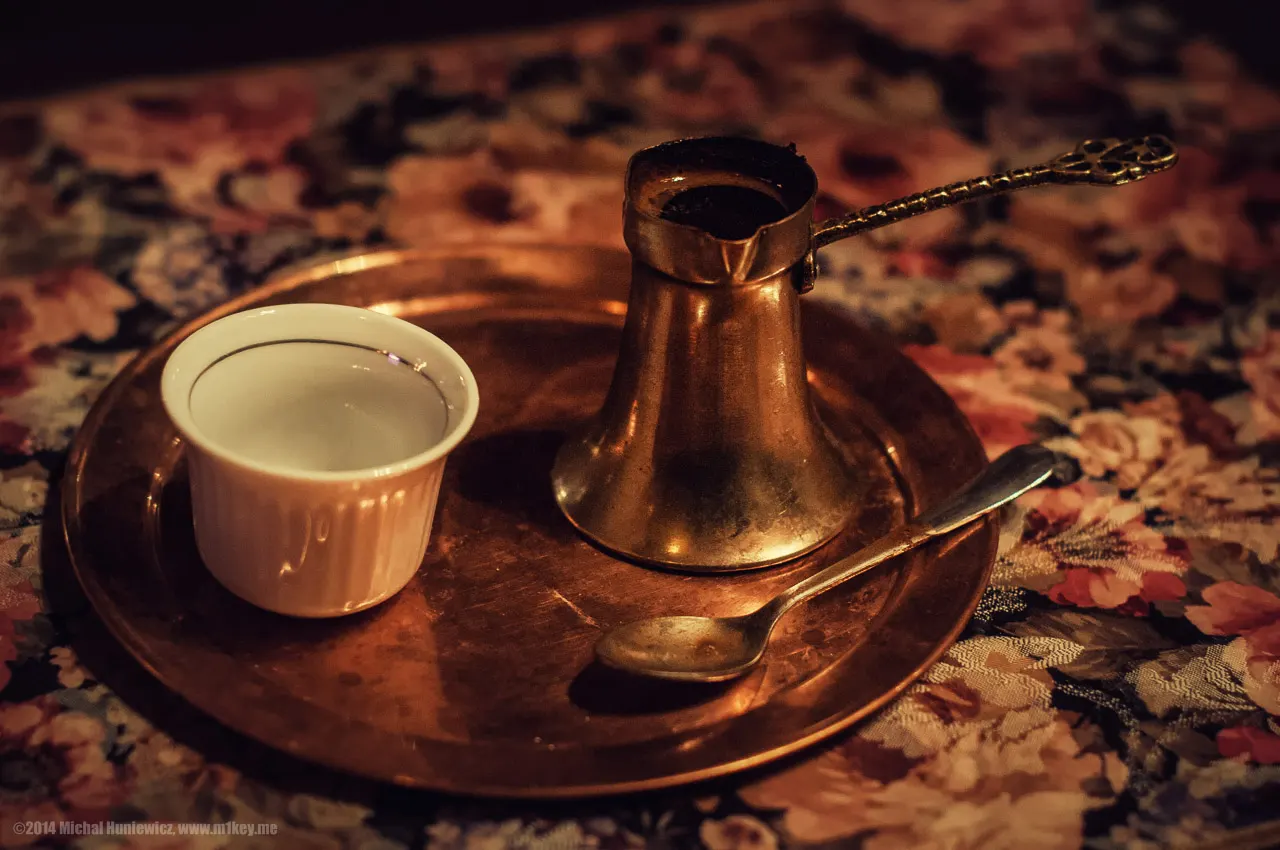
Then sit. A Bosnian coffee in a fildžan on a terrace near the square is the pacing tool of this route: foam on top, sugar on the side, no takeaway lid. Prices sit in the low single-digit marks on most boards - confirm what is written that day, pay in KM, and don’t expect card machines on every tiny terrace. Thirty-five minutes here is deliberate. Skip it and the morning starts to feel like you’re late for your own itinerary.
Stop 3: Meeting of Cultures line
Walk west along Sarači until the cobbles meet Ferhadija. Look down for a brass marker set into the pavement: Sarajevo Meeting of Cultures. Stand on it. East is low Ottoman shopfronts, domes, the bazaar you just left. West is taller Austro-Hungarian stone, shop windows, the pedestrian boulevard that could pass for a quieter Vienna block.
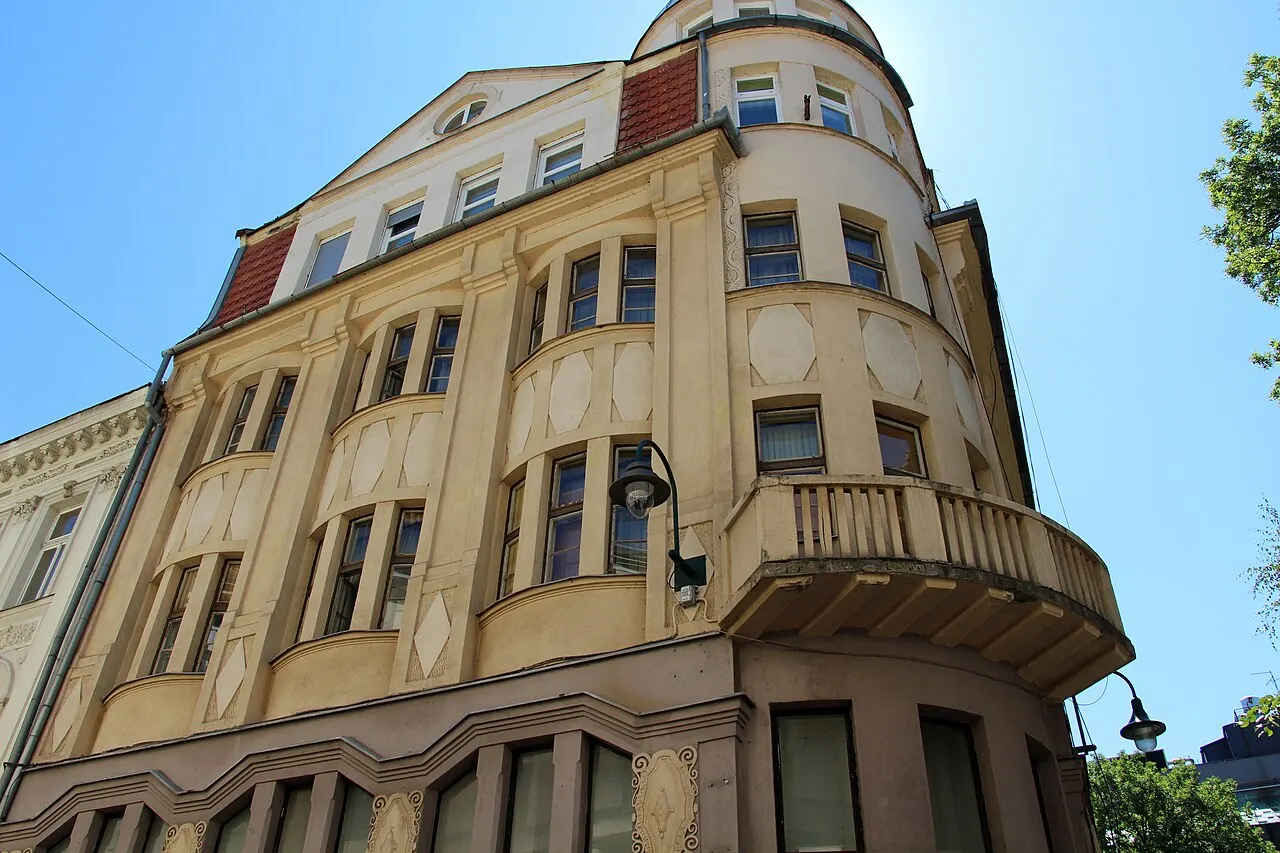
Fifteen minutes is plenty: find the plate (it is small; scan a few metres of paving), look both ways, listen if the noon call to prayer and cathedral bells overlap. There’s no ticket and nothing to “do” beyond noticing. For more bazaar context around this seam, stay with the Baščaršija page - the marker itself has no separate article.
From here you reverse east, back along Sarači and through the bazaar’s lanes, until Vijećnica lines up at the end of the street - the river itself stays out of sight until you’re at the building.
Stop 4: Vijećnica on the Miljacka
Vijećnica is the striped pseudo-Moorish city hall that sits on the river like a civic postcard. Built for the Austro-Hungarian administration and opened in 1896, it later held the national library; shelling in August 1992 burned the collections; the restored building reopened in 2014. The riverbank view is free and already worth the walk.
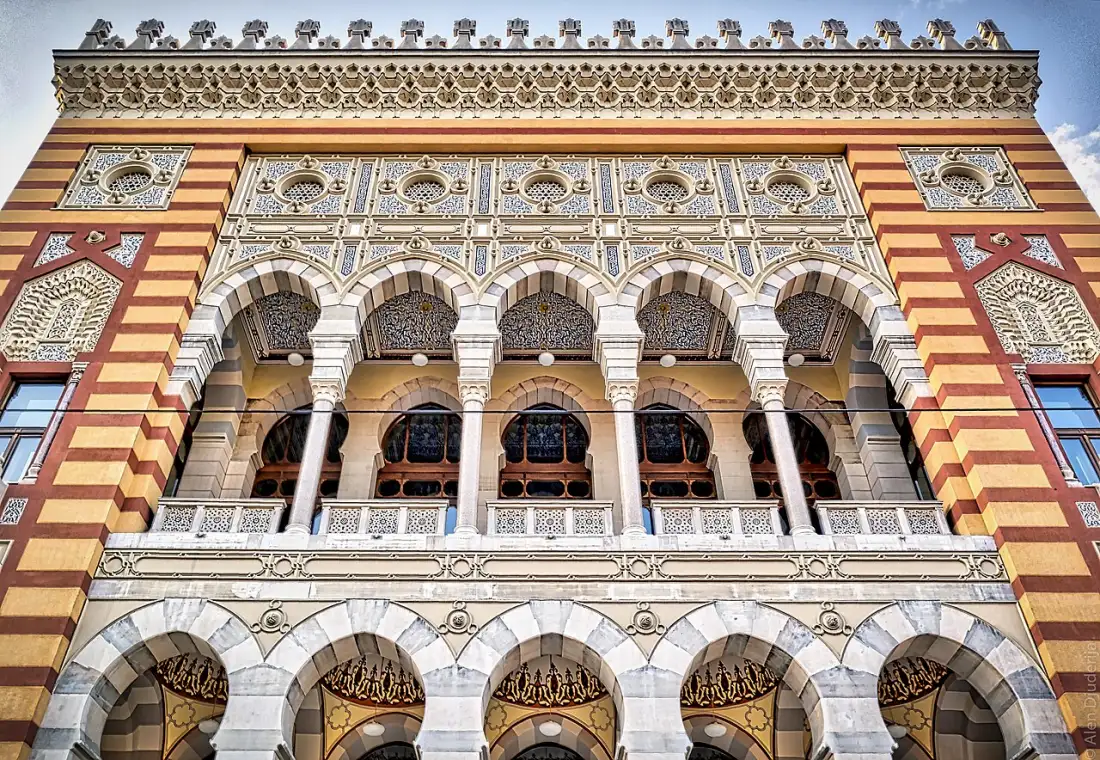
Go inside when the morning is open. The canton tourist board lists adult entry at 10 KM (reduced 5 KM for children, students, pensioners and visitors with special needs); the operator’s own homepage doesn’t currently publish a price table, so treat 10/5 KM as the last clear published band and confirm at the desk. Hours are daily 09:00-17:00, as published on vijecnica.ba - worth double-checking on busy event days too. The atrium and stained-glass canopy are the draw; the basement exhibition on the 1992 fire asks for quieter time. Full ticket, hours and interior notes sit on our Vijećnica guide. Budget forty-five minutes for a ticketed visit, fifteen for exterior-only.
Mind the geography: Vijećnica sits upstream (east) of the Latin Bridge on the Miljacka. When you leave, walk downriver - west along the bank - to the assassination corner. Get that direction wrong and you’ll do the classic first-timer loop.
Stop 5: Latin Bridge and the 1914 corner
The Latin Bridge is an Ottoman stone crossing with a weight of twentieth-century history that still surprises people who only came for coffee. On 28 June 1914, Archduke Franz Ferdinand and Sophie were shot at the corner building on the north bank; the bridge itself is free to walk and photograph.
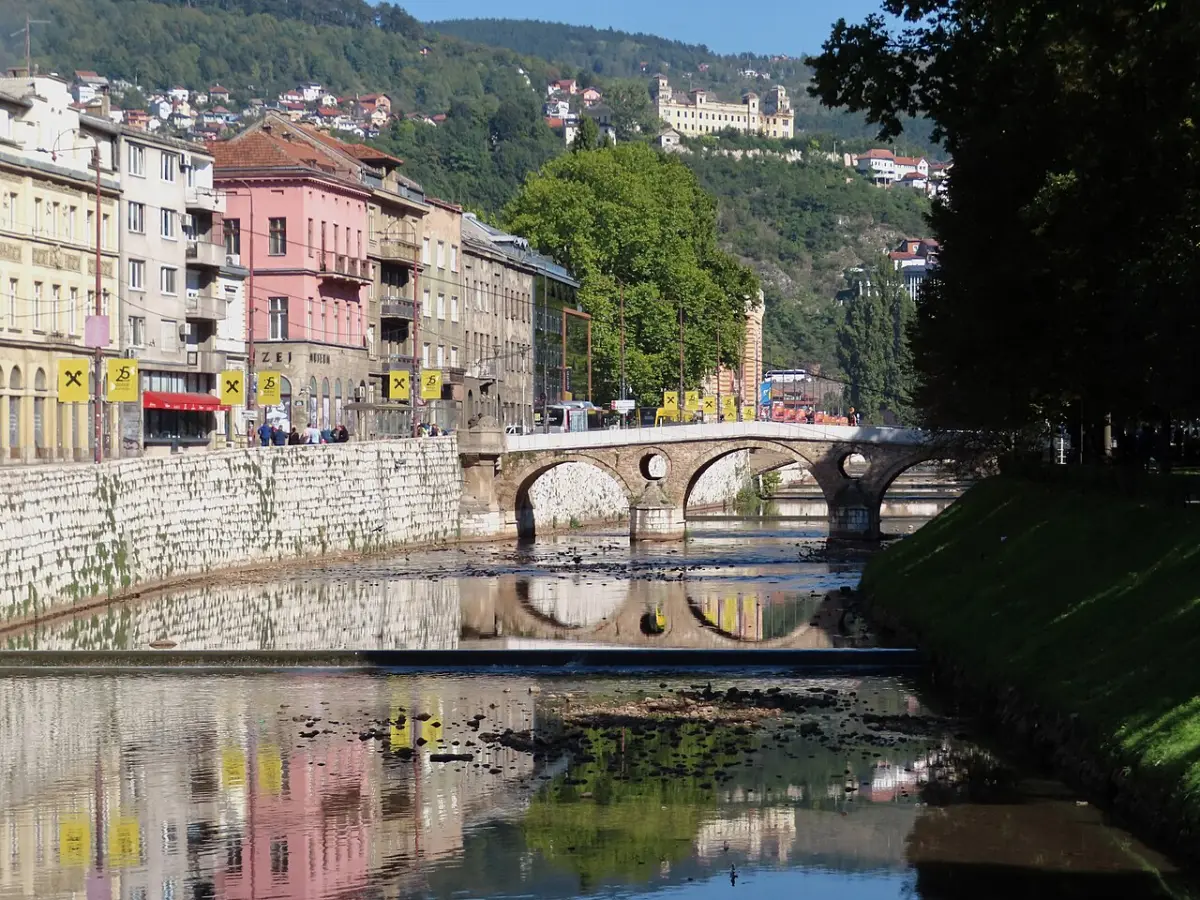
The Museum of Sarajevo 1878-1918 occupies that corner building. Adult entry is 5 KM; in the warmer months weekdays run 09:00-17:00 and Saturday 10:00-15:00, with shorter weekday hours in the colder season, and Sundays closed (muzejsarajeva.ba, checked late August 2026). Pay in KM. Forty minutes covers the bridge, the outdoor plaques and a focused museum pass; skip the ticket and you’re still done with a solid outdoor stop. The full assassination-site narrative, combined tickets and seasonal hour shifts are on our Latin Bridge page.
When to shorten, and when to stretch
Ninety-minute version: Sebilj → Meeting of Cultures → Vijećnica exterior → Latin Bridge exterior. Skip the coppersmith stop, the coffee and both interiors and you land close to ninety minutes total. Useful between a morning arrival and an afternoon bus.
Full three-hour version: all five stops, one coffee, Vijećnica atrium, Latin Bridge museum. That is the route this page is built for.
Stretch past three hours: add Gazi Husrev-beg Mosque outside prayer times (dress code, small fee - details on the Baščaršija page), or climb toward Yellow Bastion after the bridge for a hill view. Those are add-ons, not part of the 1.4 km spine.
Rain flips priorities: covered bezistan lanes and the two interiors earn their keep; the open square is less fun with a wet camera. Heat flips the clock: start closer to 08:30, take the longer coffee in shade, and do Vijećnica before the atrium warms up.
Where to base yourself for this walk
Sleep inside or next to Baščaršija / Stari Grad and you walk out the door into Stop 1. A base further west toward Ferhadija or the cathedral still keeps the route on foot; a base out by Ilidža or the airport road turns the morning into a taxi-plus-walk. For neighbourhood trade-offs see where to stay in Sarajevo; for a wider weekend frame that already sequences these sights across two days, use 2 days in Sarajevo.
Currency again at the end because it trips people: tickets and coffee want KM. Cards work in some hotels and larger cafés; they fail often enough in the bazaar that you’ll want a cash float of 30-40 KM for this morning. The legal BAM peg sits near 1.96 KM to the euro - useful for mental maths, not a promise every till will accept your notes.
You finish at the Latin Bridge with the old town behind you and the river underfoot. From here the afternoon can go uphill to Trebević, out to the Tunnel of Hope, or simply back into the bazaar for ćevapi - but the foot spine from Sebilj to the 1914 corner is already done.
Route day by day
- On foot
- ≈3 h
- Distance
- ≈1.4 km
- Budget from
- 10 EUR
- Best season
- April, May, June, July, August, September, October
The route at a glance
-
Sebilj (Baščaršija Square)
Route startstop ≈20 min
Start at the wooden fountain everyone photographs. Drink from the spout if you like the return-to-Sarajevo legend, then turn toward the copper street before the tour groups thicken.
Photo: Hibasi / Wikimedia Commons, CC BY-SA 4.0 ( source) -
Kazandžiluk & coffee stop
0.1 km from the startstop ≈35 min
Coppersmith street one lane off the square, then a terrace coffee in a fildžan. This is where the walk slows on purpose - thirty-five quiet minutes here beats racing the museums.
Photo: Hibasi / Wikimedia Commons, CC BY-SA 4.0 ( source) -
Meeting of Cultures
0.4 km from the startstop ≈15 min
Brass marker in the pavement where Sarači meets Ferhadija. Look east for Ottoman shopfronts, west for Austro-Hungarian façades - one step, two cities.
Photo: Fred Romero from Paris, France / Wikimedia Commons, CC BY 2.0 ( source) -
Vijećnica (City Hall)
0.9 km from the startstop ≈45 min
Pseudo-Moorish city hall on the Miljacka, upstream of the Latin Bridge. Outside is free; the atrium ticket is worth it if you have the morning open.
Photo: Alen Djuderija Photography from Sarajevo, Bosnia and Herzegovina / Wikimedia Commons, CC BY 2.0 ( source) -
Latin Bridge
1.4 km from the startstop ≈40 min
Ottoman stone bridge and the corner where Franz Ferdinand was shot in 1914. The bridge is free; the Museum of Sarajevo 1878-1918 sits in the corner building.
Photo: Filip Maljković from Belgrade, Serbia / Wikimedia Commons, CC BY-SA 4.0 ( source)
Route map
The map with stops loads on click - to keep the page lightweight.
The map didn’t load. Check your connection and refresh the page.