Baščaršija, Sarajevo: Old Bazaar and Baščaršija Nights
Sarajevo's Ottoman bazaar: the Sebilj, coppersmiths, ćevapi and coffee, plus Baščaršija Nights, the free festival that takes over the old town each July.
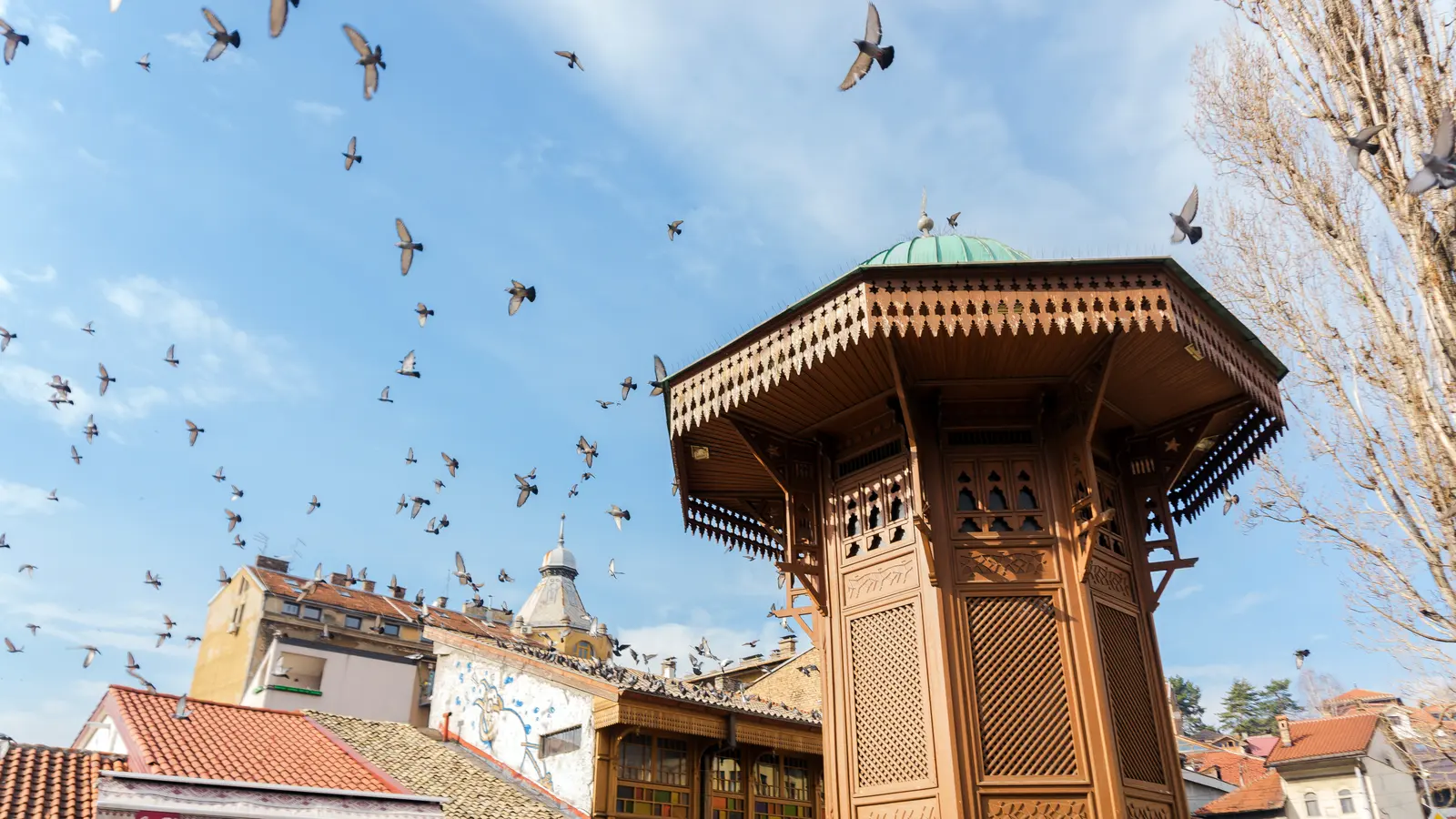
Baščaršija is Sarajevo’s old bazaar - the Ottoman-era warren of cobbled lanes, low-slung shops, mosque courtyards and coffee houses that has been the commercial heart of the city since 1462. The name is Turkish shorthand: baš (head, or main) plus čaršija (market), so literally “the main bazaar.” It’s compact enough to cross in a few minutes and dense enough to lose an afternoon in, and it’s where most people’s Sarajevo begins.
Walking it costs nothing and it never really shuts. What you spend goes on coffee, ćevapi and copper, and the small places want cash in convertible marks (KM): euros turn up only in tourist-facing shops and hotels, usually rounded to a flat 2 marks instead of the real 1.96, and cards are patchy in the lanes. The airport is 12 km out and 15 to 25 minutes by road. The one thing worth booking months ahead from abroad is the bed, because two stretches of summer empty the old town of rooms: July, when the free Baščaršija Nights festival runs all month, and mid-August, when the film festival lands.
Where it came from: 1462 and one caravanserai
Baščaršija and Sarajevo share a founding story. In 1462 the Ottoman governor of Bosnia, Isa-beg Ishaković, endowed a han - a caravanserai, the roadside inn where traders slept, stabled horses and changed money - and put a run of shops beside it. The town grew outward from that knot of trade.
By its peak in the 17th century it was enormous. The Ottoman traveller Evliya Çelebi counted something like 1,080 shops working over 80 separate crafts, each trade with its own guild and often its own street: tanners here, saddlers there, coppersmiths on the next corner. That logic is still legible in the road names, even where the trades have given way to cafés and souvenir stalls.
It nearly didn’t survive. The city burned more than once (Prince Eugene of Savoy’s raid in 1697 took much of it), and after the Second World War a municipal committee proposed demolishing the bazaar as having no place in a modern socialist city. The plans were shelved - which is the only reason you can walk it now.
The Sebilj: the symbol of Sarajevo
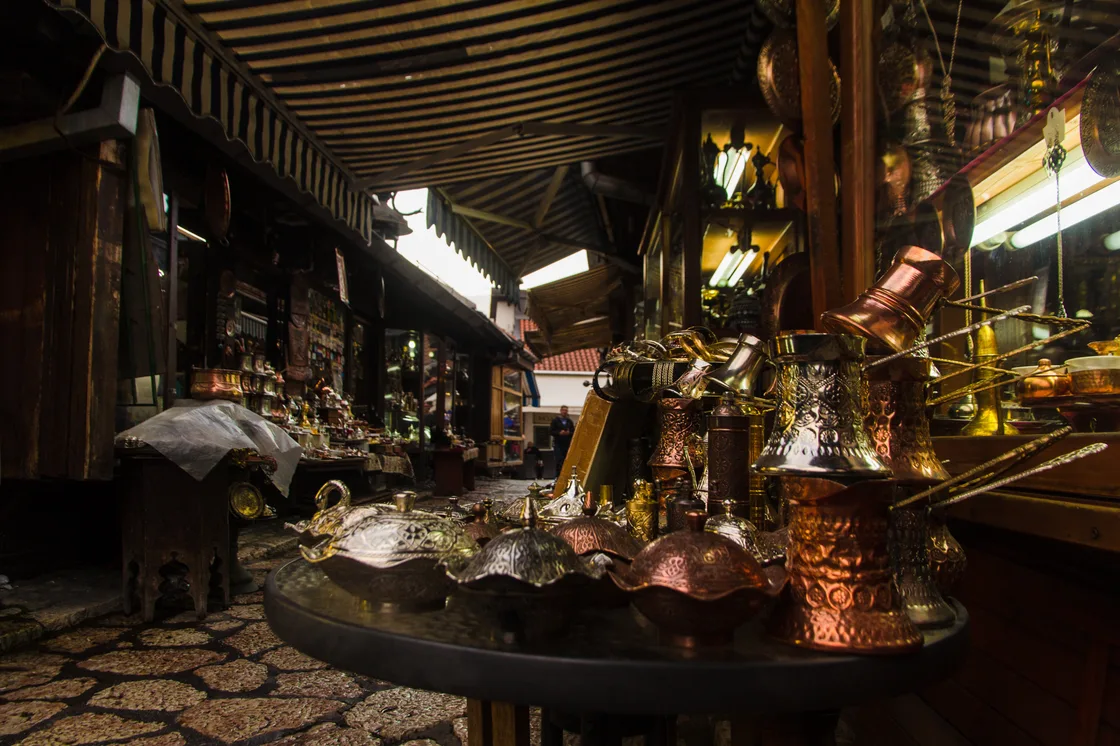
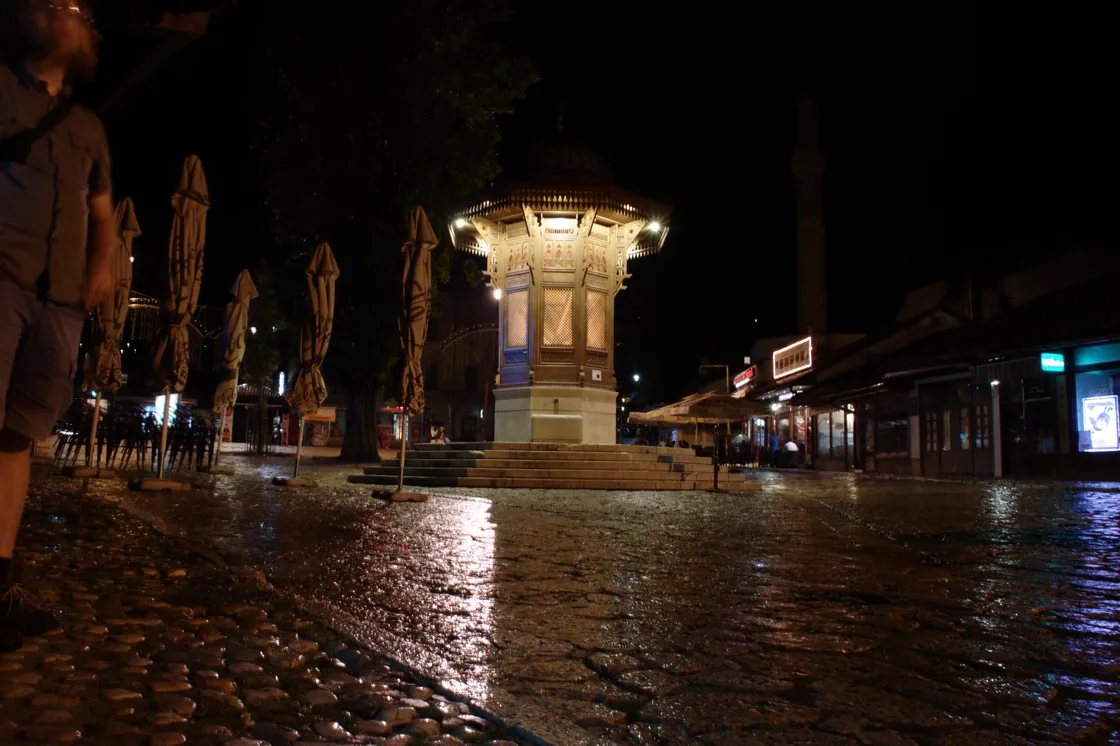
The thing everyone photographs is the Sebilj - an octagonal wooden kiosk with a fountain at its base and a green cap on top. A sebilj was an Ottoman charitable water house where passers-by drank for free; this is the last one in the city, and it stands for Sarajevo the way the Old Bridge does for Mostar.
The dates take care. The first Sebilj here went up around 1753, endowed by Mehmed-paša Kukavica, and burned down in 1852. What you see is an Austro-Hungarian rebuild in pseudo-Moorish style by the architect Alexander Wittek, shifted a few metres from the original spot; sources put it in the 1890s (often 1891) or, in much tourist literature, 1913, so take any single date with a pinch of salt. The legend is firmer than the chronology: drink from the Sebilj and you’ll come back to Sarajevo one day.
The square around it’s officially Baščaršija Square and universally “Pigeon Square,” for the unbothered flocks that carpet the cobbles. Kids chase them, old men feed them, and the birds treat the place as theirs.
Kazandžiluk: the coppersmiths’ street
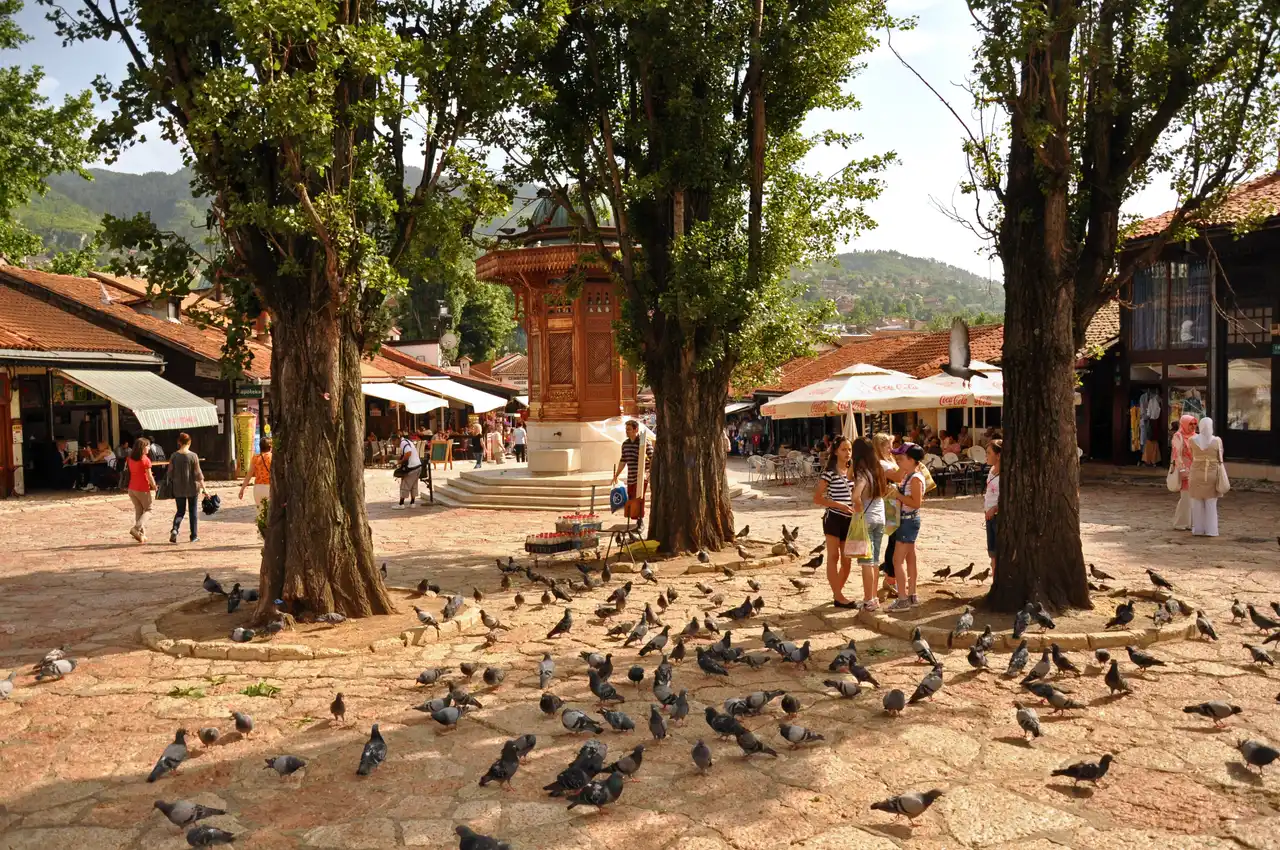
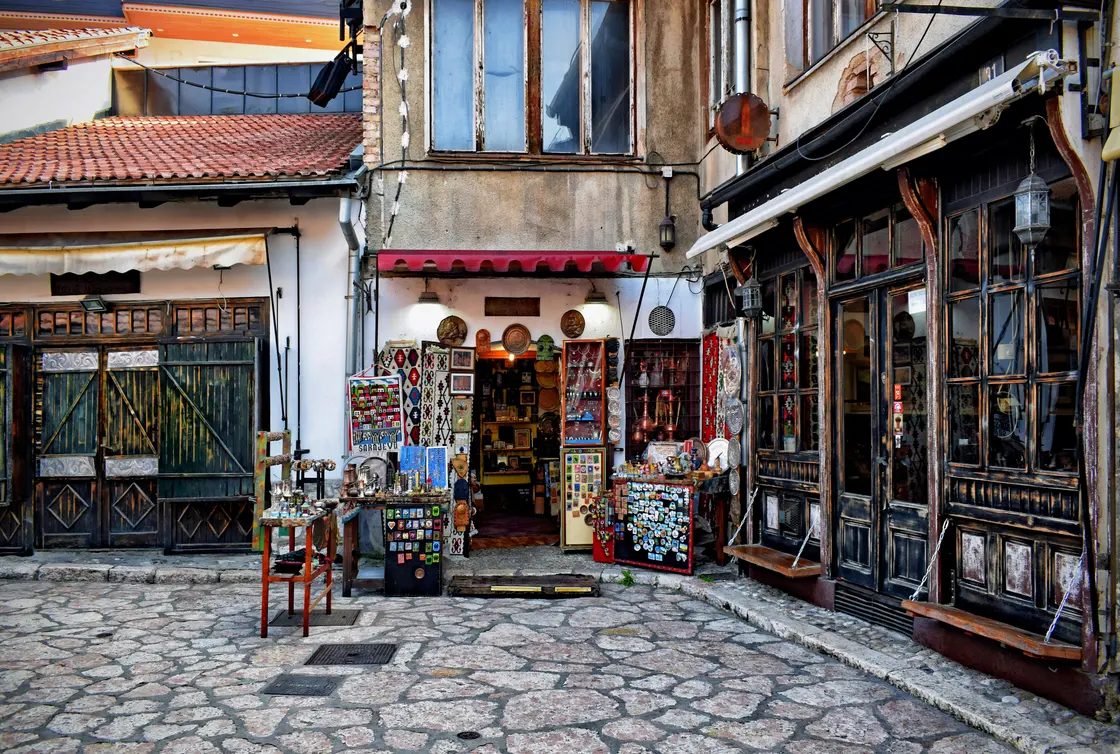
The one craft still genuinely working is copper. Kazandžiluk, the coppersmiths’ street, runs off the eastern edge of the square and takes its name from the kazandžije, the metalworkers who set up here in the first half of the 1500s. They began with kettles and cauldrons for the Ottoman army and moved on to the everyday copper of Bosnian life: džezva coffee pots, ewers, trays, engraved tabletops.
Walk it in the morning and you’ll still hear the tapping. Be clear-eyed about what’s on sale, though: a fair bit is imported souvenir stock, and one Balkan speciality you’ll see everywhere is engraved spent shell casings from the 1990s siege, worked into pens and ornaments. Some travellers take one home as a piece of dark history; others find them uncomfortable. If you want the real thing, look for the workshops where someone is actually beating metal at the back. Haggling is expected and good-natured, and the price is in marks, in cash.
Gazi Husrev-beg: the mosque that built the bazaar
If one man made this district, it was Gazi Husrev-beg, Ottoman governor of Bosnia through the 1520s and 30s. His mosque, finished in 1531, is the largest and most important Ottoman mosque in the country, usually attributed to the Persian architect Adžem Esir Ali of Tabriz. It’s only the centrepiece of a huge charitable endowment - a vakuf - that also paid for a covered market (bezistan), a madrasa, a library, an imaret (soup kitchen), a clock tower, a hammam and dozens of shops. Much of what you’re walking through was funded out of a single 16th-century foundation.
You can step into the courtyard, and outside prayer times non-Muslim visitors are generally welcome inside for a small fee - hours and the charge shift, so check on the day and dress modestly (covered shoulders and knees; head coverings are lent to women at the door). Keep your voice down and photograph the architecture rather than people at prayer.
Nearby stand the two old covered markets, the Gazi Husrev-beg bezistan and the Brusa Bezistan, the second now a small museum and a festival venue every July.
Where East meets West, in one step
Walk west out of the bazaar along the main pedestrian drag and there’s a bronze line set into the pavement, with an inscription: “Sarajevo - Meeting of Cultures.” Stand astride it and you have a foot in each of two cities. Look east and it’s Baščaršija: cobbles, timber shopfronts, domes and minarets. Turn around and it’s Ferhadija, a boulevard of pale, ornamented Austro-Hungarian façades that could belong in Vienna.
The marker itself is recent (around 2014), but the seam it traces is centuries old: the point where the Ottoman city stopped and the empire that took over in 1878 started building its own. It’s a two-second walk that tells you more than a museum room could.
What to eat: ćevapi, burek and Bosnian coffee
You don’t go hungry in Baščaršija, and three things are non-negotiable.
Ćevapi are the headline: little grilled fingers of minced beef and lamb, served by the five or ten in a soft somun flatbread with raw onion and often a smear of kajmak. Sarajevo argues fiercely about who does them best, a fight our guide to the best ćevapi in Sarajevo walks through; almost any busy ćevabdžinica off the square will do you well.
Burek is the other institution: flaky pastry coiled around spiced minced meat (strictly, only the meat one is burek; cheese is sirnica, spinach zeljanica). Head for Bravadžiluk, the little street of buregdžinice just off the bazaar - breakfast, lunch or a 2 a.m. rescue.
And the coffee, which is less a drink than a ritual. Bosnian coffee comes brewed in a copper džezva on a little tray, with a sugar cube and a square of rahat lokum (Turkish delight) on the side. You’re not meant to knock it back but to sit, sip and let half an hour go by; locals call that unhurried contentment merak. Our guide to Bosnian coffee and how to drink it explains the sugar-cube trick and the etiquette, and for the wider menu beyond the bazaar staples, Bosnian food and the 15 dishes to try covers the pastries, stews and sweets.
Once the coffee’s done, a fair few of these lanes pour something stronger too. Small rakija bars are tucked among the coppersmiths and cafés, and our guide to rakija in Bosnia names three worth seeking out, plus what to order and how to decline gracefully if it’s not for you.
Baščaršija Nights: the free festival that takes over July
For a month every summer the old town gets a festival named after it: Baščaršijske noći, Baščaršija Nights. The 2026 edition was the 30th and ran 1 to 31 July: seventeen programmes across six venues, opening with the Sarajevo new wave veterans Bombaj Štampa on Theatre Square and closing on the 30th with a homage to the sevdah singer Safet Isović, on the 90th anniversary of his birth, on the big stage facing the Vijećnica (City Hall). Dates and line-up come from the organiser’s site, bascarsijskenoci.bkc.ba, checked 4 August 2026.
The part that matters most to a visitor: entry is free to every event in the programme. The organiser, the Sarajevo Canton’s Bosnian Cultural Centre, says exactly that on its tickets page - nothing to buy, nothing to reserve, you turn up. For the open-air concerts that means getting there 30 to 45 minutes early if you’d rather see the stage than the back of a crowd.
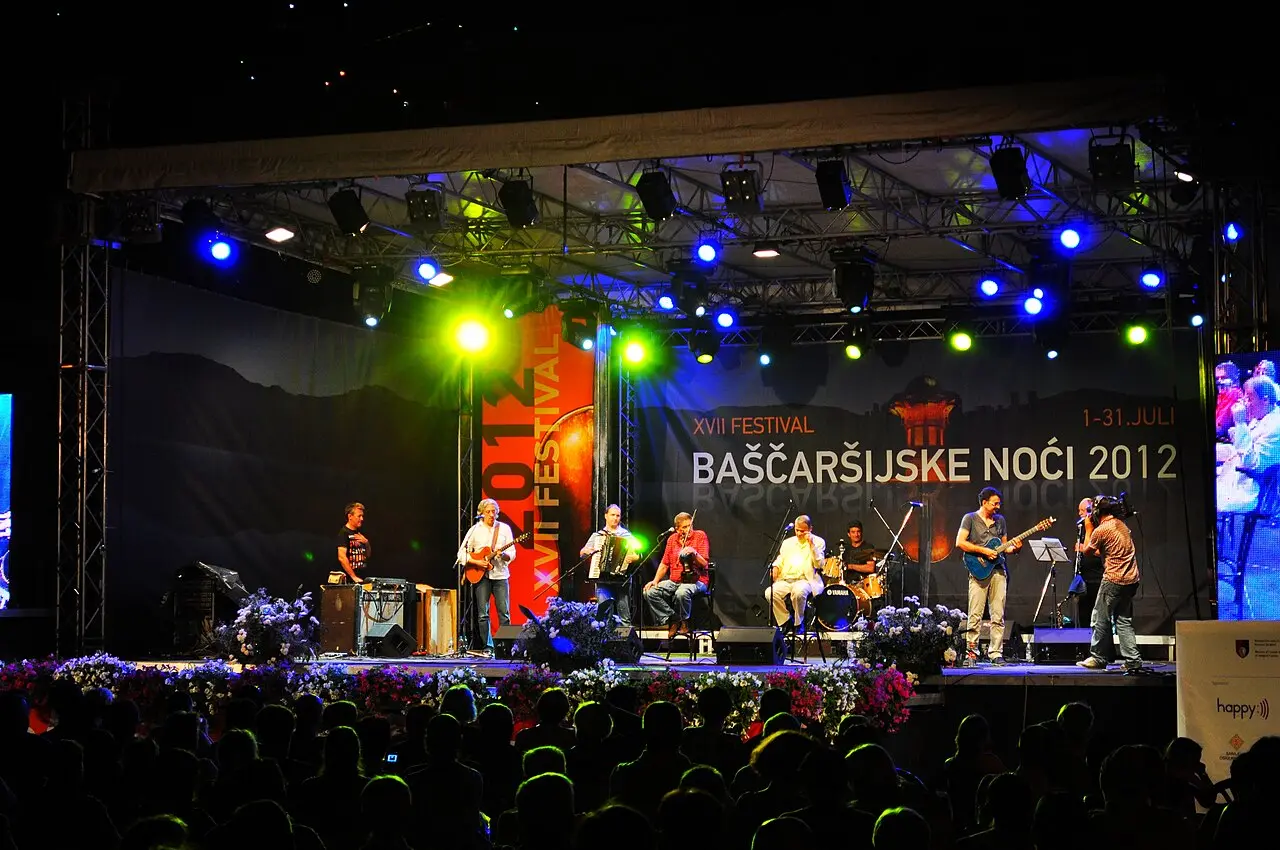
It’s broader than the folklore night you might be picturing. Here’s what the 2026 programme actually held, as published by the organiser:
- 1 July, 21:00, Theatre Square - opening night, Bombaj Štampa
- 3 July, 19:00, BKC main hall - Kalamazoo Junior Symphony Orchestra from Michigan
- 5 July, 20:00, BKC gallery - Sephardic night by the Hagada association, a fixture here for 19 years
- 7 July, 20:00, BKC - Edin Karamazov, the Zenica-born baroque lutenist, playing “Made in Silence”
- 14 July, 19:30, At Mejdan park - Smile Orchestra, Italian swing
- 15 July, 20:00, BKC main hall - Cubismo, salsa and Afro-Cuban
- 15-27 July, Brusa Bezistan - the Art Colony international exhibition, open 10:00 to 18:00
- 30 July, 21:00, the square facing the Vijećnica - closing concert for Safet Isović
Most things start between 19:00 and 21:30, which is the sane hour for an open-air stage in a Sarajevo July. On the two closing nights the riverside street by the Vijećnica shuts to traffic from 19:00 to 02:00, so if you have a car, park well away from Baščaršija and walk in.
The plural in the name is older than the festival. The whole thing grew out of a single “Baščaršija night” in the late 1980s, when Sejfudin Tanović and a handful of enthusiasts packed 15 to 20 programmes into one evening across the old town. It became a month-long international festival only after the war.
Two honest caveats. First, the festival is named after the bazaar but only partly happens in it: the Bosnian Cultural Centre and Theatre Square are a 15-minute walk west (the square carries Susan Sontag’s name, for the Waiting for Godot she staged in the besieged city in 1993), and At Mejdan park and the old Bentbaša pool sit further out along the river. Only the Vijećnica square and the Brusa Bezistan are properly in the old town, so check the address before you head out.
Second, the programme lands late and it moves: the 2026 line-up went public on 30 June, the day before the opening concert, and over the month three events were cancelled and one was pushed back. No 2027 dates are published yet, and going by the pattern - the festival has held the same 1 to 31 July slot for years - the programme won’t appear until the last days of June. So book July for the month, not for a particular act, and check the site the week before you fly. For how this fits the rest of the year, see our Bosnia events calendar.
How long to spend, and when to go
Baščaršija is small - ten minutes end to end - but it rewards slowing down. Give it a half-day: the square and the Sebilj, a wander up Kazandžiluk, the mosque courtyard, the Meeting of Cultures line, and a long coffee. The shops keep daytime hours. For a timed version of that route on to Vijećnica and the Latin Bridge, see the Sarajevo walking route.
Timing is about crowds and light. The bazaar fills with tour groups and day-trippers from the coast through the middle of the day, so come early morning for empty cobbles and low sun, or early evening, when the lanterns come on and the café tables fill with locals rather than tourists. It’s genuinely lovely after dark. Shoulder seasons - May-June and September-October - hit the sweet spot of warm-but-not-baking weather and thinner crowds. High summer is the opposite trade: hot, crowded and dear for a bed, but that’s when the festival nights run and when the Sarajevo Film Festival takes over in mid-August. Pick your side of that deliberately rather than by accident.
The bazaar is also the obvious base for the rest of the city, though not the only sensible one, as our guide to where to stay in Sarajevo sets out. It’s a short walk from most of the sights in our Sarajevo city guide, and the natural starting point for the sobering trip out to the Tunnel of Hope. When it’s time to move on to Herzegovina, the old town is ten minutes from the station and our guide on getting from Sarajevo to Mostar lays out train, bus and car. Stay in or beside the bazaar if you can - waking up to the muezzin and the pigeons is worth the price of the room on its own.
Photos
On the map
The map loads on click - to keep the page lightweight.
The map didn’t load. Check your connection and refresh the page.
Read also

What to see · 15 min read
Via Dinarica Bosnia: Huts, Stages & Logistics
Verified · September 12, 2026Plan the Via Dinarica White Trail in Bosnia: 12 stages, 334 km, hut booking, trailheads, closures and three workable section packages.

What to see · 10 min read
Jablanica: Neretva Bridge & Roast Lamb Stop
Verified · September 4, 2026Jablanica on the Sarajevo-Mostar road: Battle for the Wounded museum (5 KM), the 1943 bridge, roast lamb lunch. Hours, parking, how long to stop.

What to see · 8 min read
Prokoško Lake: Shepherd Huts High Above Fojnica
Verified · September 3, 2026Prokoško on Vranica at 1,636 m: katuni, gate prices for foreigners, no swimming, and the 2026 asphalt climb from Fojnica.

What to see · 11 min read
Franz Ferdinand's Sarajevo: Latin Bridge & 1914 Site
Verified · August 29, 2026The Latin Bridge corner in Sarajevo where Franz Ferdinand was shot in 1914: what happened, the Museum of Sarajevo 1878-1918 inside, hours and tickets.