Radimlja Stećci near Stolac: Bosnia's UNESCO Tombstones
Radimlja near Stolac: 133 medieval stećci, what the carvings show, the 8 KM ticket the operator publishes, seasonal hours and the drive from Mostar.
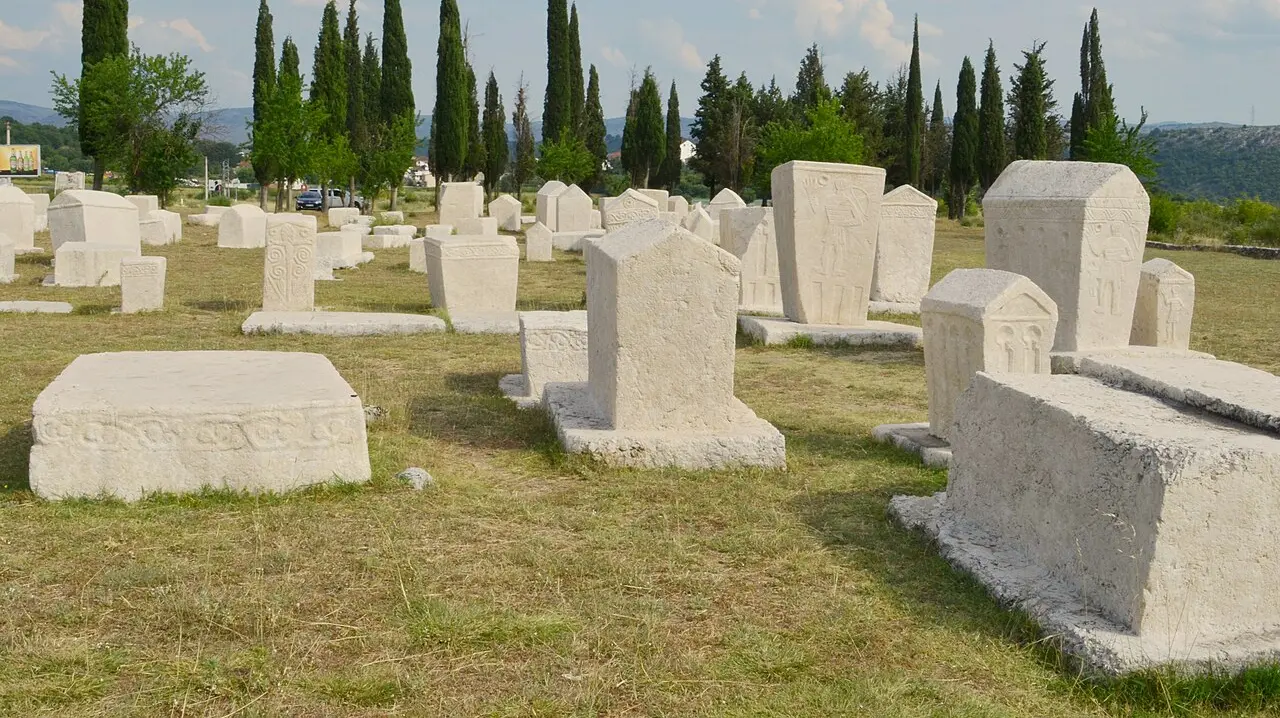
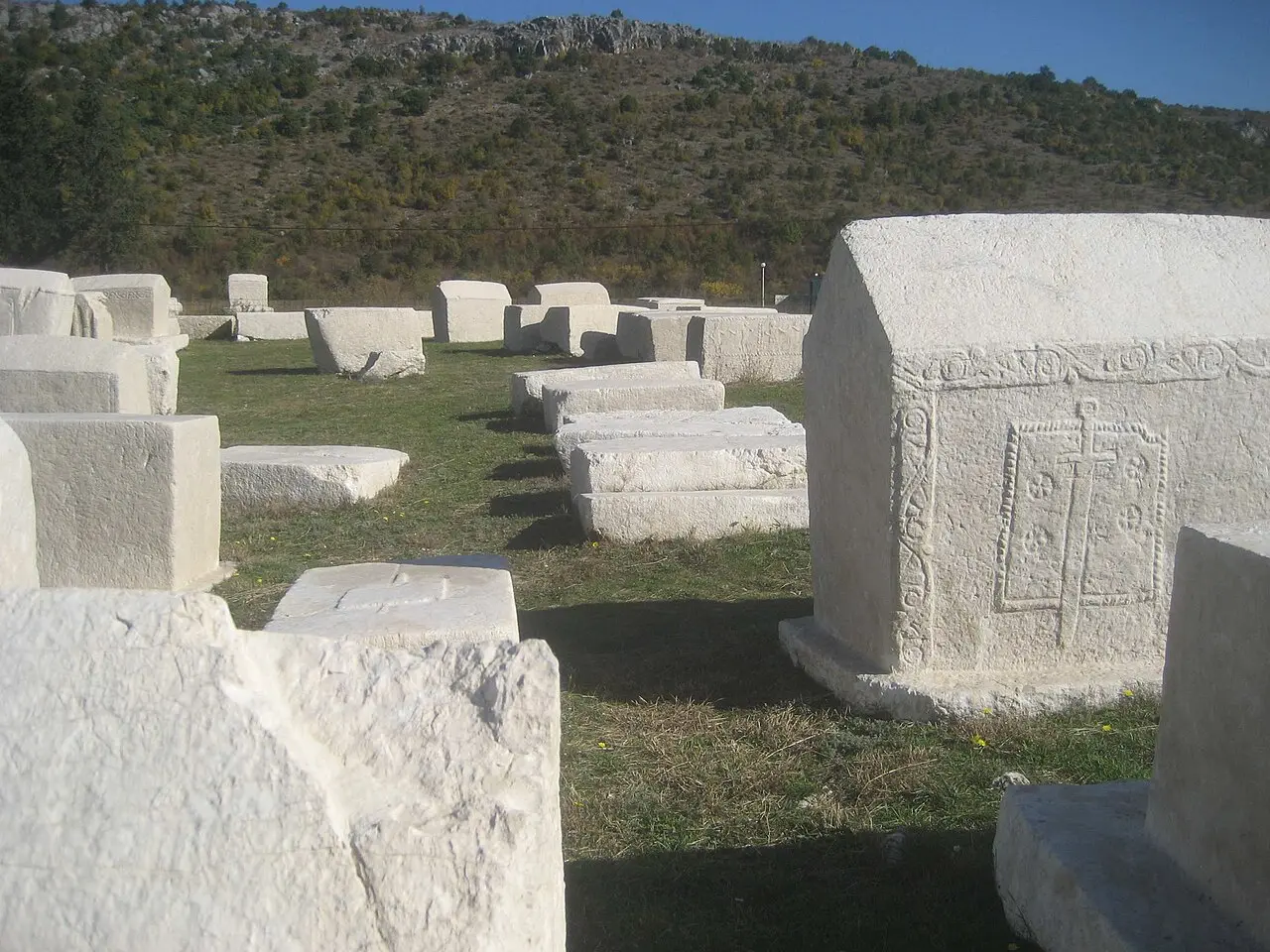
Radimlja is a field of 133 medieval tombstones right beside the road 3 km west of Stolac, and walking the whole thing takes about half an hour. The stones are stećci, the carved limestone monoliths medieval Bosnia produced by the tens of thousands, and this is the best known of the country’s necropolises: part of a UNESCO World Heritage property since 2016, and the one people mean when they say they have seen stećci. On the drive from Mostar to Trebinje it costs you twenty minutes and a handful of marks.
Two things most write-ups get wrong, though. The public institution that runs the site does publish a price list - 8 KM for an adult, 5 KM for citizens of Bosnia and Herzegovina and for groups - and it keeps office hours, closing at 15:00 from 21 October and shutting the desk at weekends right through the winter. And the setting isn’t the lonely karst meadow the photos imply: the necropolis is wedged between a working road and a commercial zone built 300 m away, on a regulatory plan the state heritage commission says Stolac municipality adopted illegally. Neither fact ruins the stop. Both change how you plan it.
What a stećak is, and why these 133 matter
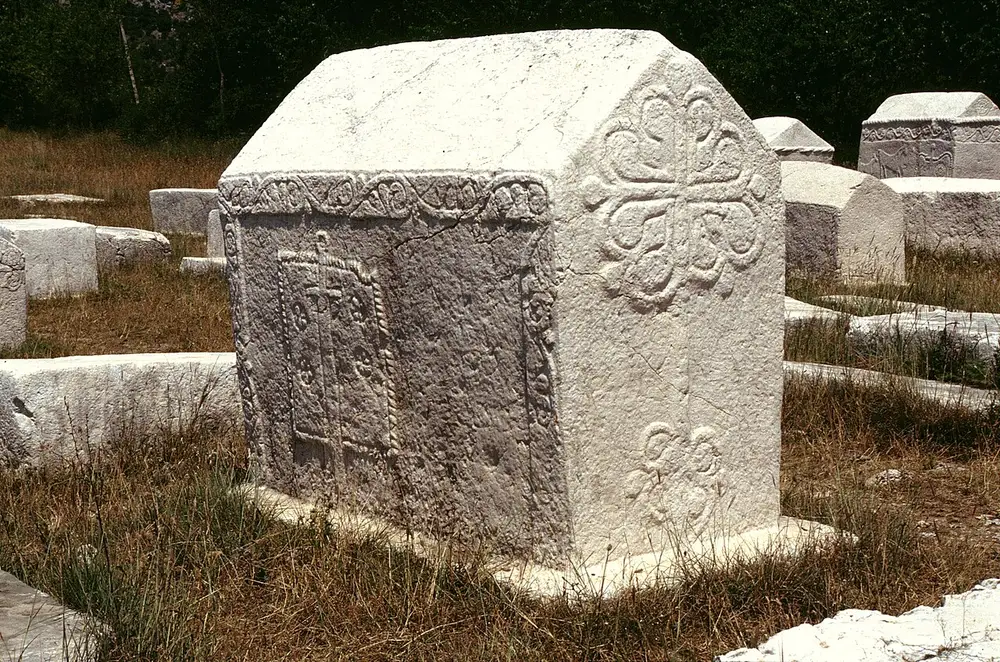
Stećci (one stone is a stećak) are monolithic tombstones cut from local limestone across medieval Bosnia, Herzegovina and the lands next door. Something like 60,000 survive inside Bosnia and Herzegovina and roughly 70,000 across the wider region at about 3,300 sites, though every survey lands on a different figure. They appear in the second half of the 12th century, peak in the 14th and 15th, and stop being made during the 16th. The shapes repeat everywhere: flat slabs, box-shaped chests, tall chests on pedestals, gabled “roof” stones, the occasional cross.
On 15 July 2016 UNESCO inscribed 28 of these graveyards as one four-country property: 20 sites in Bosnia and Herzegovina, 3 in Montenegro, 3 in Serbia and 2 in Croatia, covering some 4,000 stones. Radimlja is one of the twenty, and it’s the one that ends up on the book covers.
You’ll still hear them called Bogomil graves, usually with a story about a heretic church hiding its dead in code. That idea goes back to Arthur Evans in the 1870s and scholarship dropped it long ago: Marian Wenzel showed the tombstones were a shared regional custom of Catholics, Orthodox and Bosnian Church followers alike, with the showiest figural stones tied to the rise of Vlach herding and warrior communities in the mid-15th century. Radimlja is a neat demonstration, because we know who lies here, and they were Orthodox.
The family under the stones
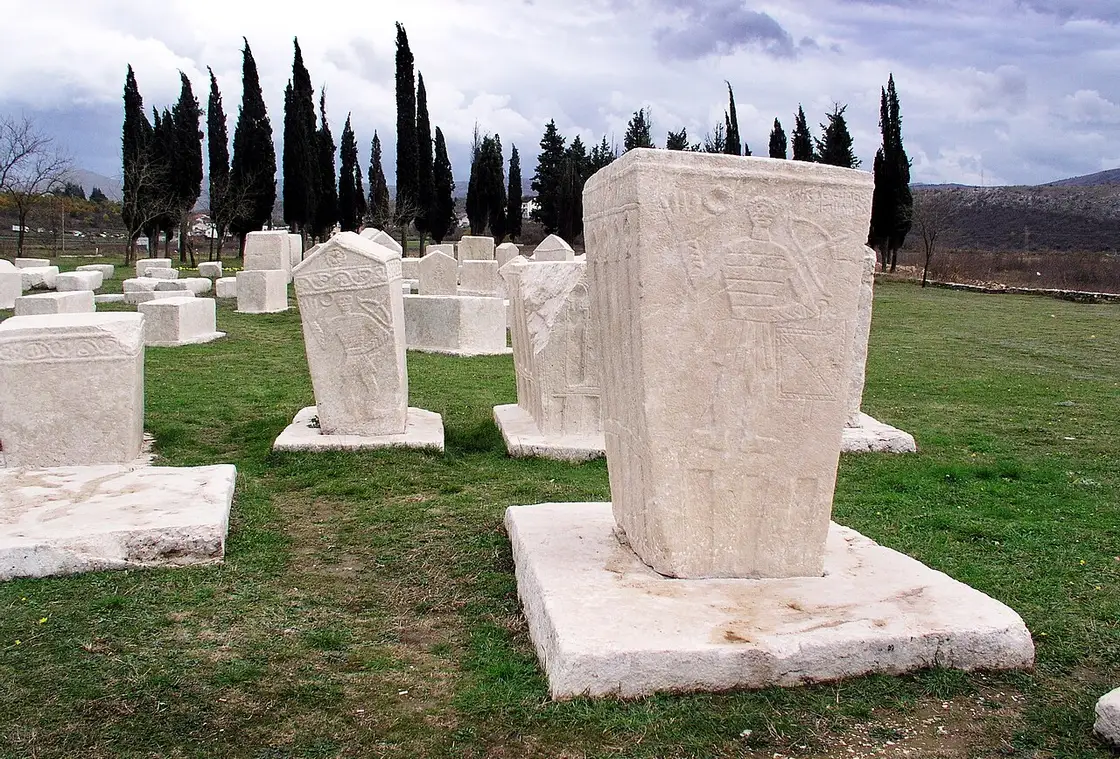
Radimlja is essentially one family’s graveyard. The Miloradović-Stjepanović clan, of the Hrabren kin, were Vlach chieftains who rose to the titles of voivode and knez and held land between Stolac and Mostar. Their settlement was called Batnoge, their seat stood on the hill of Ošanići just up the road, and five of the tombstones carry epitaphs naming them: voivode Stipan, his sons Radoje and Petar. The last securely dated burial is voivode Radosav Hrabren in 1505, and the necropolis stops growing after that - that’s where the story of this field ends on the stone.
Carry one epitaph in your head as you walk, because it turns a field of anonymous rock into something particular. Translated, it reads: “Here lies the good Radoje, son of voivode Stipan, on his own patrimony at Batnoge. This marker was set over me by my brother, voivode Petar.” Three inscriptions also name the men who cut the stone: Miogost, Bolašin Bogačić and Ratko Brativonić.
The limestone came from Ošanići hill - the same hill as the family seat - roughed out at the quarry and finished down here. Dating the group is messier than the guidebooks admit: the earliest stones are placed in the second half of the 12th or the first half of the 13th century, the family that made the place famous belongs to the 15th, and most of what you see dates from the 1480s and after. Nobody has settled it.
What to look for in the field
Sixty-three of the 133 stones are decorated, and the carving is the reason to stop rather than shoot the field from the car - you’ll get more from five minutes among them than from a roadside snap.
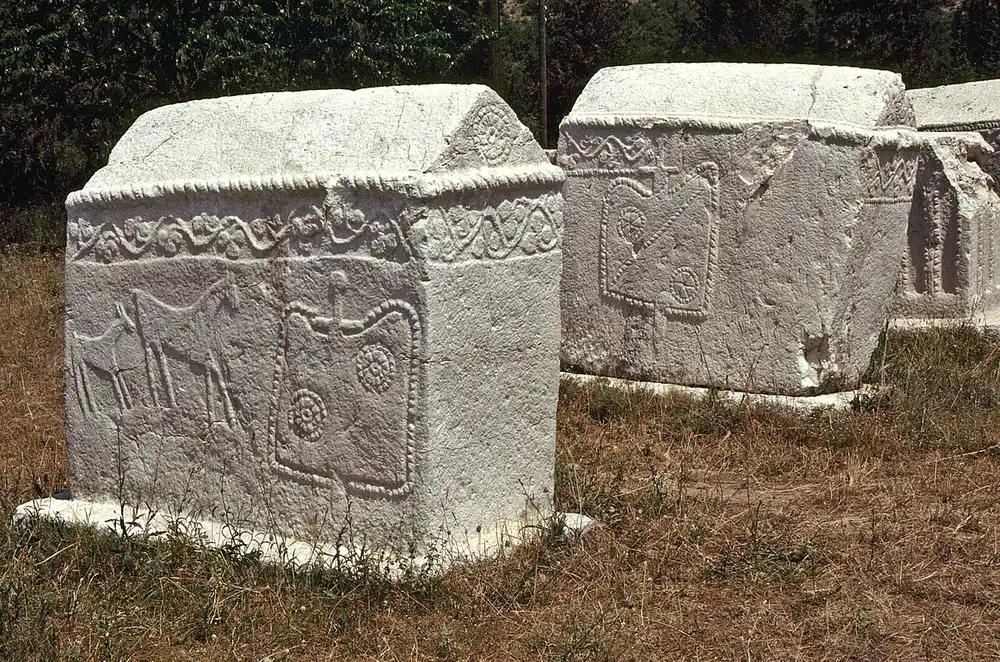
- The man with the raised hand. A standing male figure with one enormous raised right hand, in relief on the so-called voivode stones. It’s the figure everybody photographs. What it means is genuinely unresolved - a greeting, an oath, a mark of rank, or a link to the cult of Vid (Saint Vitus), which may also be what the name of the field, Vidovo polje, is echoing. Don’t treat any confident single answer as settled.
- Shields, swords and bows. Heraldic shields with rosettes inside them, swords alongside, the odd bow and arrow. Read as markers of the family’s military role.
- Riders and the hunt. Shallow engraved hunting scenes with riders and animals, plus what researchers describe as chivalric tournaments.
- The kolo. Rows of linked figures in a round dance, read by many researchers as a dance for the dead rather than a party.
- Borders and crosses. Vine and trefoil borders along the top edges, twisted rope frames, rosettes, spirals, arcades down the sides, big looping crosses on the gable ends.
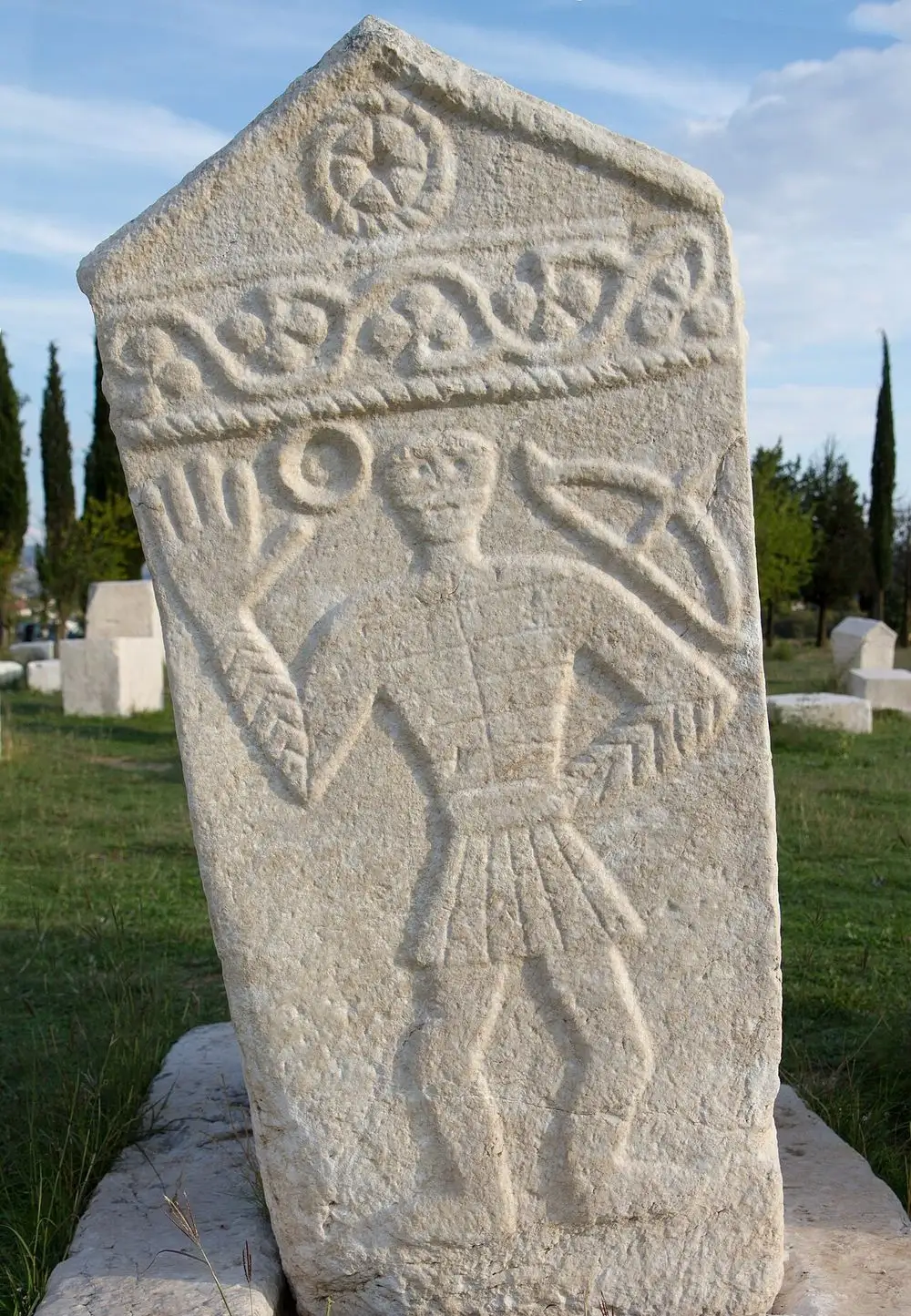
Practical bit nobody tells you: most of this carving is shallow, and hard midday sun flattens it into white glare. Come with the sun low, in the first hours after opening or late in the afternoon, and the same stones read like a comic strip.
The gaps in the rows have a history too. When the Austro-Hungarian administration built the Čapljina to Stolac road in 1882, it went straight through the necropolis and destroyed at least 15 to 20 tombstones; a 1960s excavation suggested the real loss was closer to 50. You’re walking between the survivors of something bigger.
Tickets, hours and what happens when you arrive
The site is run by a public institution, JU Radimlja, which looks after several other monuments around Stolac too. Its published tariff, checked on 27 July 2026, is 8 KM for an individual adult, 5 KM for groups and for citizens of Bosnia and Herzegovina, 4 KM for primary school pupils, free for visitors with disabilities. Parking and toilets are included. There’s a visitor building with a gallery, and the institution says wheelchair users can move through the gallery and the necropolis - though the wording on its page is ambiguous, and the necropolis is a grass field, so phone ahead if that matters.
Hours move with the season, and that’s the detail that catches people out. From 1 April to 20 October it’s 07:00 to 18:00 on weekdays and 09:00 to 17:00 at weekends. From 21 October to 31 March it’s 07:00 to 15:00, and the institution says outright: “we do not work on weekends”. A winter Saturday drive out here can mean an empty car park and nobody to sell you a ticket.
Which leads to the honest caveat: sources disagree about whether you can simply walk in. The operator publishes a tariff, undated on its own page; several recent traveller accounts describe Radimlja as free, with no ticket booth and no fence, and older guides quote 4 KM. Both can be true at different hours of different months. Turn up with 10 KM in cash and assume you’ll pay - euro isn’t reliably accepted around here, and neither is a card. If the price or the opening matters to your plans, phone +387 36 819 043 before you drive out.
Getting there from Mostar, and where it fits on the road to Trebinje
Radimlja lies 3 km west of Stolac on the Stolac to Čapljina road, marked by a brown tourist sign. Coming from the Čapljina side you reach the necropolis before the town, which is why it works so neatly as a driving stop: you never have to enter Stolac at all.
From Mostar it’s roughly 45 to 50 km and about an hour, south on the M17 then east on the M6 through Domanovići. Buses do run Mostar to Stolac - a handful a day, about an hour and a half, single-figure euros on the aggregator listings, worth checking against the station board because they change. The catch is that the bus leaves you at Stolac station, 3 km from the stones: a taxi from there, or a walk of 35 to 40 minutes along the main road.
Now the routing bit, which is where people lose an hour. Počitelj and Radimlja are both “on the way south” from Mostar, but they sit on different roads: Počitelj on the M17 above the Neretva, Radimlja on the M6 east of Čapljina. Take them in order - Mostar, Počitelj, Čapljina, Radimlja, then on through Ljubinje to Trebinje - and you never backtrack; that whole line is about 115 km and just over two hours before you stop anywhere. Somewhere past Stolac you cross into Republika Srpska: no passport check, same currency, but the signage switches to Cyrillic. Our day trips from Mostar guide ranks that southern run against the other options.
How long to give it, and when
Twenty minutes gets you the shape of the place. Forty-five lets you work the rows properly, find the raised-hand stone, pick out the riders and the dance, and read the boards. An hour is plenty unless you’re a specialist.
Season matters more than the clock. This is southern Herzegovina and the necropolis is a flat, treeless field: in July and August midday here’s punishing, no shade between the stones and glare coming off white limestone. Spring and autumn are the ones, autumn especially, when the light goes long and low by mid-afternoon. Winter is fine and empty if you work around the shorter hours and the closed weekends.
Boljuni, Daorson and Stolac itself
If Radimlja lands well, the 20 km around Stolac holds three more stops that cost nothing.
Boljuni, about 15 km south-west of Stolac on the road toward Hutovo Blato, is the other Stolac necropolis on the UNESCO list and by numbers the bigger one: 274 tombstones, 92 of them decorated, burials running from the mid-14th century into the early 16th, and around twenty inscriptions, some signed by the carver Grubač. It’s off the through road, and per the same institution’s tariff page it’s free.
Daorson on Ošanići hill, 3 to 5 km from Stolac depending on who’s measuring, is the hilltop capital of the Illyrian Daorsi, occupied around 300 to 50 BC. You climb it for the cyclopean wall: about 65 m long, 4.2 m thick and 4.5 to 7.5 m high, built from huge dry-laid blocks. It’s also the hill the Radimlja limestone came from.
Stolac itself is a small Ottoman town on the Bregava with the ruined Old Town of Vidoški above it, hit hard in the 1990s war and rebuilt since. Further west, the wetland channels of Hutovo Blato fill an afternoon by boat, and both Stolac and Trebinje sit on the signed Herzegovina wine route, which is the obvious way to end this day.
Further south again, past Ravno, is Bosnia’s other UNESCO site in this corner of Herzegovina: Vjetrenica cave at Zavala, inscribed in 2024 for its underground biodiversity. It’s a ticketed guided visit rather than a roadside stop - 25 KM, tours on the hour, about an hour underground - so treat it as its own half-day rather than something you tack onto Radimlja. Two World Heritage listings within an hour of each other, one cultural and one natural, is a fair reason to give the far south two days instead of one - our East Herzegovina wine route strings both of them together with Hutovo Blato and the Trebinje cellars.
So, is it worth the stop?
If you’re driving between Mostar and Trebinje, yes, without much argument: twenty minutes off a two-hour leg for the best known collection of medieval carving in the country, and outside the coach hours you may well have it to yourself. If you’re based in Mostar without a car, be realistic - a bus each way plus 6 km of walking or a taxi, for a field you can see in half an hour, only makes sense if you pair it with Stolac town and Daorson and give the day to it.
What it isn’t is a monument in the grand sense. There’s no ruin to climb, no view to earn, and there’s a commercial zone 300 m up the road. What there is: 133 blocks of white limestone standing where a family put them five centuries ago, a signed name or two, a raised hand nobody can explain, and rather more silence than anywhere else on this road.
Photos
On the map
The map loads on click - to keep the page lightweight.
The map didn’t load. Check your connection and refresh the page.
Admission and opening hours
- Admission price
- Price list published by JU Radimlja, the public institution that runs the site (read 2026-07-27, the page itself carries no date): individual 8 KM, groups 5 KM, citizens of Bosnia and Herzegovina 5 KM, primary school pupils 4 KM, visitors with disabilities free. Parking and toilets are included in the ticket. The same institution lists its other Stolac-area monuments (Boljuni, the Old Town of Vidoski, Daorson) as free of charge. Several recent traveller write-ups report walking in without paying, and older guides quote 4 KM, so phone +387 36 819 043 if the price matters to your plans and carry 10 KM in cash either way.
- Opening hours
- Summer, 1 April to 20 October: 07:00-18:00 on weekdays, 09:00-17:00 at weekends. Winter, 21 October to 31 March: 07:00-15:00, and the institution states it does not work at weekends. Phone +387 36 819 043 to confirm before a winter or weekend drive.
Prices are in convertible marks (KM / BAM) and euro is not reliably accepted here - bring small cash. On access, the institution says wheelchair users can move through the gallery and the necropolis, but the wording on its page is ambiguous about the necropolis itself (grass field), so phone +387 36 819 043 if that matters.
Details checked: July 27, 2026
Distance
- Sarajevo ≈175 km · ~3 h by car Down the Neretva to Mostar (about 130 km, about two hours by car), then the Stolac road. Route planners quote 156 to 178 km depending on whether they send you via Mostar or Nevesinje.
- Mostar ≈47 km · ~1 h by car South on the M17, then east on the M6 through Domanovici. Mapping tools quote anywhere from 37 to 50 km depending on the route they pick. Buses run Mostar to Stolac a few times a day and leave you 3 km short of the site.
- Dubrovnik ≈87 km · ~2 h by car plus border waits Inland via the Neum corridor and Capljina, which makes Radimlja a plausible detour on a Dubrovnik to Mostar day. The Neum and Doljani crossings back up badly in summer.
Read also

What to see · 15 min read
Via Dinarica Bosnia: Huts, Stages & Logistics
Verified · September 12, 2026Plan the Via Dinarica White Trail in Bosnia: 12 stages, 334 km, hut booking, trailheads, closures and three workable section packages.

What to see · 10 min read
Jablanica: Neretva Bridge & Roast Lamb Stop
Verified · September 4, 2026Jablanica on the Sarajevo-Mostar road: Battle for the Wounded museum (5 KM), the 1943 bridge, roast lamb lunch. Hours, parking, how long to stop.

What to see · 8 min read
Prokoško Lake: Shepherd Huts High Above Fojnica
Verified · September 3, 2026Prokoško on Vranica at 1,636 m: katuni, gate prices for foreigners, no swimming, and the 2026 asphalt climb from Fojnica.

What to see · 11 min read
Franz Ferdinand's Sarajevo: Latin Bridge & 1914 Site
Verified · August 29, 2026The Latin Bridge corner in Sarajevo where Franz Ferdinand was shot in 1914: what happened, the Museum of Sarajevo 1878-1918 inside, hours and tickets.