Franz Ferdinand's Sarajevo: Latin Bridge & 1914 Site
The Latin Bridge corner in Sarajevo where Franz Ferdinand was shot in 1914: what happened, the Museum of Sarajevo 1878-1918 inside, hours and tickets.
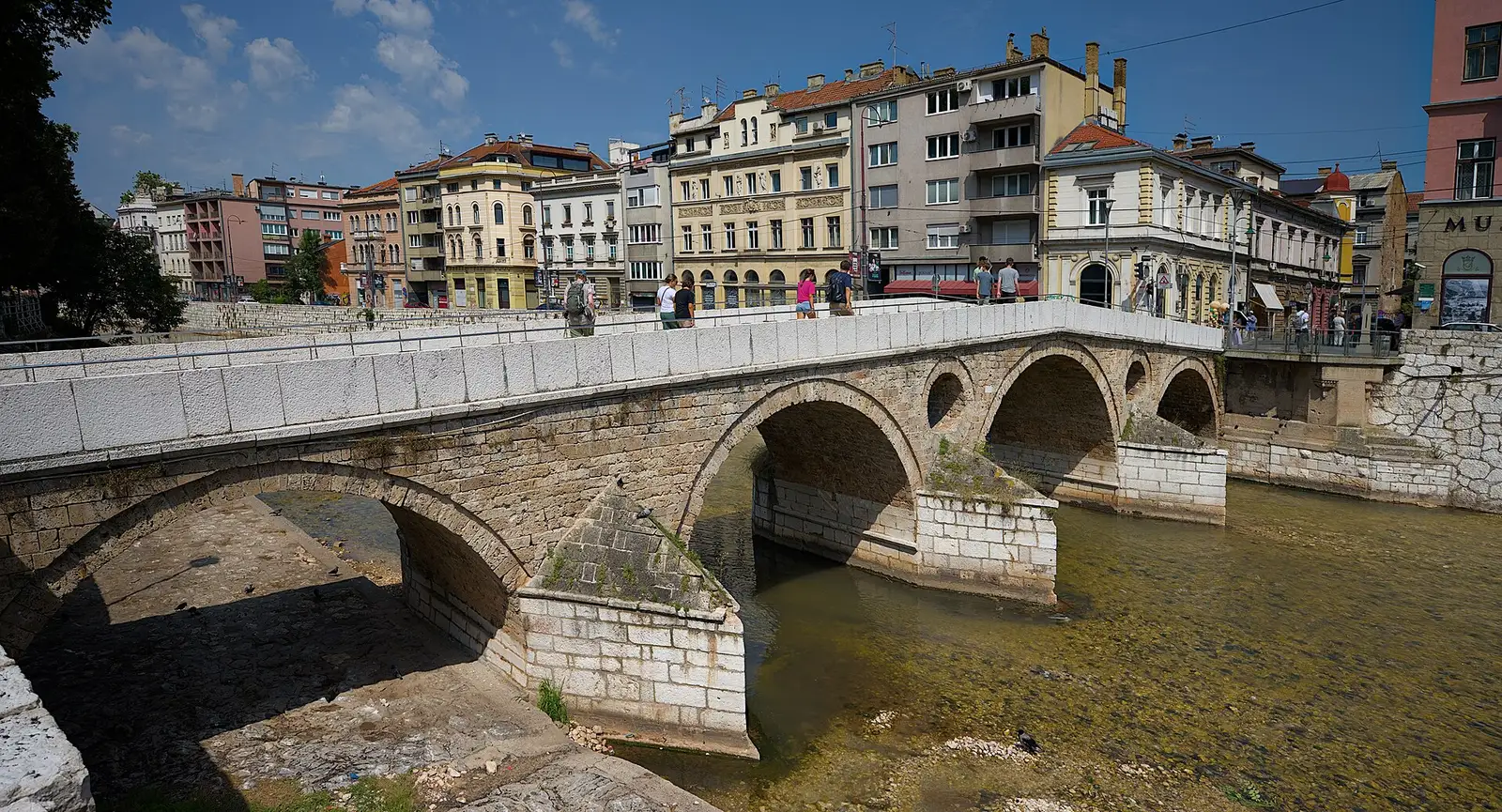
On the morning of 28 June 1914, a wrong turn and a stalled engine put Archduke Franz Ferdinand of Austria’s car directly in front of Gavrilo Princip on this corner by the Latin Bridge. Princip shot Franz Ferdinand and his wife Sophie, and within five weeks Europe was at war. The building where he stood, once a delicatessen, now holds the Museum of Sarajevo 1878-1918 - and the markers outside it have been put up, torn down and replaced at least seven times since.
The wrong turn that put the car on this corner
Franz Ferdinand and Sophie had already survived one attempt earlier that same morning. Around 10:10, as the motorcade rolled along the Appel Quay toward a reception at the City Hall (today’s Vijećnica), a conspirator named Nedeljko Čabrinović threw a bomb at their car. It bounced off the folded convertible roof and exploded under the vehicle behind, wounding somewhere between 16 and 20 people. Čabrinović swallowed a cyanide pill that had gone stale and jumped into the Miljacka, only 13 cm deep that summer in the hot, dry weather; he was pulled out and arrested within minutes.
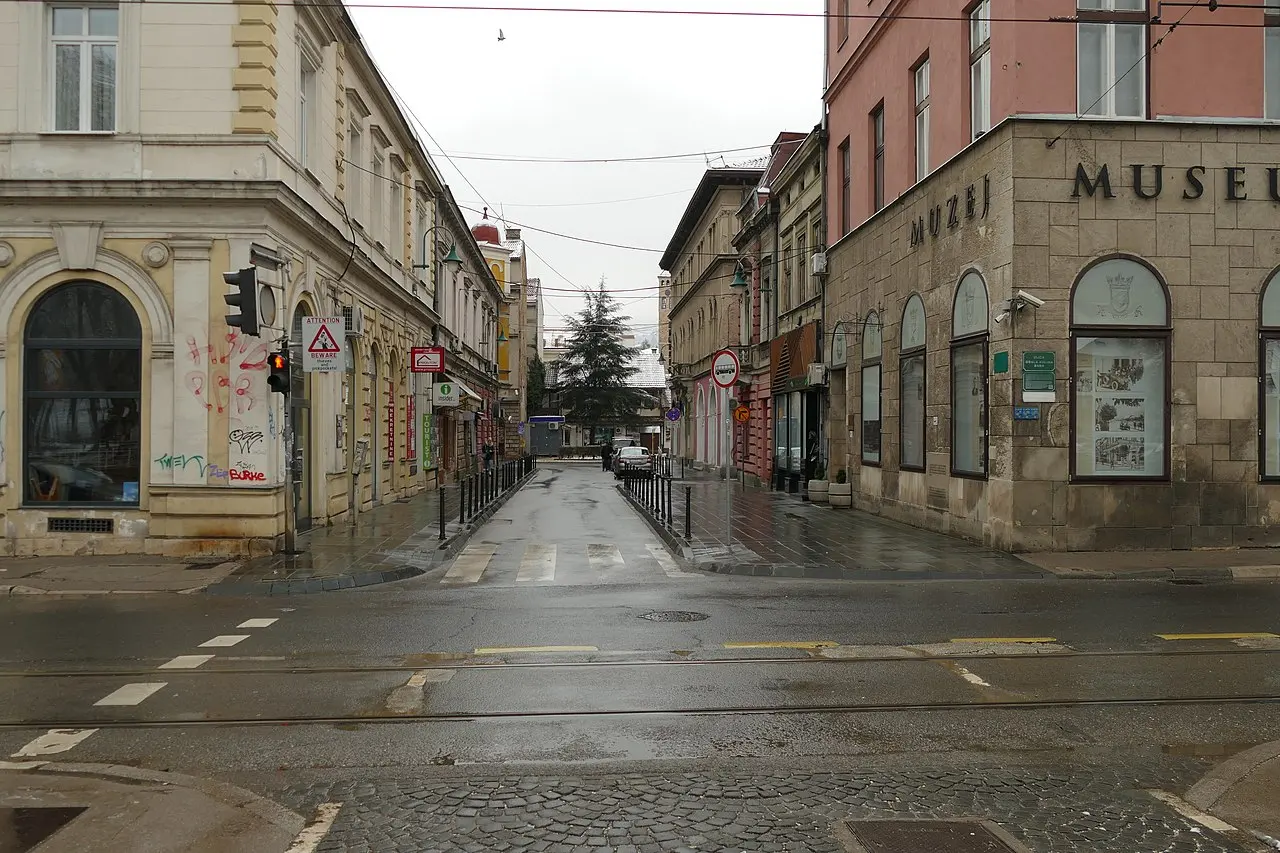
Franz Ferdinand insisted on visiting the wounded in hospital instead of cutting the day short, and that single decision is what put him back on the street. Governor Oskar Potiorek changed the route so the cars would run straight down the Appel Quay this time, but nobody told the drivers. The lead car turned right onto Franz Josef Street out of habit, and the Archduke’s driver, Leopold Lojka, followed it. Potiorek shouted that they’d gone the wrong way; Lojka braked and tried to reverse, and the engine stalled directly in front of Moritz Schiller’s delicatessen, on the corner by the Latin Bridge.
Princip, meanwhile, had not given up. After the failed bombing he worked out where the motorcade might pass again and deliberately took up a position near the Latin Bridge, in front of Schiller’s delicatessen, hoping for a second chance. What he could not have planned was how that chance would arrive: the wrong turn and the stalled reverse put the car dead in front of him, engine idling, close enough to reach the running board. The corner was his choice. The car stopping there was not.
Two shots, and a war within weeks
Princip stepped toward the car, drew a Belgian-made FN Model 1910 pistol, and fired twice at close range. The first bullet struck Franz Ferdinand in the neck; the second hit Sophie in the abdomen, and she fell unconscious and slumped onto his legs. By the account of Count Harrach, who was riding with them, Franz Ferdinand’s last words were a plea for Sophie to live for their children, followed by six or seven repetitions of “it is nothing.” Both were dead within the hour, carried to the Governor’s residence, not a hospital.
Princip was seized on the spot before he could turn the gun on himself. He was 19, too young under Austro-Hungarian law to face execution, and he died of tuberculosis in 1918 at the Austro-Hungarian military prison in Terezín, a little over six months before the war he’d set in motion finally ended. Getting from that stalled car to the trenches of the Western Front took weeks of alliances and ultimatums to unfold - this corner is only the spark, not the whole fire, but it’s the point where the story starts.
At least seven markers since 1917
What stands on this corner today isn’t the original marker, and there’s never really been just one. Austro-Hungarian authorities put up two granite columns, ten to twelve metres high, to the couple in 1917; the new Yugoslav state took them down by the end of 1918. A modest plaque went up in 1930, crediting Princip with proclaiming freedom - deliberately low-key, with no officials at the unveiling.
That plaque then travelled further than anything else on this corner. Local ethnic Germans, acting on the orders of a Lieutenant Mittelmann, pulled the marble slab off the wall on 17 April 1941, days after the Wehrmacht marched into Sarajevo. Three days later it was presented to Hitler at his headquarters in East Prussia as a 52nd-birthday present, and from there it went on show in the Berlin Zeughaus as a war trophy. A representative of the Yugoslav military mission took it back on 6 November 1946, and the head of the Yugoslav military commission confirmed the receipt in writing five days after that. Then the trail stops: the Deutsches Historisches Museum, which occupies the Zeughaus today, published its own account of the plaque in 2023 and called what happened to it after 1946 a puzzle - and that’s still where the paper trail ends.
Where 1930 had been kept quiet, partisan Yugoslavia didn’t stay quiet. On 7 May 1945, weeks after driving the Germans out of the city, partisans crossed the bridge to lay a plaque thanking Princip and his comrades as fighters “against the Germanic conquerors,” with the empire and the occupation folded into a single enemy. The sculptor Vojo Dimitrijević cast Princip’s footprints into the pavement in 1949, and on 28 June 1953, the 39th anniversary of the shooting, the corner got both a rewritten plaque and its own Museum of Young Bosnia and Gavrilo Princip. The 1953 wording dropped the Germans entirely and made Princip a hero of all Yugoslavia’s ethnic groups instead of an anti-German one. The bridge moved with the plaques: Sarajevans had been calling it Princip’s Bridge since the years after the First World War, the authorities used that name through the socialist decades, and it was the Latin Bridge again by the time the 1990s were over. Whether any of it was ever formalised on paper isn’t settled - the Contested Histories case study of the corner holds that the official name was never changed at all.
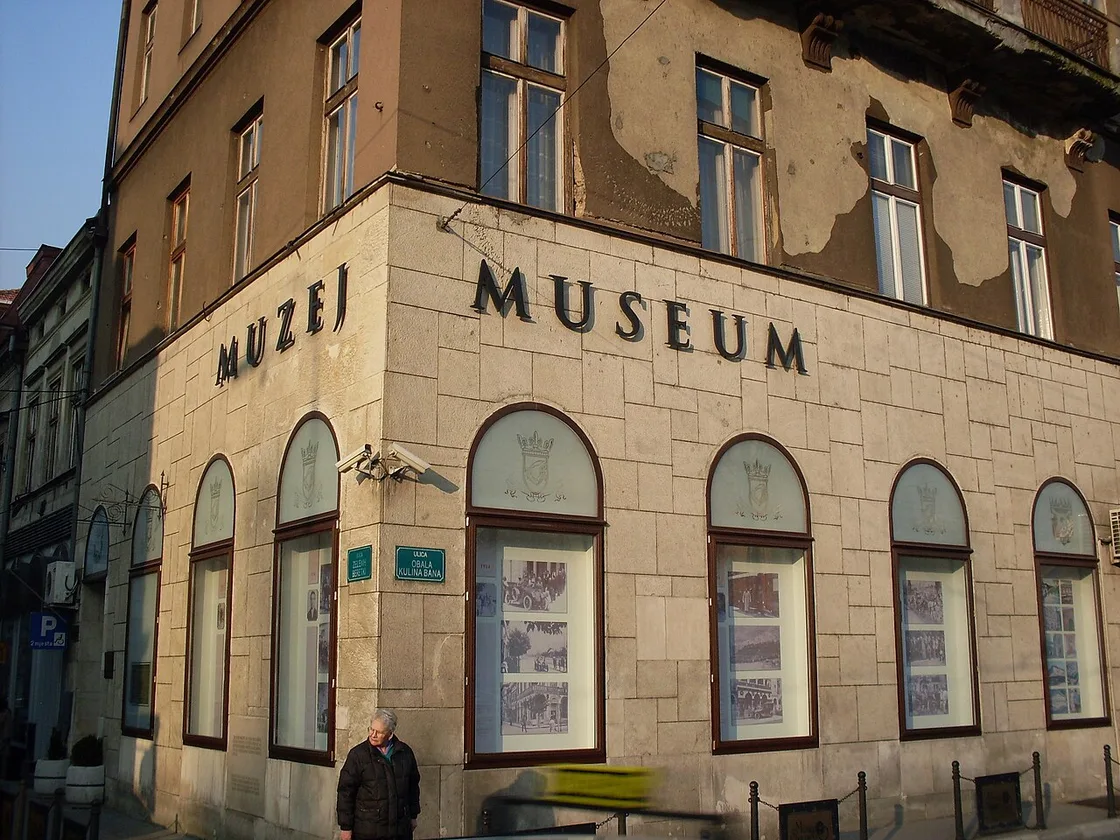
All of that came down during the 1992-95 siege. As the war reshaped how many Sarajevans saw Princip - from liberation hero to a far more contested figure - the footprints and the 1953 plaque were destroyed, and the collection went into hiding: the Museum of Sarajevo moved its archives and exhibits into its own Jewish Museum branch, in the oldest synagogue in the country, which turned out to be the safest building it had. City officials tried to get a proper monument funded in 2000; Austria wouldn’t pay for it, and in the end only a plaque went up, on 6 April 2004, reading plainly: “From this place on June 28, 1914, Gavrilo Princip assassinated the heir to the Austro-Hungarian throne, Francis Ferdinand and his wife Sophie.” The museum itself dates its new name to the years after the fighting: the Sarajevo Canton Assembly took over the founding rights and dropped Young Bosnia and Gavrilo Princip in favour of the flat, dateline-only Museum of Sarajevo 1878-1918. The rooms behind that name are newer than the name itself: the building was renovated in spring 2006 on the city council’s initiative, and the museum dates the single exhibition covering the whole Austro-Hungarian period to that same year. For the war’s centenary in 2014, a glass memorial panel appeared near the corner, tracing the outline of the 1917 columns without their old wording. Princip’s footprints didn’t return until 2022, when renovation work in front of the museum put a cast of them back in the same spot after almost thirty years - a detail most people walk straight past.
What stands on the corner today
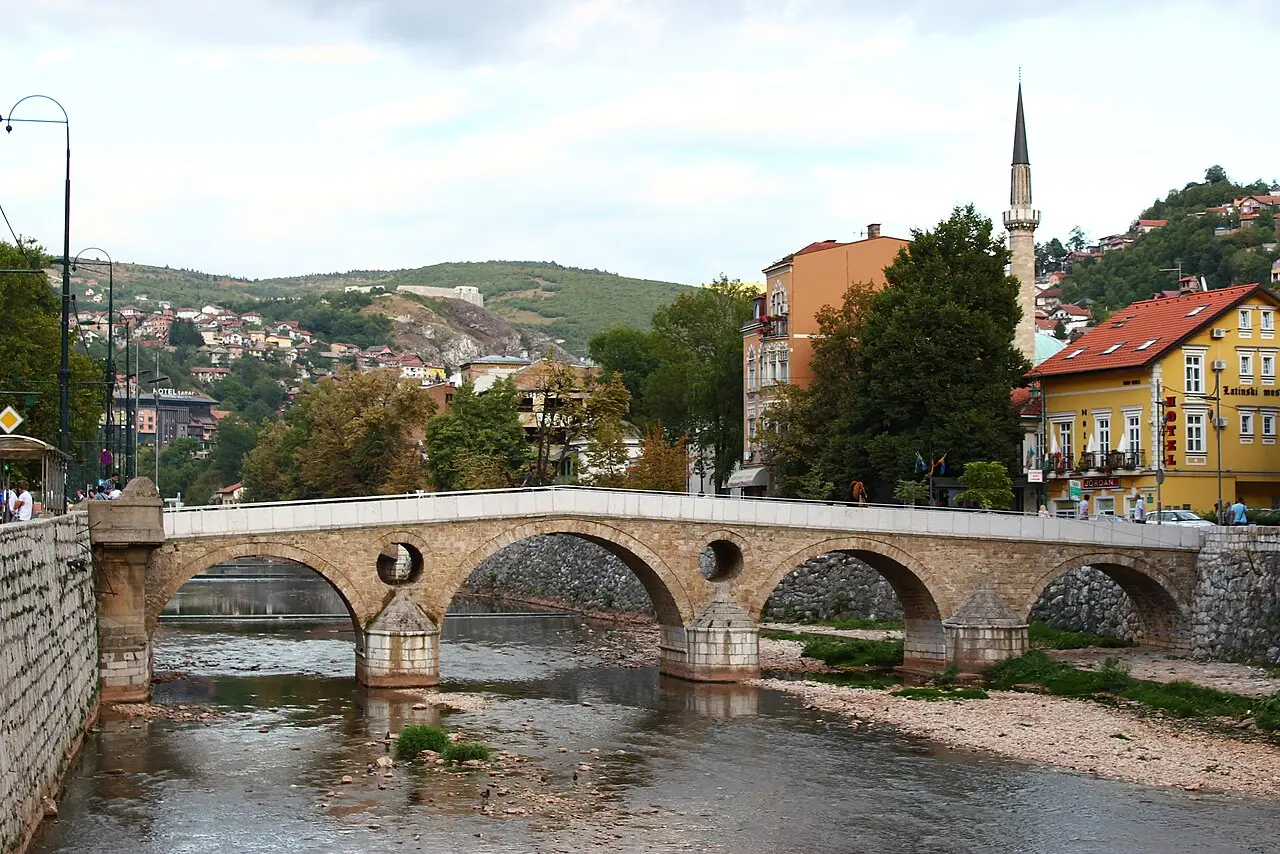
Stand on the Latin Bridge itself and you’re looking at a plain Ottoman stone span over the Miljacka - nothing built for the occasion, nothing dramatic. The corner you want is the bridge’s northern end: the building there carries the Museum of Sarajevo 1878-1918 sign, with a cast of Princip’s footprints set into the pavement right at the entrance. The 2014 glass memorial panel stands at street level close by, tracing the outline of the old 1917 columns - easy to walk past if you don’t already know it’s there.
It’s easy to mix up this corner with Vijećnica, the striped city hall a short walk upstream, because Franz Ferdinand visited both places that same morning - a reception inside the hall, then the shooting minutes later near this bridge. They’re two stops on the same story, not the same building, and it’s worth knowing which is which before you decide how long to give each.
Inside the Museum of Sarajevo 1878-1918
Inside, the permanent exhibition runs through 17 thematic sections covering Sarajevo under Austro-Hungarian rule: the shift from an Ottoman street plan to a Central European one, the administration Vienna installed after 1878, industry, cultural life, and finally the assassination itself. It’s smaller than 17 sections might suggest - half an hour covers it even if you read every panel.
The most striking room holds what the museum calls the Memorial to the Assassination: authentically preserved parts of the 1917 monument that the new Yugoslav state took down by the end of 1918. Its bronze fittings are split between this museum’s collections and the Art Gallery of Bosnia and Herzegovina, whose basement held the monument’s big portrait medallion of Ferdinand and Sophie for decades; the stone was handed to a stonemason. Standing in front of broken pieces of a monument that was itself demolished for political reasons, inside a museum that was renamed for much the same reason decades later, makes an odd kind of sense - this address has never really stopped being argued over, just more quietly now.
Most visitors reach the corner on foot as part of a longer riverside walk. The timed version is the Sarajevo walking route. The Sarajevo city guide places it between the old bazaar of Baščaršija and Vijećnica, and the city’s other museums cover the 1990s siege in more depth, a separate chapter of the same city’s history. A few minutes on the corner is enough to take in what happened here.
Tickets, hours and getting here
Hours (operator, checked 29 August 2026): May to October, the museum runs weekdays 09:00-17:00 and Saturdays 10:00-15:00. October to May it shifts to weekdays 10:00-16:00, with the same Saturday hours - the operator doesn’t publish the exact changeover date within October, so call +387 33 533 288 if you’re visiting that month or cutting it close to opening or closing time. It’s closed on Sundays all year.
Tickets, as published by the operator in August 2026: adult and tourist entry is 5 KM (about EUR 2.50 at the fixed peg), 2 KM for students, and 1 KM for children and pensioners. A combined ticket for all five Museum of Sarajevo branches costs 20 KM (about EUR 10), and there’s one version of it - the operator doesn’t list a concession price. Do the arithmetic before you buy it. At the adult rate, four single tickets already come to 20 KM, so the combined ticket is a wash at four branches and starts paying off on the fifth. At concession rates it never pays off at all: five student tickets total 10 KM, five child or pensioner tickets 5 KM.
Getting here: it’s an easy walk from Baščaršija, roughly five to ten minutes down toward the river past the Sebilj fountain, and about the same distance from Vijećnica along the riverside promenade. The bridge, the corner building’s exterior and the outdoor memorial are free and open all the time; only the museum interior needs a ticket. The corner alone takes a few minutes; add half an hour for the museum if you go inside.
Photos
On the map
The map loads on click - to keep the page lightweight.
The map didn’t load. Check your connection and refresh the page.
Admission and opening hours
- Admission price
- Museum entry: adult/tourist 5 KM (~EUR 2.50), student 2 KM, child or pensioner 1 KM. A combined ticket covering all five Museum of Sarajevo branches (this museum plus Brusa Bezistan, Despić's House, Svrzo's House and the Jewish Museum) is 20 KM (~EUR 10), and the operator lists only one version of it - no student or child rate. At the adult price four singles already come to 20 KM, so the combined ticket is a wash at four branches and pays off on the fifth; at concession prices five singles cost less than it does. Published by the operator - confirm at the desk. The bridge, the corner and the outdoor memorial cost nothing.
- Opening hours
- May-October: weekdays 09:00-17:00, Saturday 10:00-15:00. October-May: weekdays 10:00-16:00, Saturday 10:00-15:00. The operator does not publish the exact changeover date within October - call ahead that month. Closed Sundays year-round (muzejsarajeva.ba, checked 29 August 2026). Phone +387 33 533 288.
Pay in convertible marks (KM) - card machines aren't a given at small municipal museums.
Details checked: August 29, 2026
Read also

What to see · 15 min read
Via Dinarica Bosnia: Huts, Stages & Logistics
Verified · September 12, 2026Plan the Via Dinarica White Trail in Bosnia: 12 stages, 334 km, hut booking, trailheads, closures and three workable section packages.

What to see · 10 min read
Jablanica: Neretva Bridge & Roast Lamb Stop
Verified · September 4, 2026Jablanica on the Sarajevo-Mostar road: Battle for the Wounded museum (5 KM), the 1943 bridge, roast lamb lunch. Hours, parking, how long to stop.

What to see · 8 min read
Prokoško Lake: Shepherd Huts High Above Fojnica
Verified · September 3, 2026Prokoško on Vranica at 1,636 m: katuni, gate prices for foreigners, no swimming, and the 2026 asphalt climb from Fojnica.

What to see · 10 min read
Vijećnica: Sarajevo City Hall & Its Burned Library
Verified · August 28, 2026Sarajevo City Hall (Vijećnica): the 1896 pseudo-Moorish landmark, the 1992 library fire, the 2014 restoration, plus hours, tickets and what to see inside.