
Vijećnica: Sarajevo City Hall & Its Burned Library
Sarajevo City Hall (Vijećnica): the 1896 pseudo-Moorish landmark, the 1992 library fire, the 2014 restoration, plus hours, tickets and what to see inside.
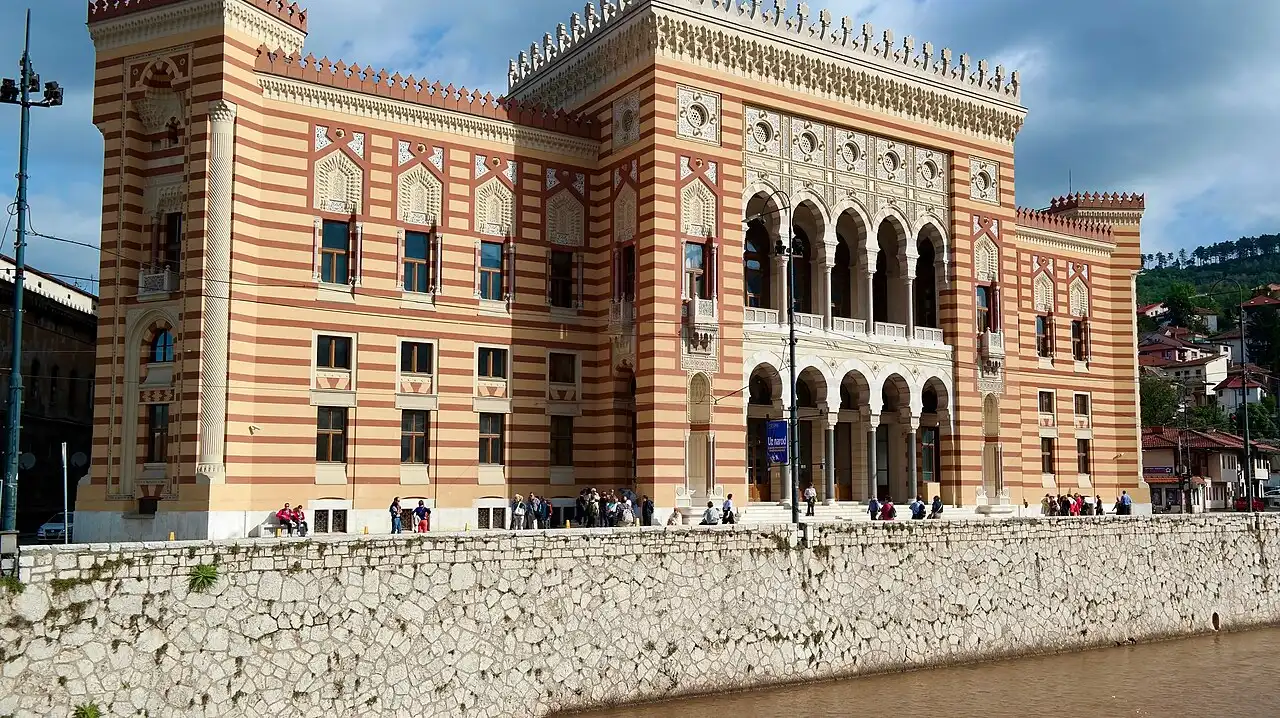
Vijećnica - Sarajevo City Hall - is the striped pseudo-Moorish palace on the Miljacka that opened in 1896, held the National and University Library for decades, burned with roughly two million books and periodicals on the night of 25-26 August 1992, and reopened after full reconstruction on 9 May 2014. You can walk the free riverbank view any hour; the paid interior run is the restored atrium, ceremonial rooms, City Council use and a basement exhibition that puts burned fragments under your feet. Operator hours on vijecnica.ba (checked 28 August 2026) are daily 09:00-17:00 at Brodac 1.
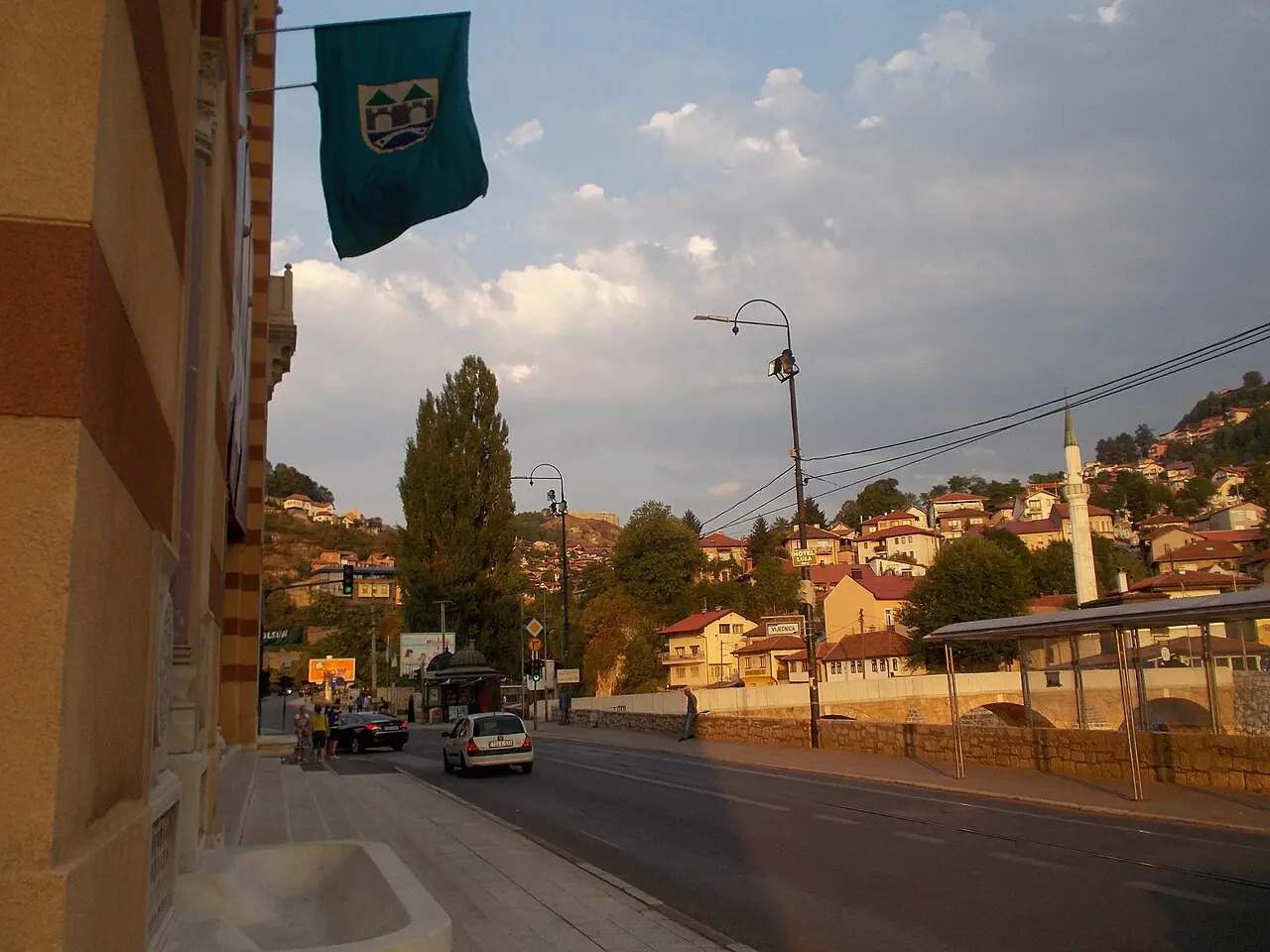
It sits a short walk upstream from the Latin Bridge and Baščaršija, so most visitors meet it without planning to. That is fine for the facade. Going inside is a different stop: part architecture, part civic building still in use, part memorial to a library that never came back intact.
Pseudo-Moorish city hall, 1892-1896
After the Austro-Hungarian occupation of 1878, Sarajevo’s city administration bounced between temporary homes and needed a proper seat. Construction of the new City Hall began in 1892 and finished in 1894; the formal opening was 20 April 1896, when the building was handed to the city government.
The design story is a relay. The first scheme by Karlo Paržik (Karel Pařík) was rejected after objections from minister Béni Kállay. Alexander Wittek took over in 1892-1893 and worked in a deliberate pseudo-Moorish idiom - he even travelled to Cairo to study buildings in that style, with the Mosque-Madrasa of Sultan Hasan as a published reference on the operator’s history page. When Wittek couldn’t finish, Ćiril M. Iveković completed the project in 1894 with only small changes to Wittek’s plan.
What you see from the river is that mix of striped stone, horseshoe arches and a silhouette that looks half North African, half Central European. It was meant to look grand and local at once - the Austro-Hungarian state’s idea of “Bosnian” form for the most representative civic building of the period.
Franz Ferdinand’s last reception
On 28 June 1914, Archduke Franz Ferdinand and his wife Sophie attended a reception in this building during their Sarajevo visit. After they left, the motorcade route took them toward the Latin Bridge corner where Gavrilo Princip shot them both - the spark of the First World War. The City Hall is not a Franz Ferdinand museum, but it is the last indoor stop on that morning’s official programme, a few minutes’ walk from the corner museum that marks the assassination site.
From city offices to national library
City administration filled the building for decades. After the Second World War the use shifted toward culture and scholarship: from 1947 the operator’s history notes a turn toward the Academy of Sciences and Arts and library functions, and the National Library was placed in Vijećnica in 1951. For the late twentieth century this was not “just” a pretty hall - it was the National and University Library of Bosnia and Herzegovina, the central stack of the country’s written memory.
That is why the fire of 1992 still lands as more than architecture damaged. The building burned. So did the catalogue of a culture.
The night the library burned: 25-26 August 1992
During the siege of Sarajevo, on the night between 25 and 26 August 1992, artillery hits set Vijećnica alight. The operator’s war page is blunt: around two million books, articles and journals were destroyed; about 80% of the library holdings went in that single night. Wooden floor structures burned out. The steel dome over the central atrium was badly deformed. Armoured glass covering was lost. Ground-floor and upper walls were heavily damaged; attic walls were destroyed outright. Parts of the atrium columns, brick vaults and stone arches failed. Stone staircases and decorative railings were ruined.
Outside, ash fell on the Miljacka. Inside, the reading rooms and stacks became a furnace. Contemporary accounts record librarians and neighbours trying to carry volumes out under sniper fire; at least one person is reported to have died doing that work. Whatever was saved was a fraction. The National and University Library later continued elsewhere; the hole in the collection never fully closed - and it isn’t a gap a rebuilt atrium can fill.
This is the section that makes Vijećnica heavier than a pretty photo stop. It belongs with the siege timeline and the war museums, not with a checklist of Instagram facades. For objects and testimony from the wider siege years, pair this visit with the Historical Museum and other Sarajevo museums - and leave gap time between them.
Reconstruction and the 2014 reopening
Repair started in 1996 and ran in phases through technical and funding constraints into the 2010s. The operator stresses that the full reconstruction followed original documentation - what could be restored was restored; what couldn’t was remade from moulds and research. The ceremonial reopening was 9 May 2014, Europe Day and Victory Day over fascism on the Bosnian calendar. Public access followed that spring and summer (secondary sources put the general public reopening later in July 2014).
Today the building is busy again: protocol events for city and state, concerts and cultural programmes, temporary exhibitions, and regular sessions of the Sarajevo City Council. It’s a working landmark, not a frozen ruin. That’s why hours can shift when a private ceremony books a hall - the phone number on the site is worth using if your day is tight.
Inside the atrium and basement
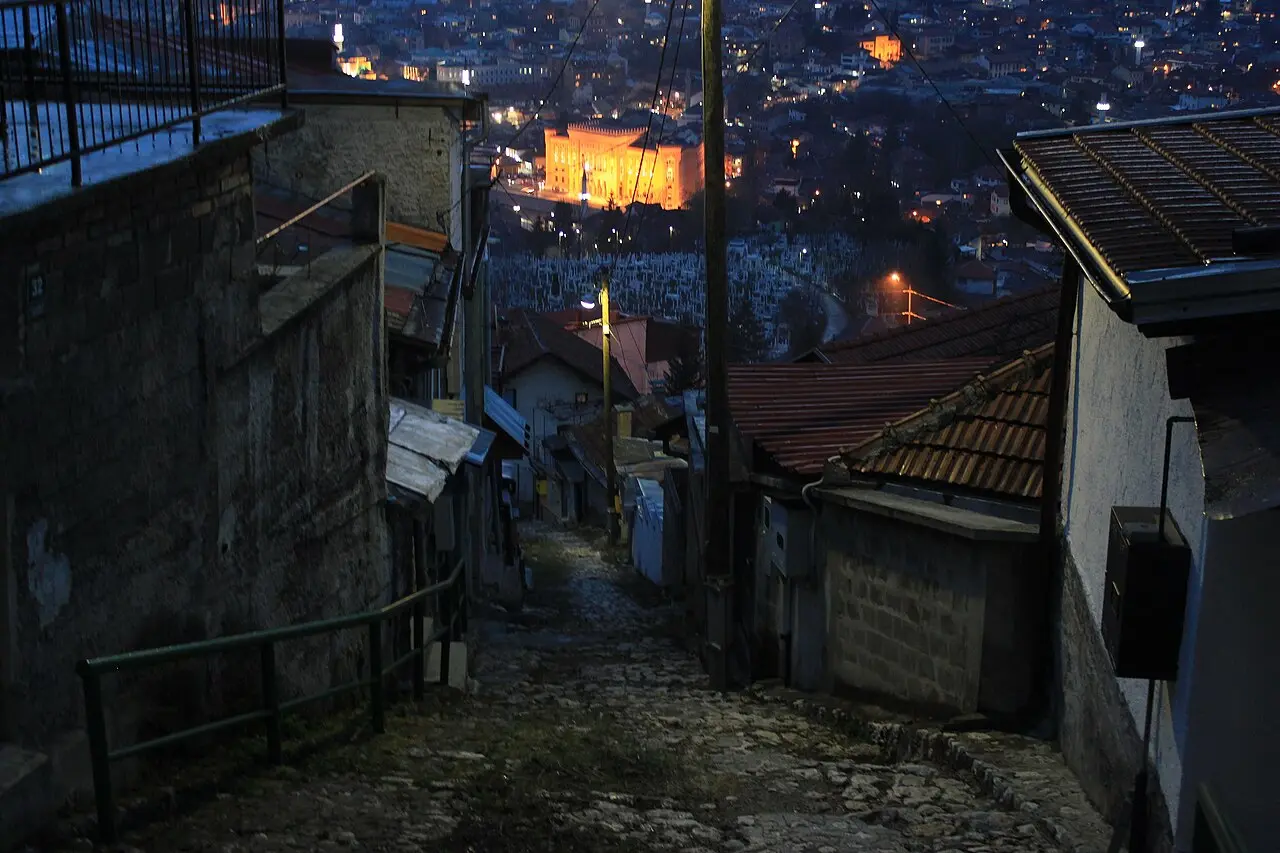
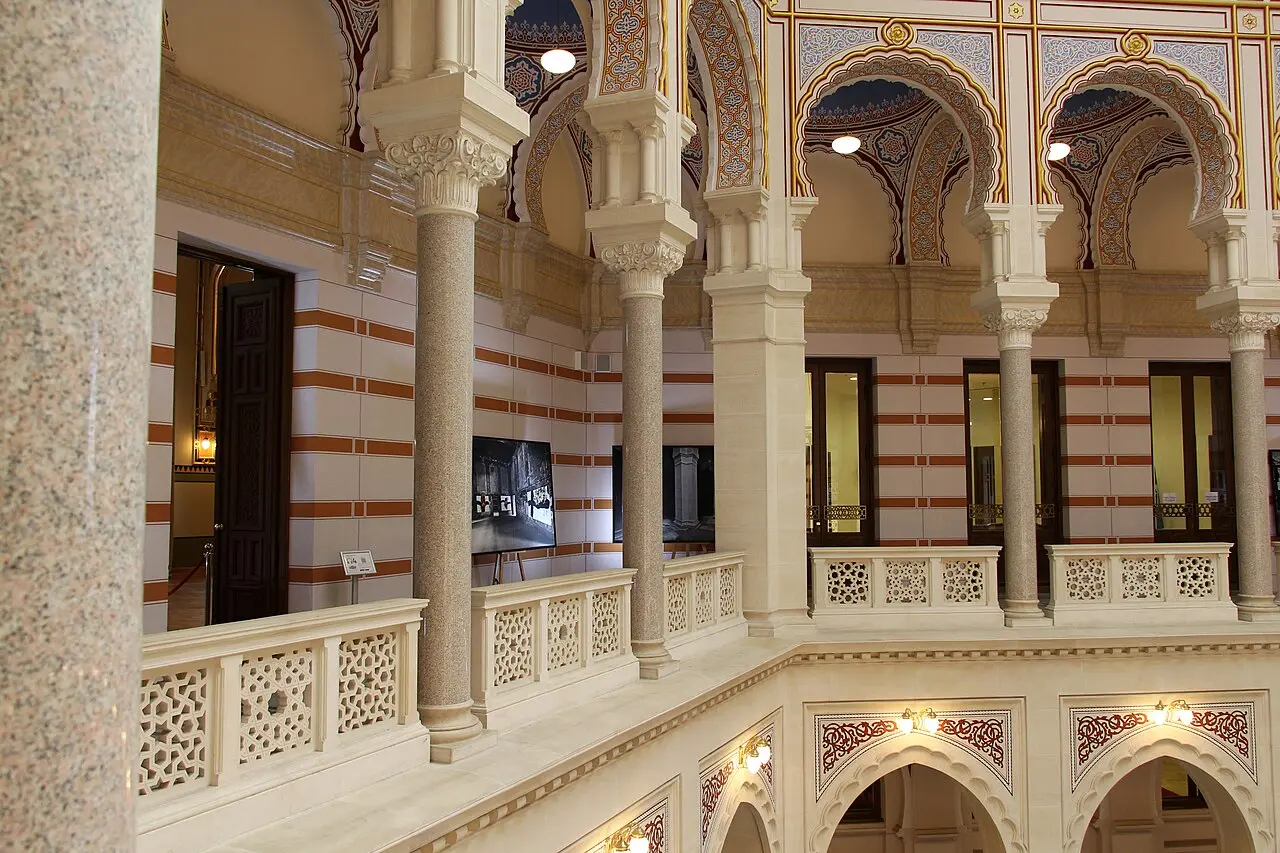
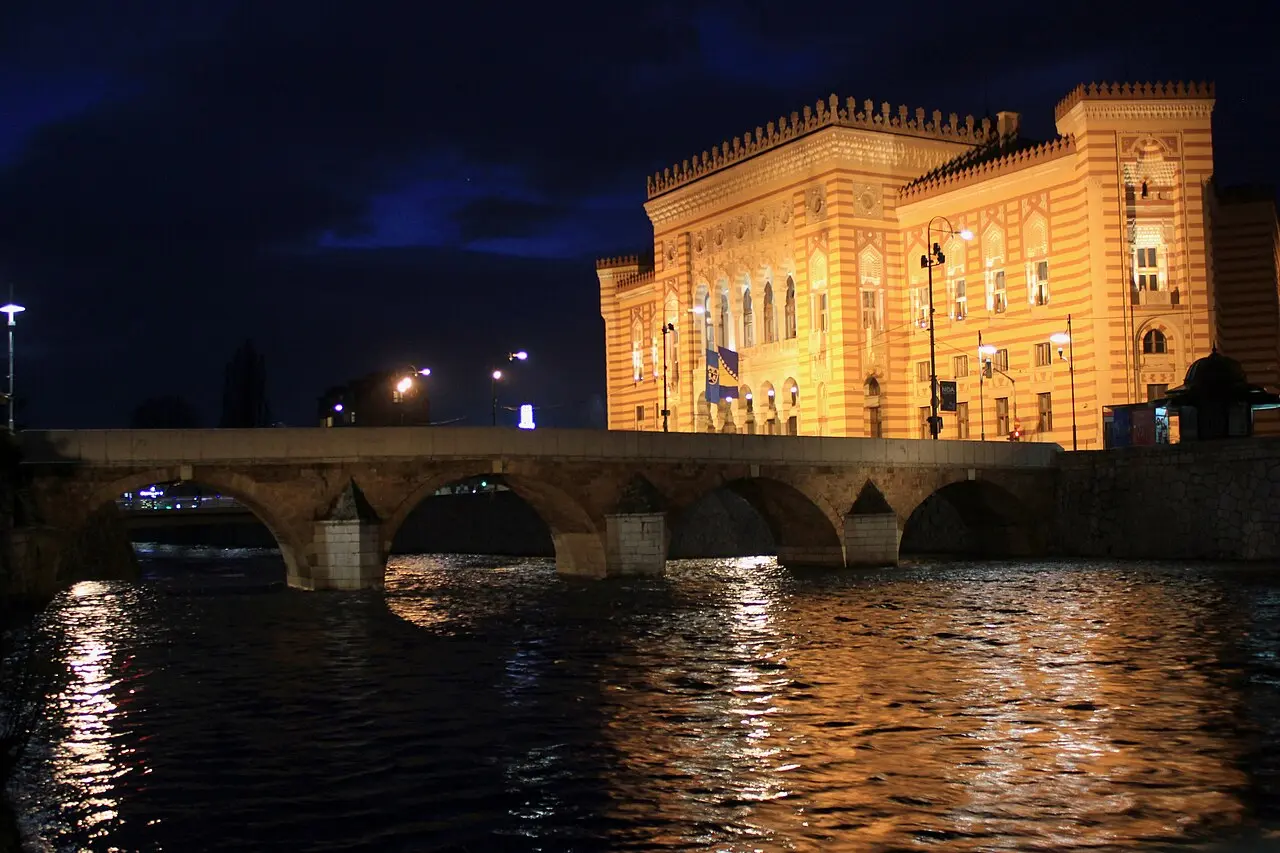
The free exterior is already worth the walk: striped stone, the river, and after dark a floodlit facade that photographs well from the opposite bank. The paid visit is about the central atrium - galleries stacked around a hexagonal volume, arches in the same striped language as the outside, and a geometric stained-glass ceiling that pulls your eyes up first.
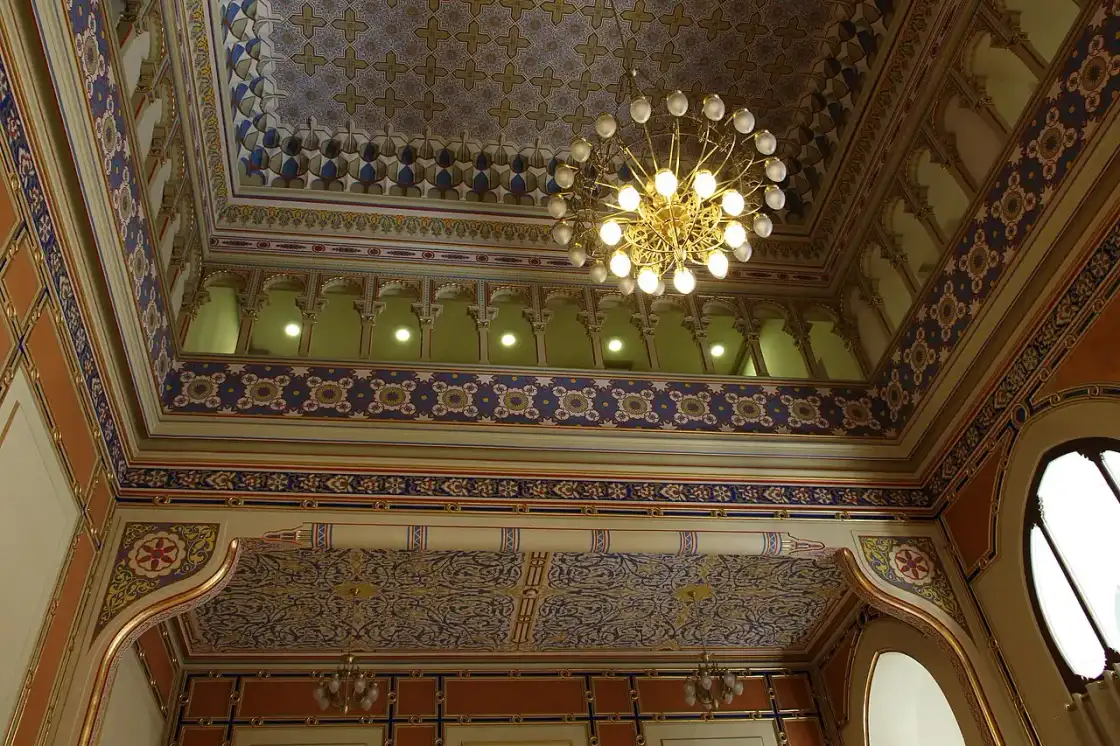
Under the atrium, in the basement, sits the permanent exhibition titled “Vijećnica”. It occupies the hexagonal undercroft beneath the aula: columns, arches and vaults arranged so you can walk a chronological loop in Bosnian/Croatian/Serbian and English. Eight thematic units run from Sarajevo just before the City Hall was built through to the building’s return to public use. On the columns, photographs by Milomir Kovačević Strašni document the wartime ruin. Unit 4 breaks the circle on purpose: a physically separate room staged as a burned shell, with authentic remains of scorched books, stone and rubble from the fire. That room is the emotional core. Don’t rush it.
Elsewhere in the same undercroft you’ll find the original foundation stone uncovered during atrium reconstruction, carved with builders’ names and the construction year, plus portraits and short biographies of Sarajevo’s mayors since 1878. The operator also hosts an ICTY information centre segment - including the authentic Tribunal courtroom no. 2 brought from The Hague - and a large showing of the Ars Aevi contemporary-art collection (the site says roughly 60-70% of that fund is on display here). Temporary shows rotate upstairs and in side rooms; check the news strip on vijecnica.ba the week you travel.
A Matterport 3D walkthrough is linked from the operator homepage for a preview before you buy a ticket: useful for mobility planning, because the basement loop includes an accessible approach noted in the exhibition description.
How Vijećnica fits a Sarajevo day
Most people see it as the eastern bookend of a Baščaršija-to-river walk: Sebilj and the bazaar, Latin Bridge, then Vijećnica. That works. The timed foot route from the Sebilj covers the same ground. Give the interior 45-90 minutes - shorter if you only do the atrium, longer if you read every basement panel and sit with unit 4. You’ll want more time if temporary shows are up.
It doesn’t replace a dedicated siege museum day. The fire story here is specific and sharp; the siege overview and the city museum round-up carry the wider context. For a wider city plan that already names Vijećnica beside the bazaar and Trebević, use the Sarajevo city guide. Night photography from the riverbank doesn’t need a ticket - just a clear evening and care on wet cobbles.
Hours, tickets and how long
Hours (operator, checked 28 August 2026): every day 09:00-17:00. Older tourist-board PDFs listed longer summer evenings; trust the live site, and call +387 33 292 800 if a wedding or protocol event might close galleries.
Tickets: the Canton tourist-board museums brochure (Visit Sarajevo) lists 10 KM for adults and 5 KM for children, students, pensioners and visitors with special needs, and 8 KM each for groups of ten or more. As of late August 2026 the operator homepage doesn’t publish a price table, so treat 10/5 KM as the last clear published band and confirm at the desk when you arrive. Cash in convertible marks (KM) is the safe assumption; euro isn’t a reliable fallback in Bosnian ticket offices.
Duo offer - check before you count on it. JP Sarajevo ran a Žičara - Vijećnica Duo at the Trebević cable-car ticket office - one return cable-car ride plus City Hall entry, 12 KM for residents and 35 KM for non-residents, valid the day of purchase - but the published run was 15 May to 31 August 2026 and that window has closed. Whether it returns next season is not something the operator has said, so treat it as a maybe and ask at the cable-car desk - check Trebević and the Olympic bobsled track for the ridge half of that combo.
How long: plan an hour for atrium plus basement; add time for temporary shows. The building is still used for City Council sessions and events, so some rooms may be closed without drama - staff will steer you.
Getting there: walk east along the river from Baščaršija / Latin Bridge (about five to ten minutes). Trams stop nearby at the Vijećnica stop. Address for maps: Brodac 1 (you’ll also see Obala Kulina bana in older listings - same riverside block).
You’ll leave with two images that don’t cancel each other: the restored glass canopy, and the basement room that still smells like a warning. Both are the point of the visit.
Photos
On the map
The map loads on click - to keep the page lightweight.
The map didn’t load. Check your connection and refresh the page.
Admission and opening hours
- Admission price
- Adult entry 10 KM (~EUR 5); reduced 5 KM for children, students, pensioners and visitors with special needs; groups of 10 or more 8 KM each (Sarajevo Navigator, the canton tourist board's live listing). Confirm at the desk before you queue.
- Opening hours
- Daily 09:00-17:00 as published on vijecnica.ba (checked 28 Aug 2026). Private events can close rooms - phone ahead on busy days: +387 33 292 800.
Pay in convertible marks (KM) when the desk asks for cash; cards are not guaranteed. The basement exhibition covers the 1992 fire with burned book fragments - give yourself quiet time for that section. Exterior viewing and night photos from the riverbank are free.
Details checked: August 28, 2026
Read also

What to see · 15 min read
Via Dinarica Bosnia: Huts, Stages & Logistics
Verified · September 12, 2026Plan the Via Dinarica White Trail in Bosnia: 12 stages, 334 km, hut booking, trailheads, closures and three workable section packages.

What to see · 10 min read
Jablanica: Neretva Bridge & Roast Lamb Stop
Verified · September 4, 2026Jablanica on the Sarajevo-Mostar road: Battle for the Wounded museum (5 KM), the 1943 bridge, roast lamb lunch. Hours, parking, how long to stop.

What to see · 8 min read
Prokoško Lake: Shepherd Huts High Above Fojnica
Verified · September 3, 2026Prokoško on Vranica at 1,636 m: katuni, gate prices for foreigners, no swimming, and the 2026 asphalt climb from Fojnica.

What to see · 11 min read
Franz Ferdinand's Sarajevo: Latin Bridge & 1914 Site
Verified · August 29, 2026The Latin Bridge corner in Sarajevo where Franz Ferdinand was shot in 1914: what happened, the Museum of Sarajevo 1878-1918 inside, hours and tickets.