Siege of Sarajevo: Timeline, Death Toll & Sites Today
The siege of Sarajevo, 1992-1996: a timeline of the 1,425-day blockade, the death toll, and the war sites today, from Sniper Alley to the Sarajevo Roses.
The siege of Sarajevo was the longest blockade of a capital city in modern warfare: for 1,425 days, from 5 April 1992 to 29 February 1996, the city was encircled and cut off during the war that followed the break-up of Yugoslavia. That’s more than a year longer than the siege of Leningrad, and roughly three times the length of the Battle of Stalingrad. According to the Research and Documentation Center in Sarajevo, whose “Bosnian Book of the Dead” is the most careful count, the siege left 13,952 people dead, among them 5,434 civilians and 1,601 children. This guide explains, plainly, what happened, and then walks through the places in Sarajevo where you can understand it today - visited not as sights, but as memorials.
What the siege was
When Bosnia and Herzegovina declared independence in the spring of 1992, forces opposed to it took up positions in the hills that ring Sarajevo. From those heights, the Army of Republika Srpska and its Sarajevo-Romanija Corps held the high ground around the city; inside, the Bosnian government forces, the ARBiH, and the roughly 300,000 people trapped with them held the valley floor. The encirclement closed on 5 April 1992 and didn’t fully lift for almost four years.
Life under it meant living within range. The city was shelled from the hills - by one wartime tally, an average of hundreds of shells struck the city on a normal day - and exposed streets were watched by snipers. There was little running water, electricity or heat for long stretches; people queued at communal taps and chopped furniture for fuel, and crossed open ground at a run. The city wasn’t passive: it kept its newspapers, its hospital, a wartime government and even, famously, a film festival and a beauty pageant running through the shelling. But the toll was immense, and it fell across every community in the city - the RDC’s figures record Bosniaks, Serbs and Croats among the dead. The siege ended only after the Dayton Peace Agreement of late 1995, with the encirclement formally lifted at the end of February 1996.
Responsibility for specific crimes of the siege has been established in court. The International Criminal Tribunal for the former Yugoslavia (ICTY) in The Hague convicted two commanders of the Sarajevo-Romanija Corps, Stanislav Galić and Dragomir Milošević, of crimes against humanity for a campaign of shelling and sniping against the civilian population; Galić was sentenced to life. These are judicial findings against named individuals, not a verdict on any people.
A timeline of the siege
The siege didn’t arrive in a single day, and it didn’t end in one either. These are the dates that give the four years their shape:
- February to March 1992 - Bosnia and Herzegovina votes for independence in a referendum; barricades go up in Sarajevo and the political crisis tips into violence.
- 5 April 1992 - Tens of thousands march for peace through the city; shots are fired on the crowd and the first people are killed. The encirclement closes, and this is the date the siege is counted from.
- 2 May 1992 - The ring is sealed. A cordon of roughly 60 km in the surrounding hills cuts the city off; the main post office is burned out and the telephone lines go dead.
- 25-26 August 1992 - Incendiary shells set Vijećnica (City Hall) alight; the National and University Library inside loses around two million books and periodicals in a single night.
- Summer 1993 - With the city strangled, volunteers finish the hand-dug Tunnel of Hope under the airport runway - the lifeline that keeps Sarajevo fed and armed for the rest of the war.
- 5 February 1994 - A mortar shell lands in the Markale market and kills 68 people, the deadliest single attack of the siege to that point.
- 28 August 1995 - A second shell hits Markale, killing 43. It’s the attack that finally pushes the outside world to act.
- 30 August 1995 - NATO launches Operation Deliberate Force, a sustained air campaign against the guns in the hills around the city.
- 14 December 1995 - The Dayton Peace Agreement is signed in Paris, formally ending the war.
- 29 February 1996 - The siege is officially declared over and the city reunified, 1,425 days after it began.
The prose that follows walks the places where those dates are still legible in the streets today.
Sniper Alley and the Holiday Inn
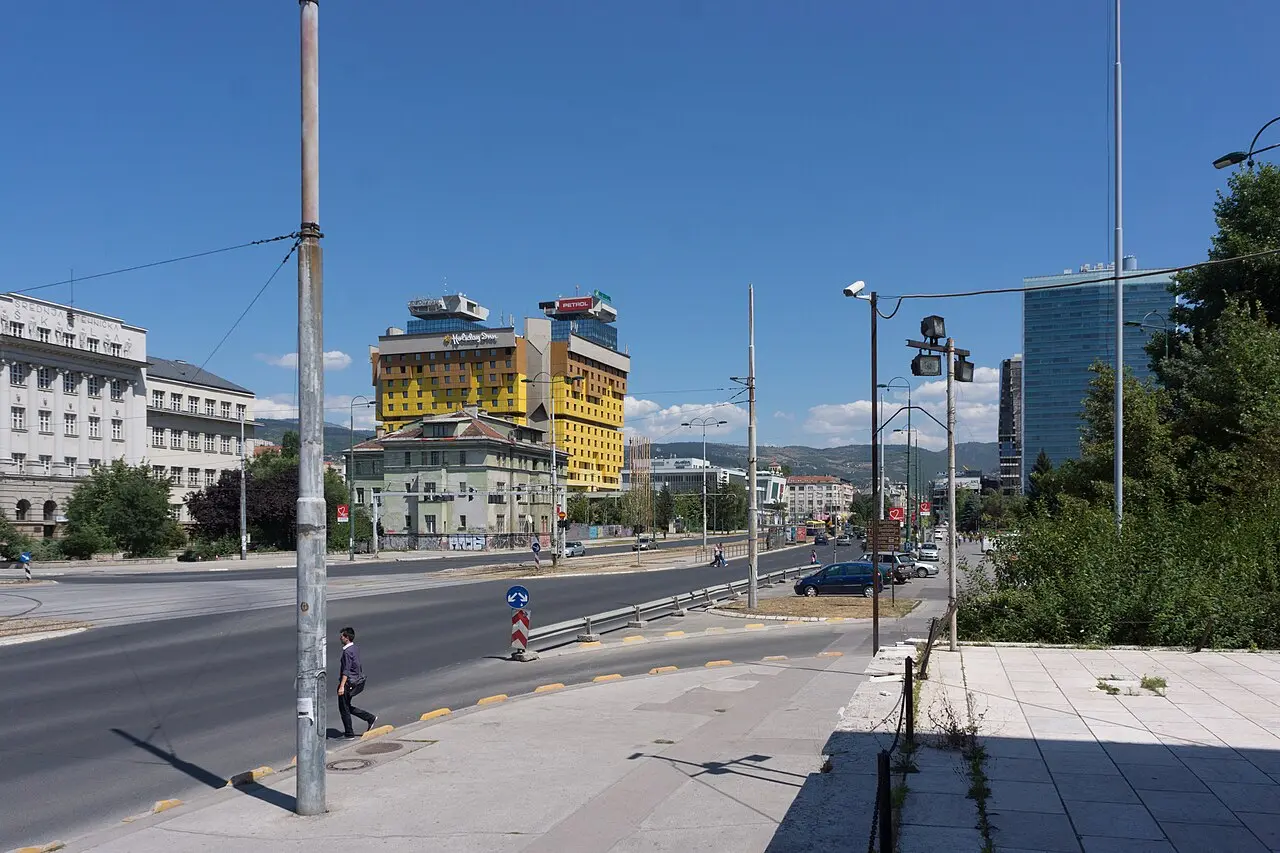
The main artery running west out of the centre - Zmaja od Bosne, the wide boulevard toward the airport - earned the wartime nickname “Sniper Alley” because it ran straight beneath the high-rise blocks and the hills where gunmen were positioned. Crossing it, or the junctions off it, could be lethal, and improvised barriers of wrecked cars and shipping containers were set up to block the sightlines. It’s an ordinary, busy road today, lined with rebuilt towers and trams; there is nothing to buy or enter, but walking or riding its length, and understanding what an everyday errand along it once cost, is its own quiet lesson.
Halfway along it stands the bright yellow former Holiday Inn (now the Hotel Holiday), built for the 1984 Winter Olympics and designed by the Sarajevo architect Ivan Straus. Through the siege it was the base for the foreign journalists who reported the war to the world, its exposed front facing the boulevard and the hills; it was shelled repeatedly and never closed. It still operates as a hotel, and while it is not a museum, its blunt Olympic-era shape is one of the most recognisable survivors of the siege.
Markale market
Two of the deadliest single incidents of the siege happened at the Markale open-air market, just off the main pedestrian street in the old town. On 5 February 1994, a mortar shell landed among the stalls and killed 68 people, wounding well over a hundred. On 28 August 1995, a second shelling of the market killed 43 people; the ICTY attributed both to the forces besieging the city, and the second attack was among the events that prompted the NATO air campaign that helped bring the war to an end.
The market trades again today, ordinary and busy, and on its wall is a memorial: a plain red backboard listing the names of those killed there. It’s easy to walk past if you don’t know it is there. Standing in front of the names for a moment, in a working marketplace where people are buying fruit and vegetables exactly as they were on those two mornings, is one of the more affecting things you can do in the city.
The Sarajevo Roses
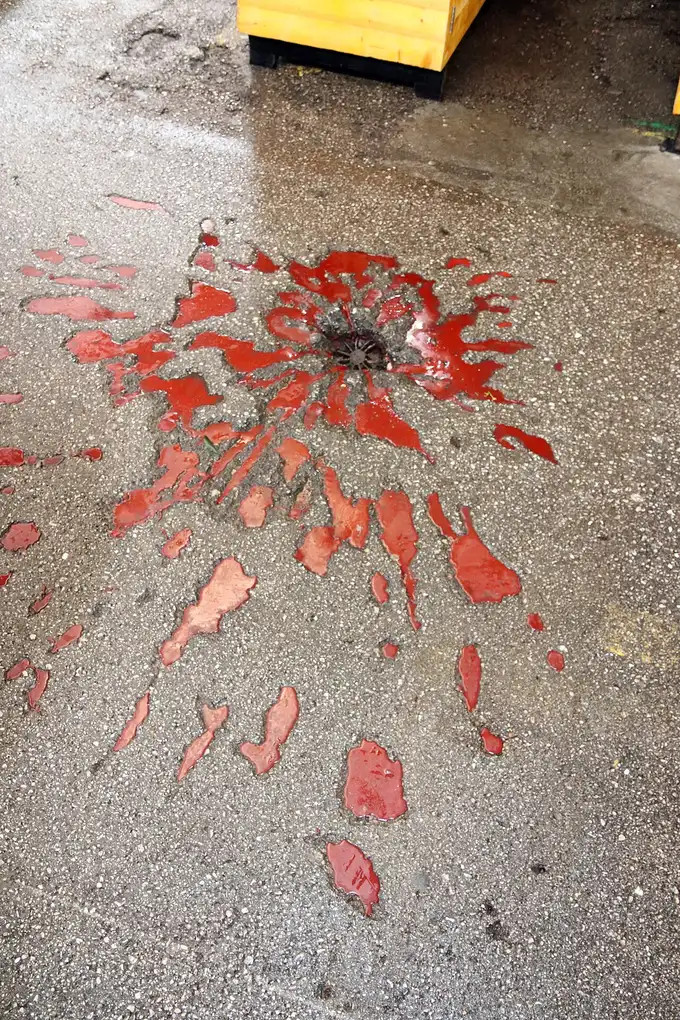
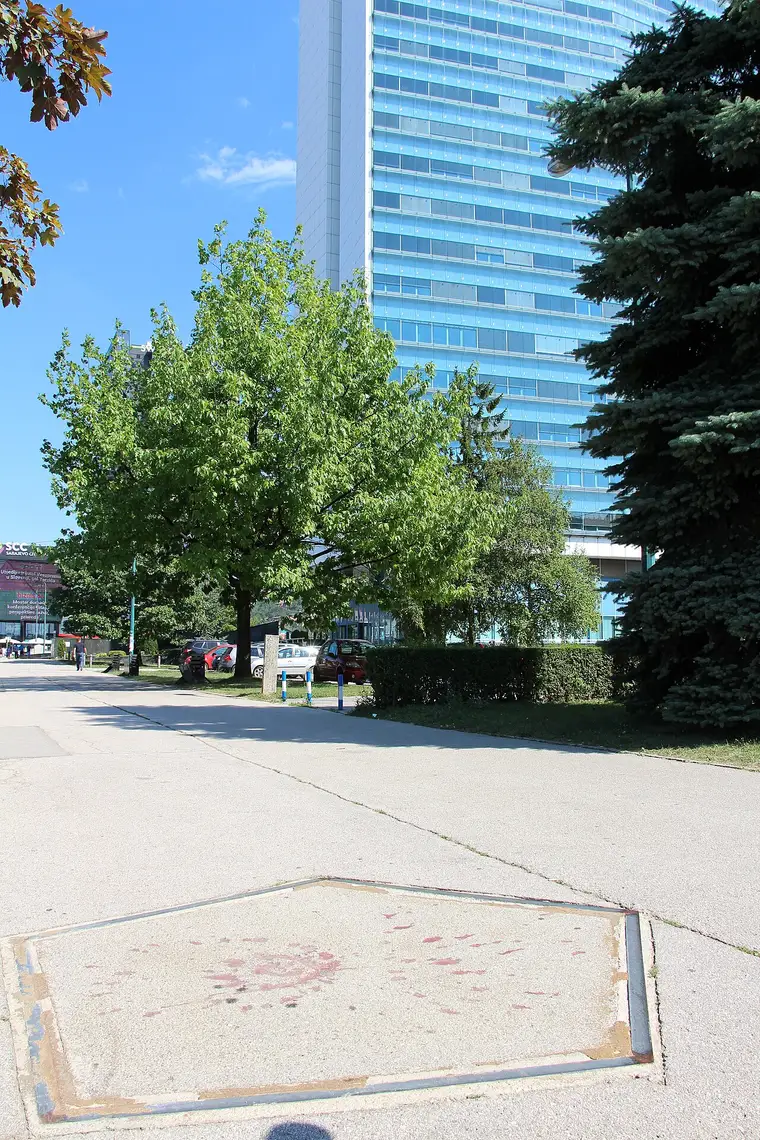
Where a mortar shell struck the ground and killed people, the concrete was left scarred in a distinctive scatter pattern. In a number of places around the city, those scars have been filled with red resin - turning the mark of an explosion into something that looks like a red flower pressed into the pavement. These are the Sarajevo Roses, and they’re the city’s quietest memorial: no sign, no fence, just a red bloom underfoot that marks a spot where lives were lost.
There’s no trail and no ticket; you come across them. There are surviving examples near the market and elsewhere in the centre, though weather and repaving have worn many away over the years. If you find one, it is worth pausing - each marks a specific place where specific people died, and that is exactly what the resin is there to say.
The cemeteries on the hills
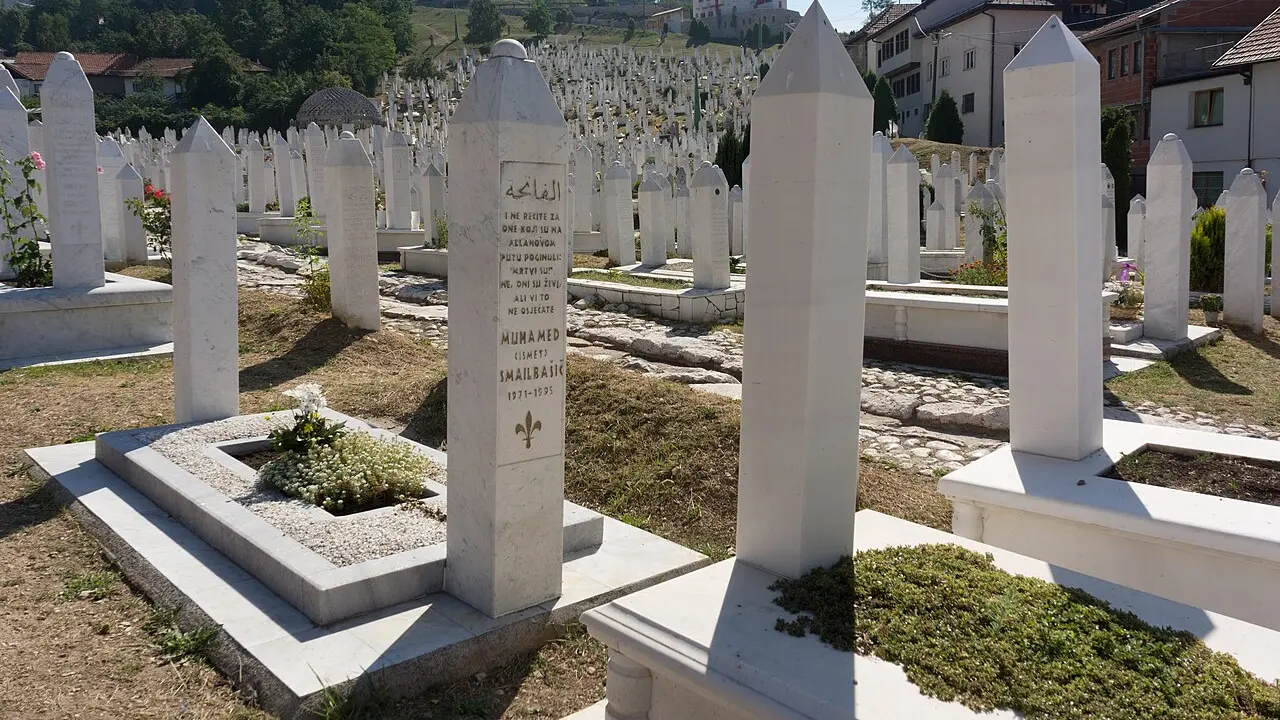
Look up from almost anywhere in Sarajevo and you see the war’s clearest mark: fields of white gravestones climbing the surrounding hillsides, most of them dated between 1992 and 1995. When the established cemeteries came under fire or filled, the city buried its dead wherever it safely could - on slopes, in parks, and in the green areas around the Koševo stadium, where an auxiliary football pitch became a graveyard.
The largest of these wartime cemeteries is Kovači, the martyrs’ memorial cemetery above the old town, its ranks of slim white markers rising steeply up the hill. It’s also the resting place of Alija Izetbegović, the country’s first president, whose grave sits under an open pavilion at the top. Nearby, the older Lav (Lion) cemetery by the stadium holds graves from the siege among its earlier ones. These are active places of mourning, not viewpoints; if you go, keep to the paths, dress and behave as you would at any cemetery, and let the sheer number of stones from those four years register on its own.
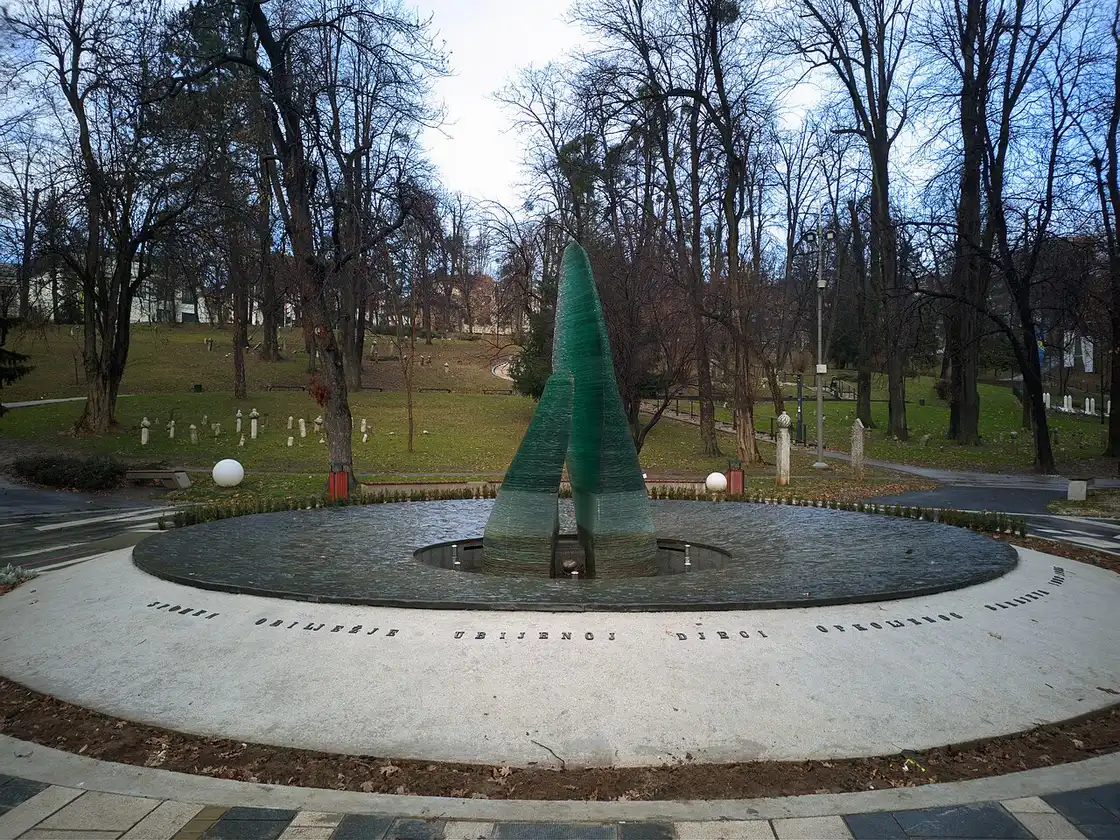
In the city centre, in the green space of Veliki Park, a separate monument remembers the youngest of the dead: the memorial to the children killed during the siege, unveiled in 2009. A glass sculpture rises from a fountain, ringed by a bronze band cast from spent shell casings and imprinted with children’s footprints. The RDC counts 1,601 children among those killed in the siege; the memorial gives that figure a face.
The Tunnel of Hope
The single most important physical relic of the siege sits out by the airport: the Tunnel of Hope, a hand-dug passage under the runway that was, for most of the war, the city’s only link to the outside world - the route by which food, fuel, weapons and people moved in and out of the encirclement. A surviving stretch and the house it began from are now a museum, and it’s the best single place to grasp how the city survived. Because it deserves the space, we cover it fully in our guide to the Sarajevo War Tunnel, including how to get there, the opening hours and the cash-only entry.
How to visit, and in what spirit
None of these places is a packaged attraction, and that is exactly why they land. Most are simply parts of the living city - a boulevard, a market, a scar in the pavement, a hillside of graves - that you can walk to for free, at any hour, on your own. For the indoor half of the story - the objects, photographs and testimony a walk past a memorial can’t give you - Sarajevo’s war museums are the natural complement, above all the Historical Museum’s exhibition on the besieged city. There’s no set route; the natural way to see them is on foot while you are exploring Sarajevo anyway, threading them into a day that also takes in the old bazaar of Baščaršija and the rest of the city. If you would rather have the history spoken aloud, local guides who lived through the siege run walking war tours that link these same sites with first-hand testimony; the places themselves are free, so what you’re paying for is the context, and for a lot of visitors that turns out to be worth it. To see the siege from the other side, the cable car climbs to one of the firing positions itself - the abandoned Olympic bobsled track on Mount Trebević, its concrete still pocked with bullet holes. And a long day east of the city, the Srebrenica-Potočari genocide memorial remembers the more than 8,000 men and boys killed there in July 1995, the war’s gravest crime. Our full Sarajevo city guide covers how the pieces fit together and where to base yourself.
A word on how to be here. This is recent history, and the people who lived through the siege - who lost family in it - are your waiters, your guesthouse hosts, your fellow passengers on the tram. Sarajevans are, by and large, remarkably willing to talk about what happened, often with a directness and even humour that can catch you off guard; take your cue from them, listen more than you ask, and don’t treat the scars of the city as a backdrop for photographs of yourself. Go quietly, read the names, and you will leave understanding not just what Sarajevo endured, but the ordinary resilience with which it carries that memory today.
Photos
On the map
The map loads on click - to keep the page lightweight.
The map didn’t load. Check your connection and refresh the page.
Good to know
The sites in this guide are spread across the city and most are open, public places you can walk to for free - the Zmaja od Bosne boulevard, the Sarajevo Roses in the pavement, the Markale market memorial and the hillside cemeteries. They are memorials, not attractions; visit them quietly and with respect. The Tunnel of Hope museum by the airport is ticketed and covered in its own guide.
Details checked: July 4, 2026
Read also

What to see · 15 min read
Via Dinarica Bosnia: Huts, Stages & Logistics
Verified · September 12, 2026Plan the Via Dinarica White Trail in Bosnia: 12 stages, 334 km, hut booking, trailheads, closures and three workable section packages.

What to see · 10 min read
Jablanica: Neretva Bridge & Roast Lamb Stop
Verified · September 4, 2026Jablanica on the Sarajevo-Mostar road: Battle for the Wounded museum (5 KM), the 1943 bridge, roast lamb lunch. Hours, parking, how long to stop.

What to see · 8 min read
Prokoško Lake: Shepherd Huts High Above Fojnica
Verified · September 3, 2026Prokoško on Vranica at 1,636 m: katuni, gate prices for foreigners, no swimming, and the 2026 asphalt climb from Fojnica.

What to see · 11 min read
Franz Ferdinand's Sarajevo: Latin Bridge & 1914 Site
Verified · August 29, 2026The Latin Bridge corner in Sarajevo where Franz Ferdinand was shot in 1914: what happened, the Museum of Sarajevo 1878-1918 inside, hours and tickets.