Trebević: Cable Car & the Olympic Bobsled Track
Ride the Sarajevo cable car up Mount Trebević to the abandoned 1984 Olympic bobsled track - graffiti, siege scars, tickets and how to get there.
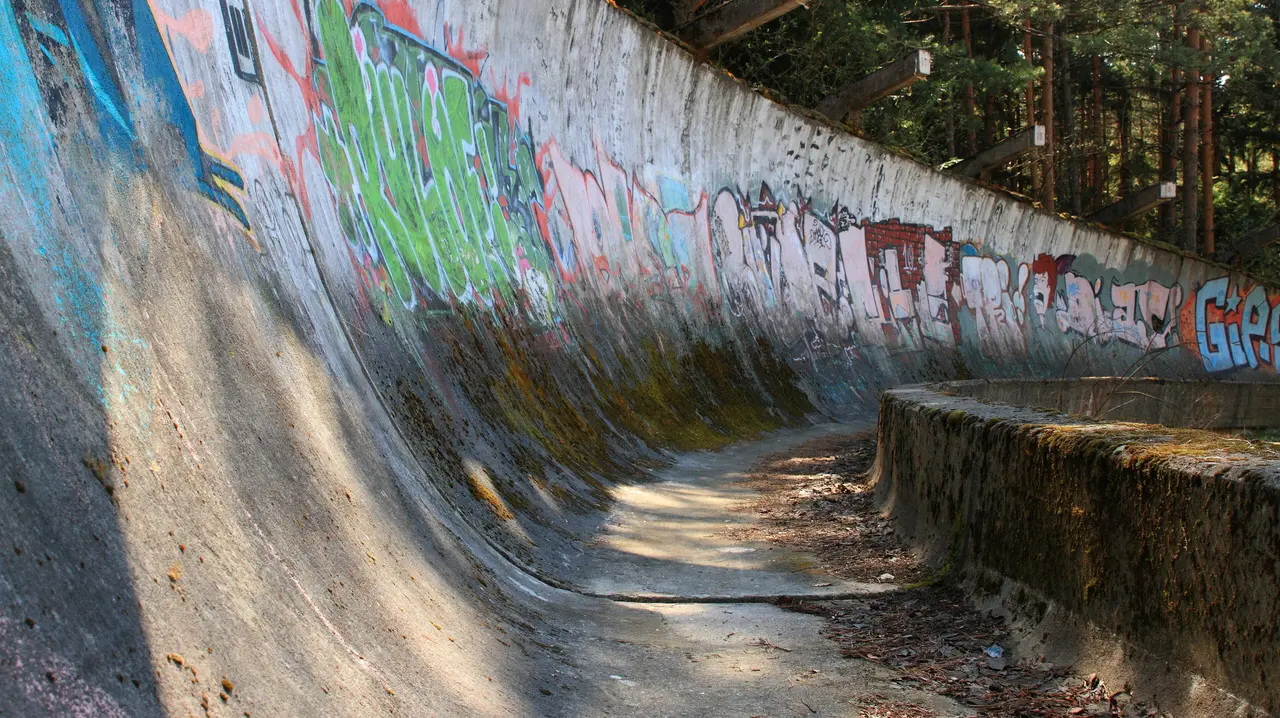
Take the cable car from Bistrik up Mount Trebević, walk ten minutes downhill from the top station, and you reach one of the strangest sights in the Balkans: the abandoned 1984 Winter Olympic bobsled track, a concrete snake curling through the pines, drowned in graffiti and scarred with bullet holes from the siege. The round trip on the cable car runs about 30 KM (roughly €15) and the track is free to walk. This guide covers the cable car, the history that makes the track so haunting, what it’s actually like to walk it, and the practical details - price, hours, safety and how to get up there.
The Trebević cable car
The cable car is half the experience and a story in itself. The original line opened on 3 May 1959 and became the way generations of Sarajevans got up to their favourite mountain. Then the war came. During the Siege of Sarajevo (1992-95) the cable car was destroyed, and for more than two decades the route up Trebević simply didn’t exist. It finally reopened on 6 April 2018, rebuilt for around €11 million, and its return was genuinely emotional for the city - a piece of pre-war normal life handed back.
The new line, built by Leitner Ropeways, runs 2,200 metres from the Bistrik lower station in the old town up to a station on Trebević at about 1,160 metres. There are 33 cabins - five of them painted in the Olympic ring colours, a nod to 1984 - and the ride takes roughly seven to nine minutes, climbing steadily over red rooftops, minarets and steep hillside neighbourhoods before the city drops away and the forest takes over. It’s a lovely ride in its own right, and the view back over the bowl of Sarajevo is the best you’ll get without hiking for it.
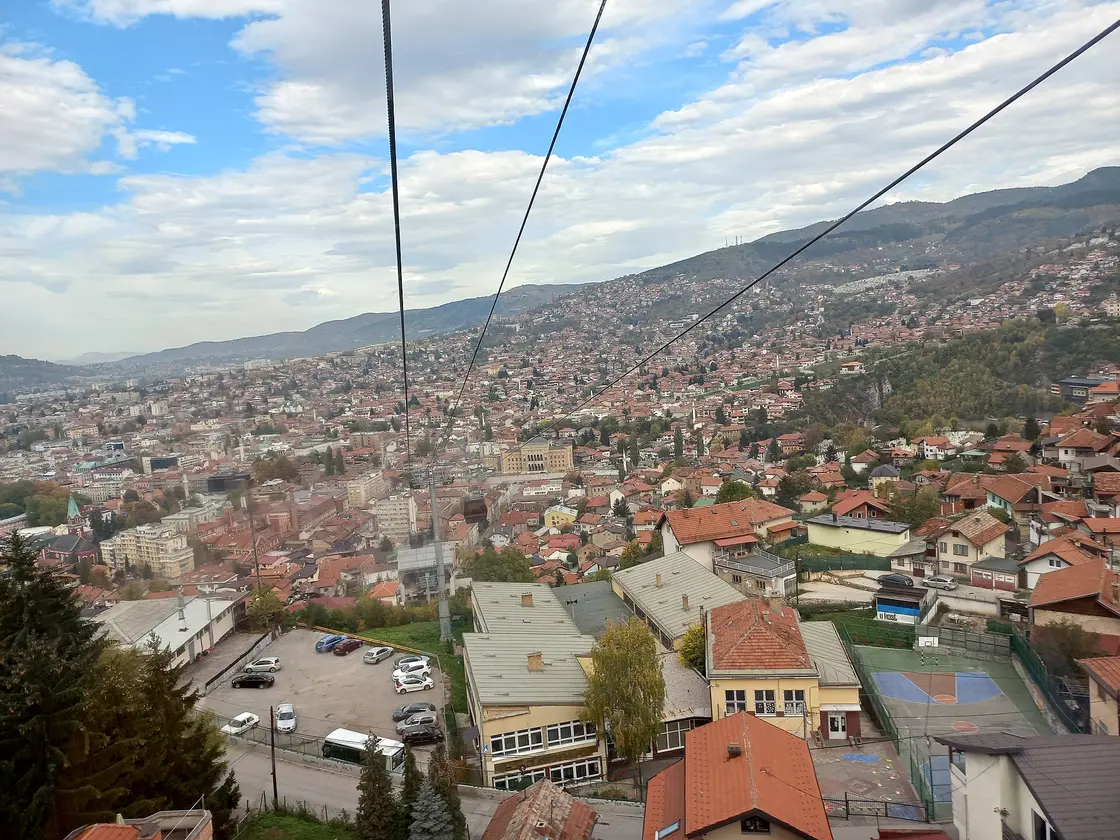
A round-trip ticket is about 30 KM (~€15) for foreign visitors; BiH residents pay far less - around 6 KM return with a valid ID. You buy at the Bistrik station and can pay in convertible marks or by card. The lower station sits a short, steep walk above City Hall (Vijećnica) and Baščaršija, so most people just walk there from the old town.
The abandoned Olympic bobsled track
Here’s what makes Trebević more than a viewpoint. Below the top station lies the bobsled and luge track built for the 1984 Sarajevo Winter Olympics - the games that, for a couple of weeks, put this city on the world’s front pages for the best possible reason.
The track’s design was approved in 1981, construction started that June, and the concrete run was finished by September 1982. The Sarajevo games were the first Winter Olympics held in a socialist country, and the city threw itself into them - the wolf mascot, Vučko, is still an affectionate local emblem. At the Olympics the track drew big crowds - roughly 20,000 spectators for the luge and 30,000 for the bobsleigh - and it kept hosting World Cup racing right up until 1991. Then, within a year, the same hillside that had staged the Olympics became a front line.
During the siege, Trebević’s height over the city made it a military prize, and the bobsled track was used as an artillery and firing position by Bosnian Serb forces, its concrete banking a ready-made bunker aimed down at the people below. Walk it today and you can still read that history in the surface: the run is pockmarked with bullet holes and shrapnel scars, the Olympic dream and the war stacked on the same few metres of concrete. That collision is exactly why the place stays with you.
Walking the track
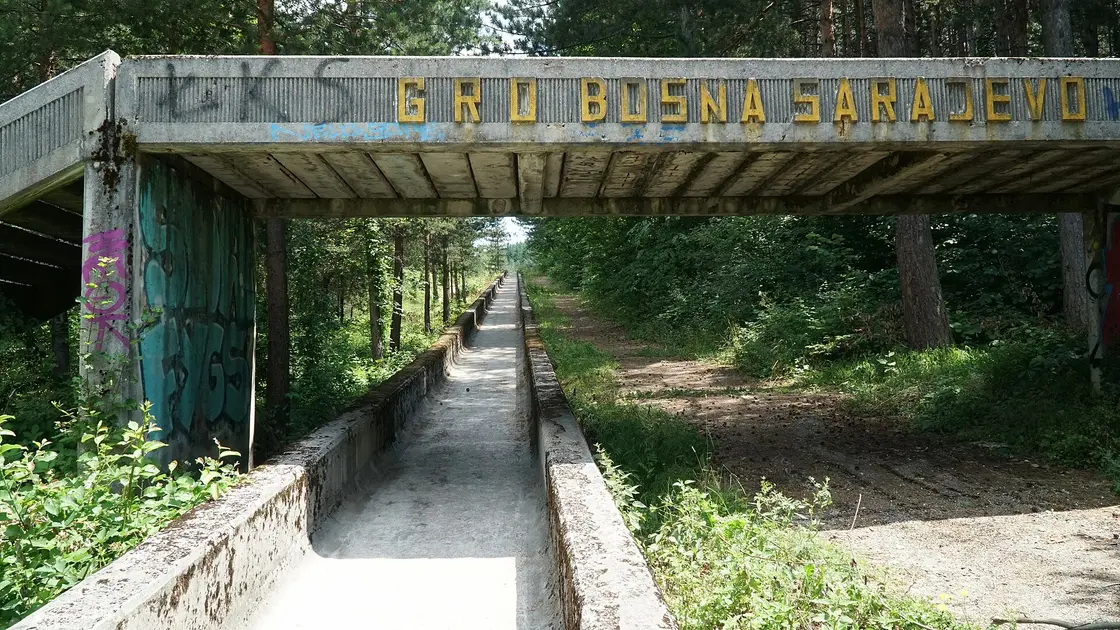
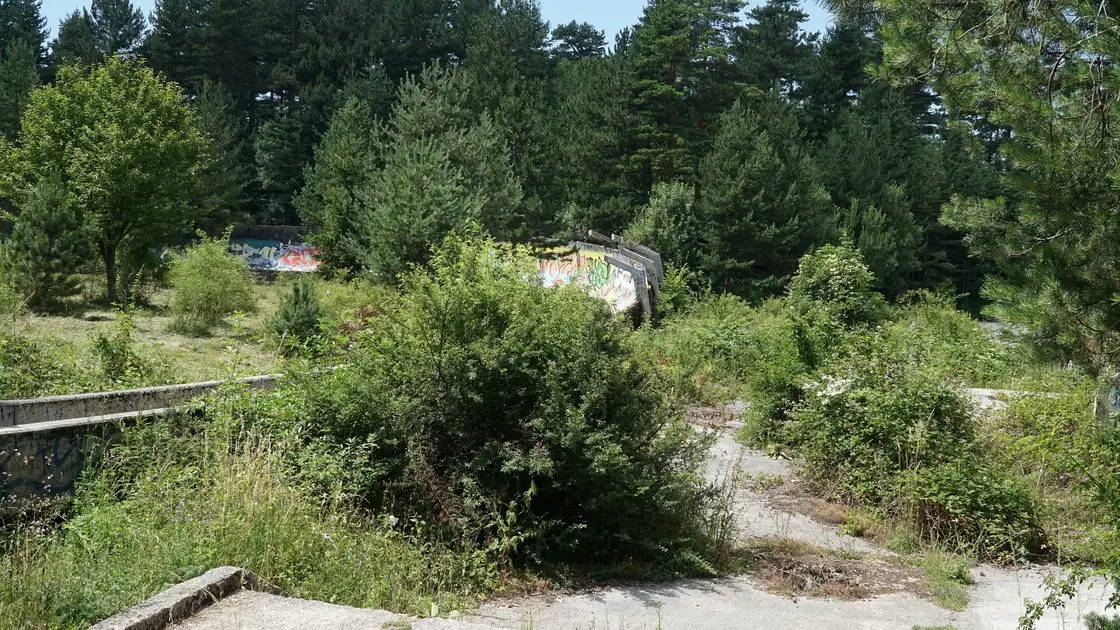
Nobody officially maintains the track as a tourist site, and that’s a big part of its appeal. Since around 2014, after demining cleared the area, it has been slowly reborn as an unofficial attraction: covered end to end in bright, layered graffiti by local artists, used by mountain bikers who bomb down the old run, and photographed by everyone who makes it up.
You can walk right along the concrete channel, stand in the banked curves where sleds once hit serious speed, and catch glimpses of Sarajevo through gaps in the trees. It’s quiet, a little eerie, and slowly being reclaimed by the forest - in places young pines are pushing straight up through the run. Give yourself a relaxed hour to walk down a stretch and back up.
Two honest cautions. First, mines: Trebević was one of the most heavily mined areas around Sarajevo, and while the track and the marked paths have been cleared, the old warning still applies - stay on the concrete and the obvious trails, and don’t wander off into the undergrowth. Second, it’s a real mountain: cooler, windier and often a few degrees colder than the city, so bring a layer and shoes with grip, especially if the concrete is wet.
Trebević the mountain
It is worth remembering what Trebević is when it is not being a dark-tourism curiosity: Sarajevo’s home mountain, the green wall the city looks up at every day. Before the war this was where families came at weekends to walk, picnic and ski, and the cable car’s return has brought a lot of that back. Around the top station there are viewpoints over the city, walking trails, a small adventure park and a couple of places to eat and drink, so you can easily turn the trip into a half-day rather than a quick up-and-down. It’s also a genuine reminder of how close the mountain and the city are - the same slope that Sarajevans once skied on became the place their neighbours were shelled from, and now it’s a weekend walk again. Few short trips fold so much of a city’s story into one ridge.
If you have any interest in the wider story of what happened to the city below, the track lands much harder once you understand the siege; our guide to the Siege of Sarajevo fills in that history and the other sites tied to it. And for everything else in the city at the foot of the mountain, from Baščaršija to the museums, see our things to do in Sarajevo. If you want to press on past the city into the mountains, Trebević is the first stop on our Olympic mountains day loop, a self-drive circle out to the Bjelašnica ski slopes, the highland village of Lukomir and the derelict Igman ski jumps. For the other two Olympic mountains in full, both seasons and their own wartime story, see our Bjelašnica & Igman guide.
Getting there, tickets and timing
The simplest way up is the cable car from Bistrik. The lower station is a 10 to 15 minute walk uphill from Baščaršija and City Hall, tickets are about 30 KM (~€15) return, and the ride is 7 to 9 minutes each way. If you would rather not queue or you’re short on time, you can also drive or taxi up the mountain road in 20 to 30 minutes and reach the track from above, though the cable car is far more fun and skips the parking. Because there’s no established local tour operator in Bosnia, most visitors do Trebević independently - by cable car or a private transfer - rather than on a packaged tour.
On timing, aim for a clear day - the whole point is the view and the light on the concrete, and low cloud can swallow both. Check the current cable car hours on zicara.ba before you set out, since they shift with the season and the occasional maintenance closure, and give yourself buffer so you’re not sprinting for the last cabin down. Late afternoon is the sweet spot: softer light on the graffiti, cooler air for the walk, and Sarajevo glowing below you on the ride back into town.
Photos
On the map
The map loads on click - to keep the page lightweight.
The map didn’t load. Check your connection and refresh the page.
Admission and opening hours
- Admission price
- Cable car round trip about 30 KM (~€15) for foreign visitors, roughly 6 KM for BiH residents who show ID; pay at the Bistrik station in convertible marks (KM), cash or card. Walking the bobsled track itself is free.
- Opening hours
- The cable car runs roughly 09:00-17:00 off-season and later in summer (up to about 20:00-21:00). Hours change with the season and maintenance, so confirm on zicara.ba before you go.
Trebević was heavily mined during the war and cleared from 2014 onward. Stay on the track and the marked paths and do not wander into the woods. It is cooler and windier on top than in the city - bring a layer and proper shoes.
Details checked: July 15, 2026
Distance ≈5 km · ~7-9 min by cable car
- Sarajevo ≈5 km · ~7-9 min by cable car The Bistrik lower station is a 10-15 min walk uphill from Baščaršija and City Hall (Vijećnica). You can also drive or taxi up the mountain road in 20-30 min.
Read also

What to see · 15 min read
Via Dinarica Bosnia: Huts, Stages & Logistics
Verified · September 12, 2026Plan the Via Dinarica White Trail in Bosnia: 12 stages, 334 km, hut booking, trailheads, closures and three workable section packages.

What to see · 10 min read
Jablanica: Neretva Bridge & Roast Lamb Stop
Verified · September 4, 2026Jablanica on the Sarajevo-Mostar road: Battle for the Wounded museum (5 KM), the 1943 bridge, roast lamb lunch. Hours, parking, how long to stop.

What to see · 8 min read
Prokoško Lake: Shepherd Huts High Above Fojnica
Verified · September 3, 2026Prokoško on Vranica at 1,636 m: katuni, gate prices for foreigners, no swimming, and the 2026 asphalt climb from Fojnica.

What to see · 11 min read
Franz Ferdinand's Sarajevo: Latin Bridge & 1914 Site
Verified · August 29, 2026The Latin Bridge corner in Sarajevo where Franz Ferdinand was shot in 1914: what happened, the Museum of Sarajevo 1878-1918 inside, hours and tickets.