Things to Do in Mostar: Bridge, Bazaar & Day Trips 2026
The best things to do in Mostar: the Old Bridge and its divers, the coppersmith bazaar, Blagaj and Kravice day trips, plus why it is best after 4pm.
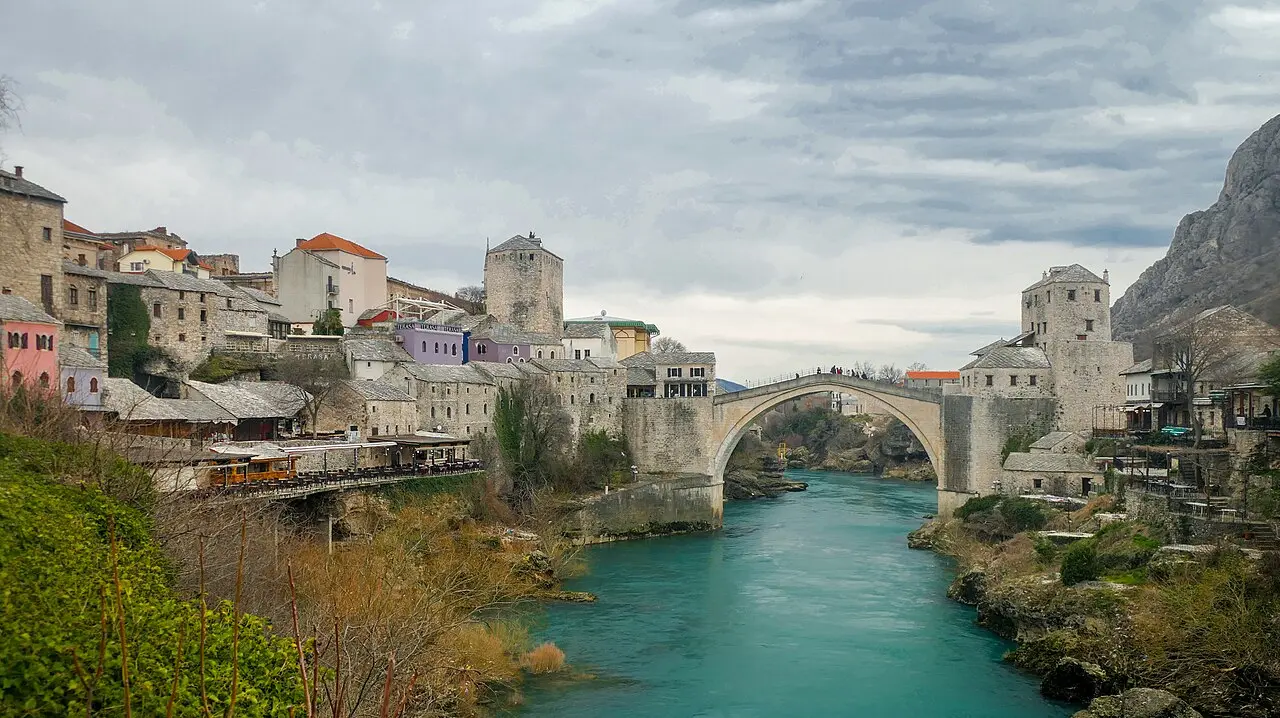
Mostar packs more into a small space than almost anywhere in the Balkans: a single soaring stone bridge over a turquoise river, a cobbled Ottoman bazaar of coppersmiths, and a set of day trips - Blagaj, Počitelj, Kravice - that most cities would kill to have on their doorstep. You can see the headline in a few hours, which is why so many come as a day trip from Dubrovnik or Split, or from the Makarska Riviera - our Makarska to Mostar guide covers that run. But the town changes character after four in the afternoon, and that gap between the day-trip Mostar and the evening one is the most useful thing to grasp before you go. (If you’re still deciding on the trip itself, our guide to whether Bosnia is worth visiting puts Mostar in the wider picture.)
The best things to do in Mostar, at a glance
Mostar’s highlights sit tight together, most within ten minutes of the bridge:
- Cross Stari Most, the rebuilt 16th-century Old Bridge, and wait for a local diver to leap 24 metres into the Neretva.
- Wander Kujundžiluk, the coppersmiths’ bazaar, and climb the Koski Mehmed-Paša minaret for the postcard view down the river.
- Find the quiet Crooked Bridge, then read the town’s 1990s war story on the walk west of the Old Town.
- Day-trip to Blagaj Tekija, the Kravice waterfalls (a swimming hole from June to September) and hilltop Počitelj.
- Give it an overnight: Mostar empties after 4pm and is a different, better place at dawn and after dark. Weighing that overnight against quieter Trebinje beds? See Mostar or Trebinje.
Stari Most: the bridge, and the divers
Everything in Mostar orbits Stari Most, the Old Bridge - a single 16th-century stone arch that leaps the Neretva in one clean line, about 24 metres above the water at its highest. It was built between 1557 and 1566 for Suleiman the Magnificent by the Ottoman architect Mimar Hayruddin, and for four centuries it simply stood there being one of the loveliest bridges in Europe.
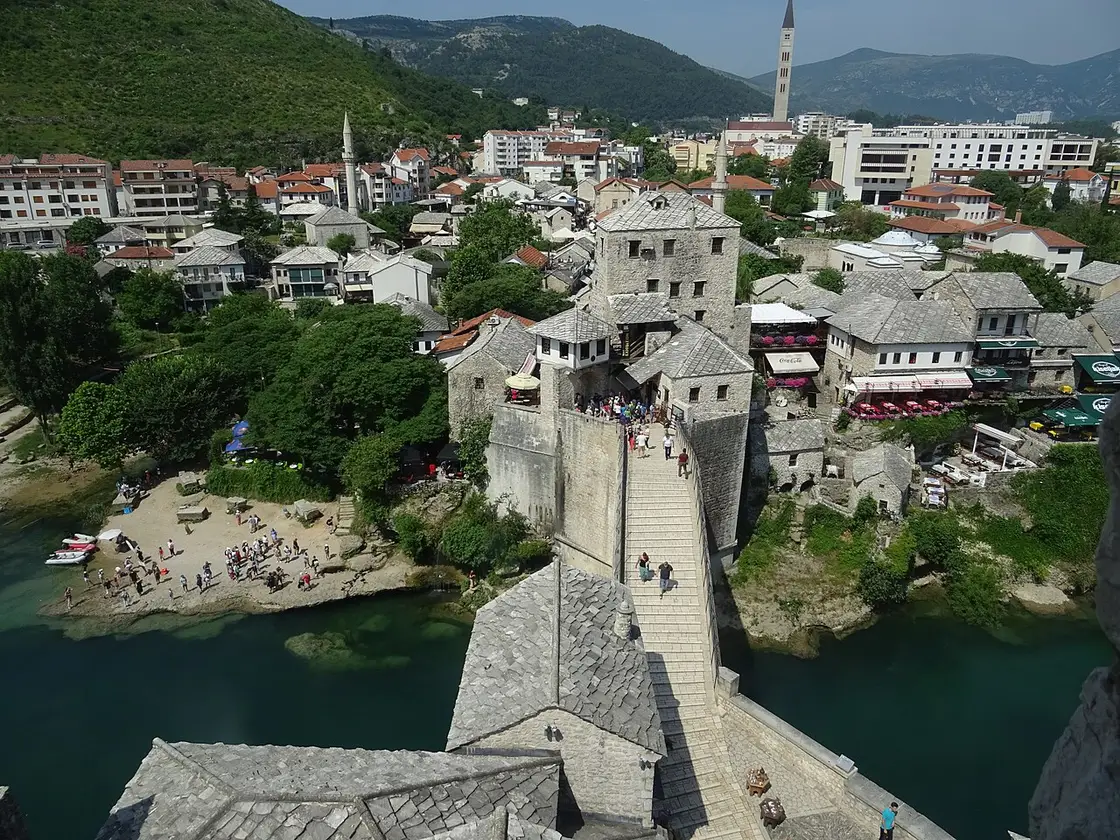
Then, on 9 November 1993, it was shelled to rubble during the Croat-Bosniak war. What you cross today is a faithful reconstruction: a coalition led by UNESCO and the Aga Khan Trust for Culture rebuilt it, Hungarian army divers hauled the original stones up from the riverbed, and the same limestone and techniques raised it again. It reopened on 23 July 2004, and the Old Bridge area became a UNESCO World Heritage Site the following year. Cross it slowly: the stones are worn glassy and domed, with raised ridges for grip, and the pitch is steeper than photos suggest.
The other thing that happens on the bridge is the diving. Mostar has an unbroken tradition of young men leaping off Stari Most into the Neretva that dates to 1664, and in summer you’ll find the local divers’ club working the crowd from the parapet. They don’t jump on a schedule: a diver climbs onto the rail and waits - sometimes a long while - collecting money in a bucket, and won’t leap until the pot is worth it (a few dozen euros, locals reckon). To catch one, be patient, stand near the towers, and tip a euro or two. Don’t try it yourself - the water is only 10-14°C even in August, the drop is real, and tourists get hurt most summers. Our full Stari Most guide digs into the bridge’s history, the divers and the best time to see it.
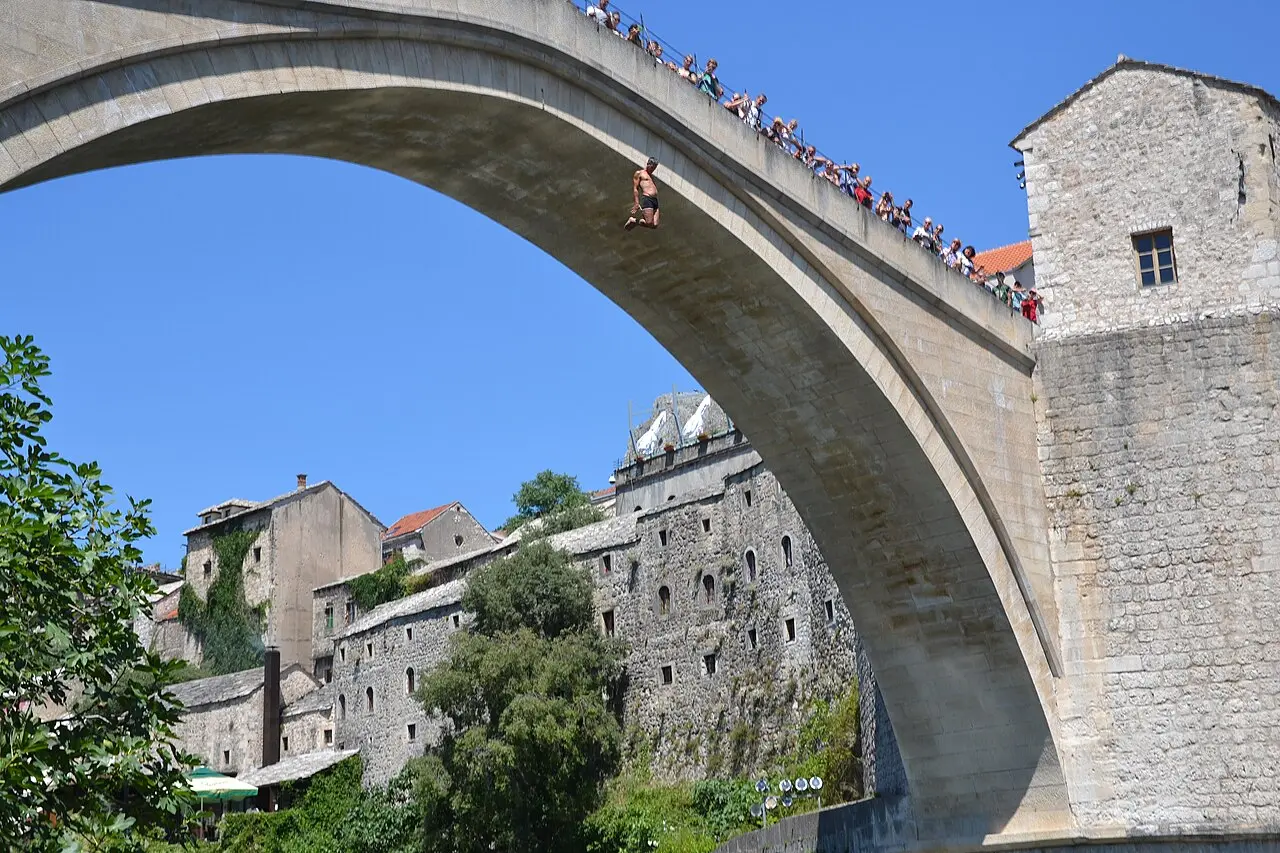
Mostar is also the summer stop for the Red Bull Cliff Diving World Series, when professional divers launch off the bridge in front of thousands. In 2026 it runs on 31 July-1 August; the exact dates shift year to year, so check the current Red Bull schedule before you plan around it.
The Old Town: what to see around the bridge
Mostar’s must-sees cluster tightly on both banks, mostly within five to ten minutes’ walk of the bridge. You don’t need a plan so much as a couple of hours and comfortable shoes.
Kujundžiluk, the coppersmiths’ bazaar
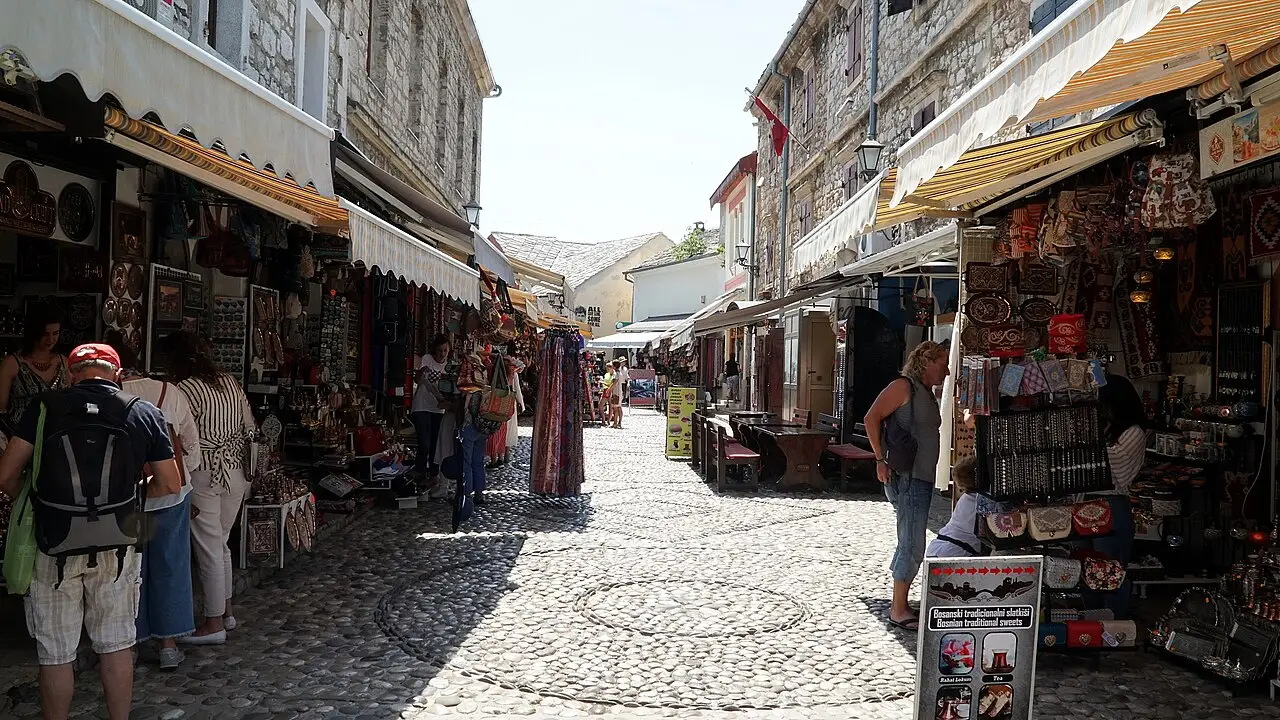
Step off the east end of the bridge and you’re straight into Kujundžiluk, the old bazaar street - a narrow, uneven cobbled lane of copper and brass workshops where you can still hear metal being hammered into coffee sets and lamps. It’s touristy, and plenty of stalls sell the same fridge magnets, but there are also genuine coppersmiths working a trade handed down for generations - a little Turkish-style coffee set or hand-beaten tray is the one souvenir here worth buying. Come early, or after the day-trip buses leave, and the street is a quieter place entirely.
Koski Mehmed-Paša Mosque, for the view
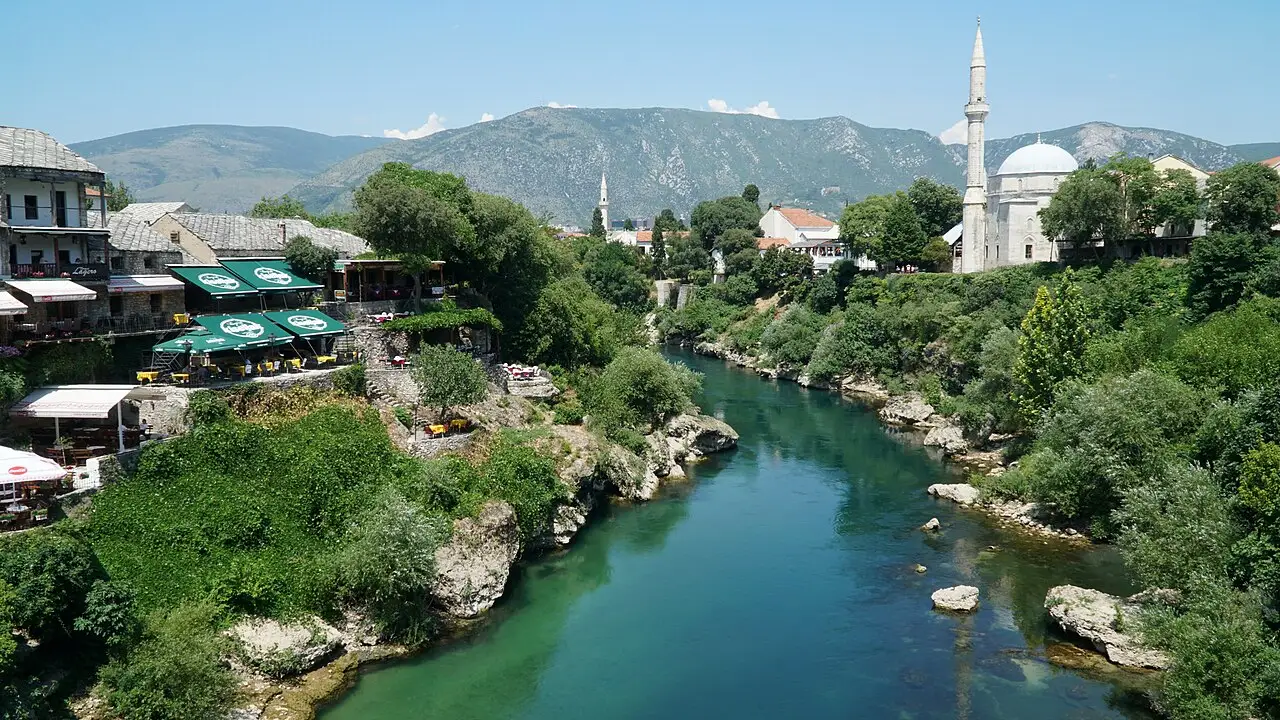
If you photograph one thing in Mostar besides the bridge itself, make it the view of the bridge from the Koski Mehmed-Paša Mosque (1618). For a small fee - around €2 / 5 KM when we checked, though the courtyard and the minaret can be priced separately, so confirm at the window - you climb the tight spiral of the minaret and come out level with the rooftops, looking straight down the river at Stari Most. It’s the postcard shot, and even the riverside courtyard has one of the best views in town. Dress modestly - it’s an active mosque.
The Crooked Bridge (Kriva Ćuprija)
A few minutes upstream, over the little Radobolja stream, sits the Crooked Bridge - a small, steep, mossy stone arch that looks like a miniature rehearsal for Stari Most. That’s more or less what it was: it dates to 1558 and is generally read as the test build for the bigger bridge. Hardly anyone walks the extra five minutes to find it, which is exactly its charm - a lovely Ottoman bridge, a few streamside restaurants, and none of the crush.
The war, told honestly
Mostar wears its recent history openly, and it’s worth understanding rather than editing out of the photos. The 1990s frontline ran roughly along the Bulevar and the Neretva, and once you cross west of the Old Town you start seeing it: facades still pocked with shell scars, the gutted “sniper tower,” small memorials. The rebuilt bridge is the emblem of the city’s recovery, but the divide it once symbolised hasn’t entirely gone - Mostar is still, quietly, two cities in places. A slow walk west of the tourist core takes it in, and a good local guide adds context.
How long do you need in Mostar?
Short version: the Old Town core is a half-day, the town plus one good day trip is a full day or an overnight, and Mostar as a base for Herzegovina is two nights. For how Mostar fits into a trip of the whole country, see our guide to how many days you need in Bosnia, or slot it into a 3-day Sarajevo and Mostar run for a short break. And to weigh whether Mostar or Sarajevo should get more of your nights, see Sarajevo or Mostar.
Three or four hours covers the bridge, the bazaar, the mosque view and a leisurely lunch - that’s what a day trip delivers, but it means arriving into peak crowds and leaving before the town exhales. The Old Town is at its best at either end of the day: at dawn you get the bridge almost to yourself, and after sunset it’s lit and the mood shifts from theme-park to something closer to real. An overnight also unlocks the day trips below without a mad dash.
Best day trips from Mostar
The area around Mostar is arguably a stronger reason to base yourself here than the town itself. Three sights stand out, and you can pair the closest two easily in a single day; our full guide to the best day trips from Mostar ranks these alongside the quieter runs to Stolac, Medjugorje and Trebinje by whether each earns the drive.
Blagaj Tekija
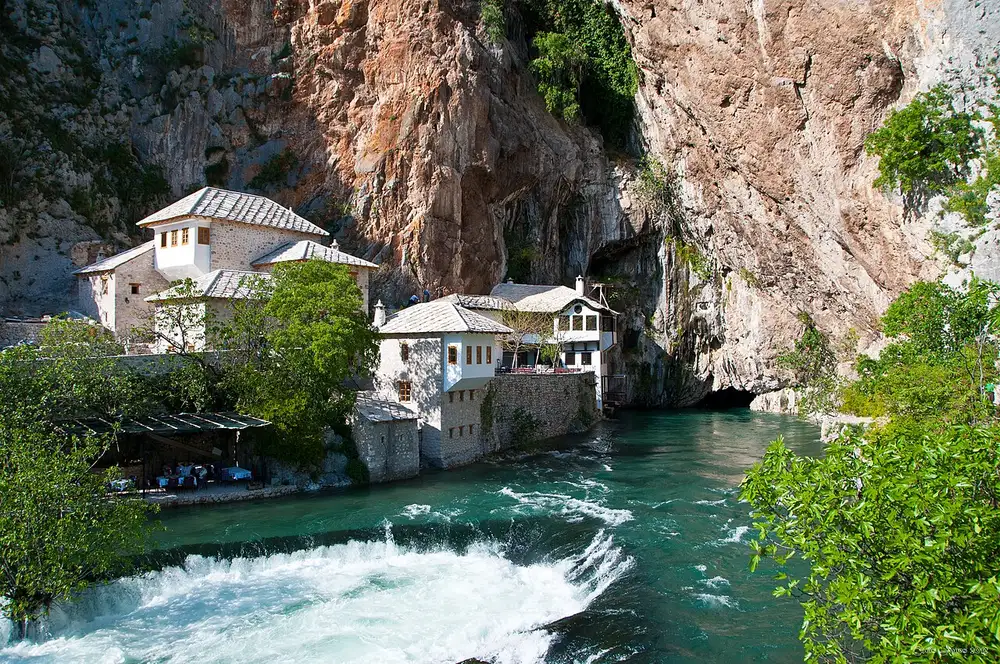
Twelve kilometres southeast of Mostar - about fifteen minutes by car - the Blagaj Tekija is a white 16th-century dervish house built flush against a cliff, right where the Buna river bursts, full-force and startlingly clear, from a cave at the base of the rock. It’s still an active religious site: you pay an entry fee at the booth, so bring marks in cash (the lodge doesn’t publish the amount online), and there’s a dress code (shoulders and knees covered; free wraps if you turn up in shorts). Go early, before the terrace fills. Our full Blagaj Tekke guide covers the boat into the cave, the fortress above it and the best time to go.
Kravice Waterfalls
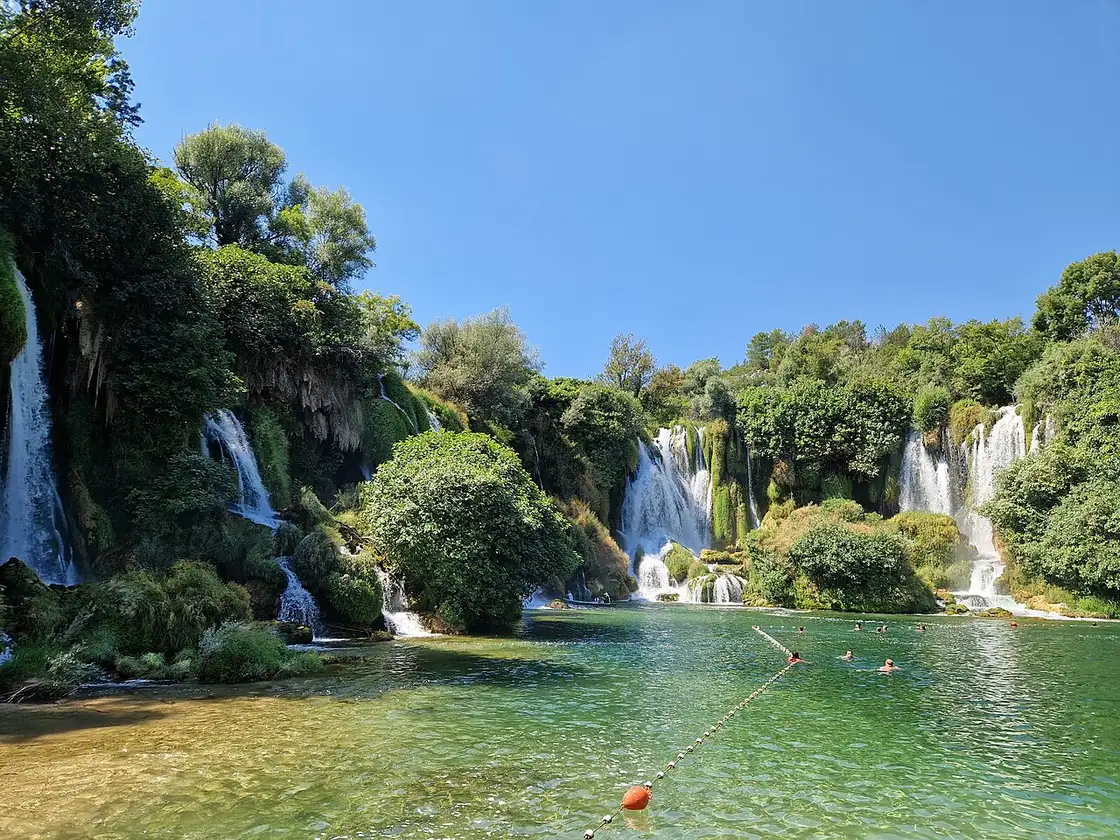
About 45 kilometres south - roughly 45 minutes on the M17 - Kravice is a broad horseshoe of waterfalls tumbling into a wide green pool, and in high summer it doubles as the region’s best swimming spot. Entry is 20 KM (€10) per person year-round, not just in season; bring cash, as the card machines are unreliable. Swimming runs roughly June to September - the water tops out around 20°C with no lifeguards, bracing but glorious on a hot afternoon. Our full Kravice Waterfalls guide covers the fee, the boat and the best time to go.
Počitelj
Roughly halfway to Kravice, Počitelj is a stepped Ottoman-medieval town stacked up a hillside above the Neretva, with a fortress you can climb for free. It’s one of the best-preserved historic towns in the country and takes about an hour to wander, which makes it the natural pairing with Kravice on a southbound day - from the top of the citadel you look back over terracotta roofs to the water, largely to yourself outside the brief tour-bus windows.
With your own car you can do all three - Blagaj, Počitelj and Kravice - in one relaxed loop from Mostar, the single best reason to have wheels in Herzegovina, as public transport between them is patchy and slow. If you’d rather not drive, a private driver for the day is the flexible alternative. Just 25 km southwest, the pilgrimage town of Medjugorje is another easy add-on - one of the busiest Marian shrines in the world, and an interesting stop whether or not the apparition story is your thing.
Further south, about two hours away, Trebinje makes a rewarding overnight - a sunny old town with a hilltop monastery and fine wine, and the natural halfway pause if you carry on down to the Montenegrin coast (our Mostar to Kotor guide covers that run). Or point the car the other way entirely: north and west into the mountain half of Herzegovina. Blidinje Nature Park is the cool high plateau about an hour up via Jablanica - lake, stećci, Masna Luka pines - and our wild west Herzegovina route stretches that same direction into Buško reservoir and the wild horses above Livno.
Getting to Mostar
| Route | Roughly | Notes |
|---|---|---|
| Dubrovnik → Mostar (car) | ~147 km / ~2.5 h | One border crossing since the Pelješac Bridge opened; EU ID card is fine, others need a passport. |
| Split → Mostar (car/bus) | ~2.5-3 h | Popular day-trip origin; buses and tours run daily in season. |
| Sarajevo → Mostar (train) | ~129 km / ~2 h | The scenic option - see below. |
| Sarajevo → Mostar (bus) | ~2.5 h | Roughly hourly departures; cheap and frequent. |
From Dubrovnik or Split
Most visitors first meet Mostar as a day trip from the Croatian coast. From Dubrovnik it’s about 147 km and 2.5 hours by car, and since the Pelješac Bridge opened in 2022 you cross the Croatia-Bosnia border once now, not twice through the old Neum corridor. Bring the right document: Bosnia is outside the EU, but EU, EEA and Schengen nationals can enter on a valid ID card, while other passport holders (UK, US and the like) need a passport. Queues are usually 5-15 minutes, but budget an extra 20-40 if you cross between about 10am and 2pm in July or August. Our full Dubrovnik to Mostar day trip guide walks through the drive, the bus and the best stops, and the Dubrovnik travel guide on our sister Croatia Guidebook covers the other end.
Three ways to do the Croatia run: a group day tour (easiest, least flexible), a private driver (pricier, but you set the stops and can bolt on Kravice or Blagaj), or your own hire car. To fold in the day trips above, a car or private driver pays for itself. From Split it’s a little further, about 3 to 3.5 hours down the coast, and our Split to Mostar guide covers the bus, the drive and the border. Carrying on inland? Mostar is the natural midway stop - our Dubrovnik to Sarajevo guide covers the full run.
From Sarajevo - take the train
If you’re coming from the capital, take the train. The 129-km line down the Neretva canyon from Sarajevo is regularly called one of the most scenic rail journeys in the Balkans, and it earns that - the track clings to the gorge, threading tunnels and river bends the road never sees. Air-conditioned Talgo trains run twice a day each way; departures from Sarajevo are currently around 07:15 and 16:46, the ride takes about 2 hours, and a second-class ticket is roughly 14 KM (cheaper on a return, bought at the station rather than online). For the full breakdown of times, buses and driving, see our transport guides.
Where the station is
The train and bus stations sit together in the north of the city, about a 15-20 minute walk (mostly downhill into the Old Town) or a short, cheap taxi from the Old Bridge - take the taxi with heavy bags or in peak summer heat.
Where to stay in Mostar
For a first visit, base yourself in or just above the Old Town on the east bank - it puts the bridge, the bazaar and the best restaurants on your doorstep, and lets you have the town at dawn and after dark when the day-trippers have gone. Streets here are cobbled and cars can’t reach many guesthouses, so pack light; if you’re driving, somewhere with parking on the flatter edges saves real hassle. Rates climb in July and August; spring and September are cheaper. Our guide to where to stay in Mostar breaks down the Old Town, the quieter east bank, the modern west side and Blagaj, and who each suits.
Where to eat
Mostar eats like the crossroads it is - Ottoman-Bosnian at heart, Mediterranean at the edges. Look for ćevapi (grilled minced-meat fingers with warm somun bread and raw onion), burek and other filled pastries, and grilled river trout. Herzegovina also has its own speciality worth hunting down, sogan-dolma (stuffed onions braised in their own gravy), which our guide to Bosnian food and the 15 dishes to try covers along with the rest. The restaurants right on the bridge charge a view premium and are hit-and-miss; walk two or three streets back and you eat better for less. Finish with a proper Bosnian coffee, served in a little copper džezva with a sugar cube and a square of Turkish delight. Ask where you’re staying for their pick. Named rooms - a terrace on the arch, a courtyard on Jusovina, a grill that isn’t selling the view - are in where to eat in Mostar.
Practical tips
A few things worth knowing before you go:
- Money. The currency is the convertible mark (BAM / KM), pegged to the euro at roughly 1.96 KM to €1. Euros are taken in some tourist spots, but at poor rates and not everywhere - the divers’ bucket, small cafés, and the gates at Blagaj and Kravice all want cash in KM. ATMs are plentiful; draw out marks and you’ll never be stuck.
- When to go. Late spring and September are the sweet spot: warm enough for Kravice, without the July-August heat (past 30°C in Herzegovina) or the thickest crowds. See our trip-planning guides for the month-by-month picture.
- Getting around. The town is walkable, but the day trips reward your own wheels - the car rental section covers hiring and driving here.
- Wear real shoes. The bridge, the bazaar and Počitelj are all steep, uneven, polished-slippery stone. Flip-flops will betray you.
A hurried lunch stop sells Mostar short. Stay for the full day and the night, and it rewards you like few other places in the region.
Photos
On the map
The map loads on click - to keep the page lightweight.
The map didn’t load. Check your connection and refresh the page.
Distance
- Sarajevo ≈129 km · ~2 h by train or car The Neretva-valley train (2 a day each way) is one of the best rides in the Balkans; buses run roughly hourly.
- Dubrovnik ≈131 km · ~2.5 h by car, plus one border crossing Since the Pelješac Bridge opened you cross the border only once. EU/EEA/Schengen citizens can use a national ID card; others need a passport.
Read also

Cities · 12 min read
Bihać City Guide: Your Base for Una National Park
Verified · July 23, 2026Bihac in northwest Bosnia: a Gothic church that became a mosque in 1592, the Captains Tower museum, the Una through town and the July regatta.

Cities · 9 min read
Konjic: Ottoman Bridge, Rafting & Cold War Secrets
Verified · July 21, 2026A guide to Konjic on the Neretva: the 1682 Ottoman bridge, upper-Neretva rafting, a secret Cold War bunker, a UNESCO woodcraft and Boračko Lake.

Cities · 12 min read
Things to Do in Banja Luka: Bosnia's Second City
Verified · August 9, 2026Things to do in Banja Luka: Kastel fortress on the Vrbas, the rebuilt Ferhadija mosque, cafe-lined Gospodska and the city's Trappist beer heritage.

Cities · 10 min read
Travnik: Vizier Capital, Fortress & Painted Mosque
Verified · July 20, 2026Things to do in Travnik, Bosnia's old Ottoman vizier capital: the best-preserved fortress, the painted Sarena Dzamija over a bazaar, and Plava Voda.