Sarajevo or Mostar: Where to Spend More Time?
Sarajevo or Mostar? How to split your nights: why Sarajevo earns two or three, when Mostar is worth an overnight, and combos by trip length.
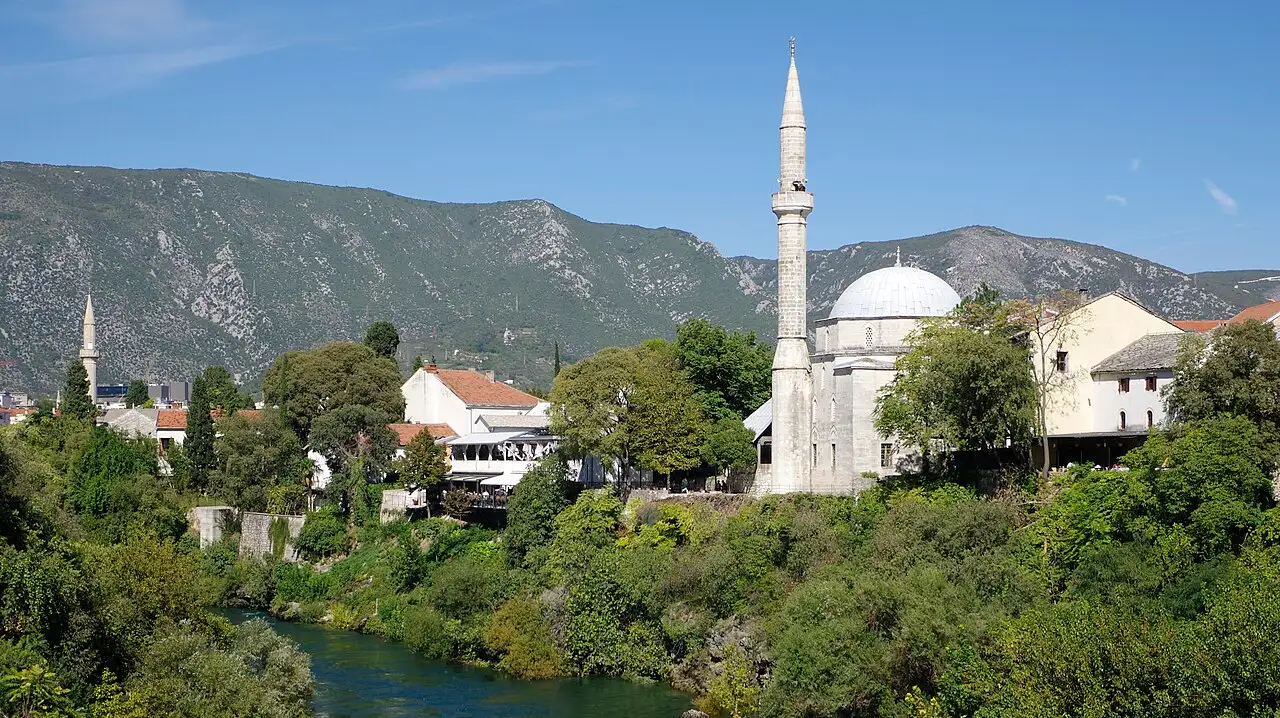
Short answer: give Sarajevo the bulk of your time, two or three nights, and treat Mostar as either a single night or a day trip. Sarajevo is bigger, deeper and much slower to exhaust: an Ottoman bazaar, an Austro-Hungarian downtown, and a 1990s siege you can still read on the walls. Mostar is smaller, and its headline sight, the rebuilt Old Bridge, can be walked in an afternoon. What Mostar has going for it’s a change of mood after dark, once the day-trip coaches pull out, and that’s the real argument for sleeping there. Below is how to split the nights by how long you’ve got, what kind of traveller you are, and the season you’re arriving in.
The one-line verdict
If you just want the call without the reasoning:
- Weight Sarajevo if you care about history, food, museums, or you want a base for day trips. It pays back a second day and often a third.
- Add a night in Mostar if you want the Old Bridge without the crowds, or you plan to use it as a base for Herzegovina, meaning the Kravice waterfalls, Blagaj and Počitelj. If the southern choice is Mostar versus Trebinje rather than Sarajevo, see Mostar or Trebinje.
- Only room for one? Pick Sarajevo. It’s the fuller city and the better story, and it feels like a capital rather than a single monument.
- Doing the classic loop down from Dubrovnik or Split? Then Mostar is the natural first stop coming inland, and Sarajevo is the finale.
Why Sarajevo swallows the days
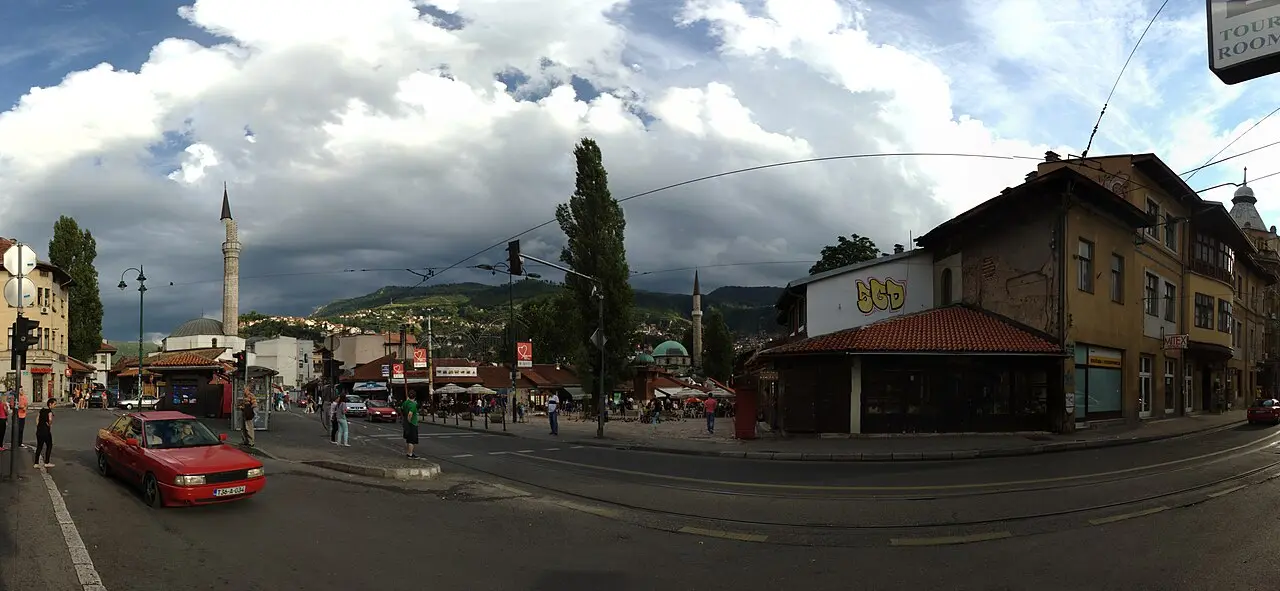
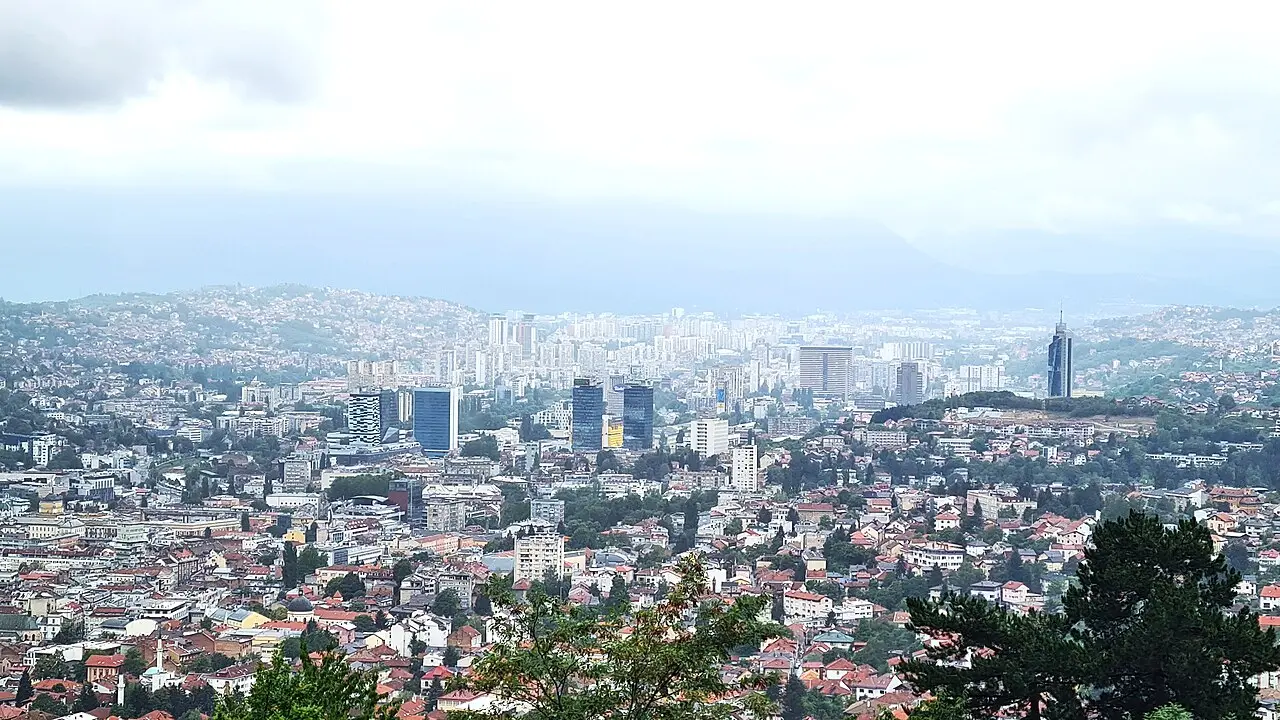
Sarajevo is really three cities stacked in one narrow valley, and that layering is why a day is never enough. You start in Baščaršija, the Ottoman bazaar of coppersmiths, tiny coffee houses and the pigeon-filled square around the Sebilj fountain. Walk west and the architecture flips within a single street to grand Austro-Hungarian facades, department stores and the yellow Vijećnica city hall. Keep going and you reach the modern, socialist-era city of tower blocks along the river.
Then there’s the recent history, which needs a half-day on its own. The siege of the 1990s is everywhere once you know to look, from the shell-scars filled with red resin, the Sarajevo Roses, to the Tunnel of Hope out by the airport and the War Childhood Museum in the centre. Give this the attention it deserves and you’ve already used your second day. Sarajevo is also the country’s transport hub, so it doubles as a base: the full list of things to do in Sarajevo runs well past what two days can hold, and there’s a spread of neighbourhoods to sleep in, which our guide to where to stay in Sarajevo breaks down.
The case for sleeping in Mostar
Here’s the honest part: you can see Mostar’s core in half a day. The Old Bridge, the Kujundžiluk bazaar of copper and carpets on either side of it, a couple of mosques with river views, and you’ve covered the postcard. That is exactly why so many people do it as a day trip, and why the town is packed shoulder to shoulder from roughly ten in the morning to six in the evening.
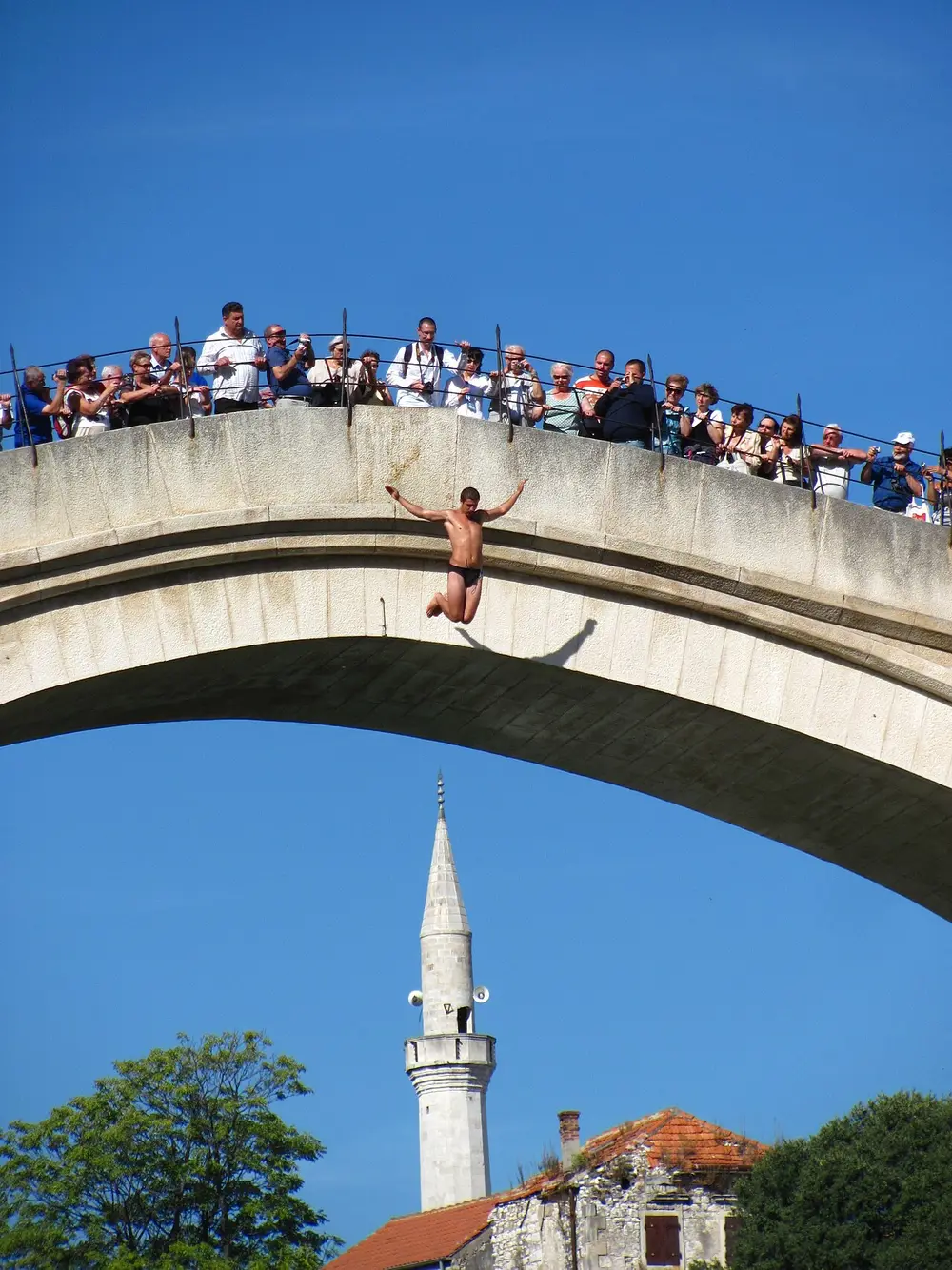
Stay the night and you get a different place. After the last coach leaves, the lanes empty out, the bridge is floodlit against the dark water, and locals reclaim the riverside for their evening stroll. Come back at breakfast and you can stand on the Old Bridge almost alone. In summer you’ll also catch the divers: young men from the local club who take money from the crowd, then leap the 20-odd metres into the cold Neretva, a tradition that goes back centuries. Watching that with a morning coffee, before the tour groups arrive, is the Mostar that day-trippers never see.
Mostar as a base for Herzegovina
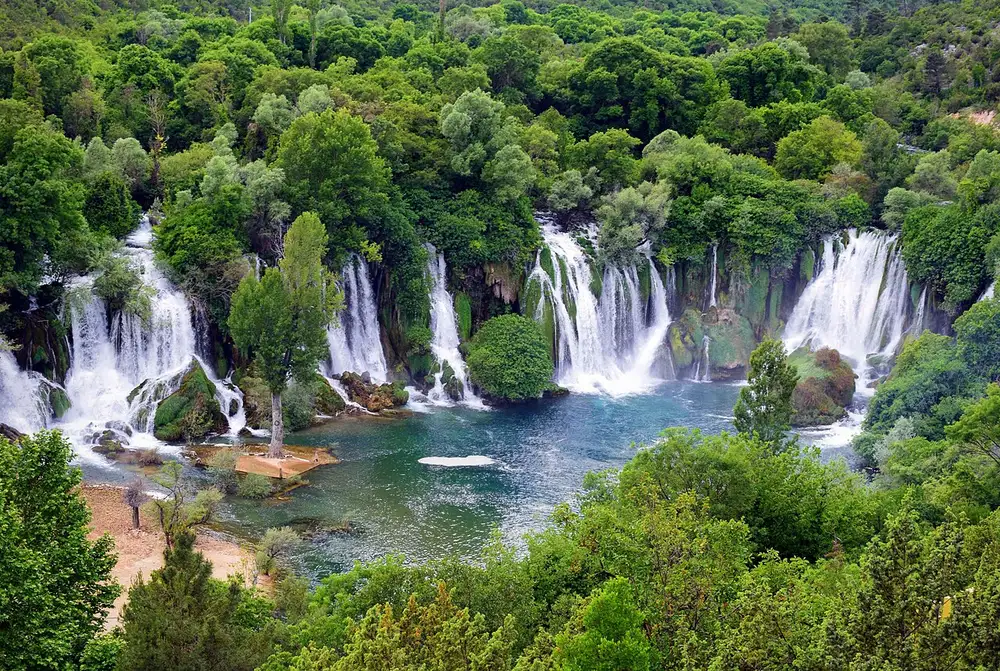
The second, stronger reason to give Mostar a night, or even two, is that it’s the gateway to Herzegovina. Everything worth seeing in the sun-baked south sits within a short drive: the Kravice waterfalls, a wide curtain of falls you can swim under; the Blagaj tekke, a white dervish house wedged against a cliff where the Buna river gushes out of a cave; and Počitelj, a stone Ottoman village climbing a hillside above the Neretva. None of these work well from Sarajevo, they’re simply too far, so if they are on your list, Mostar is where you sleep to reach them. The full run of things to do in Mostar and its surroundings is what turns a half-day into a proper two-night stop.
They are only two hours apart, so relax
One reason you shouldn’t agonise over this: the two cities are close and easy to link. The roughly 130 km between them takes about two hours by train or car, and the Sarajevo to Mostar train is one of the most scenic rides in the Balkans, threading the Neretva canyon on modern Talgo carriages. Sit on the left side heading south for the river. The catch is that it runs only about twice a day, so buses, which leave far more often, are the flexible fallback. Because the hop is short and cheap, you can weight one city and still catch the other, which is what most of these combinations do.
Match the split to your trip length
The right answer really comes down to nights, so here is how it usually shakes out. If you want the fuller reasoning behind these, our guide to how many days in Bosnia goes stop by stop.
- Two nights total: both in Sarajevo, with Mostar as a long day trip by train. You lose the empty-bridge evening, but you keep momentum.
- Three nights: two in Sarajevo, one in Mostar. This is the sweet spot for a first visit and covers both cities properly.
- Four nights: three in Sarajevo and one in Mostar, or two and two if the Herzegovina waterfalls are a priority.
- Five nights: three in Sarajevo and two in Mostar, using that second Mostar day for Kravice, Blagaj and Počitelj.
Or split it by the kind of trip you want
Nights aside, your own leanings tip the balance:
- History and culture: weight Sarajevo hard. Nowhere else in the country layers the Ottoman, the Habsburg and the 1990s war so densely.
- Photography: give Mostar the overnight. The bridge at blue hour, lit and mirrored in the Neretva with no crowds, is the shot, and you only get it if you sleep there.
- Families: base in Sarajevo, where there’s more variety, parks and museums to break up a day, and do Mostar as a day trip, since children tire of a single bridge fast.
- Food: lean Sarajevo. The ćevapi, the burek and the slow coffee ritual are at their best in the capital’s grill houses and old-town cafés.
- A short romantic break: flip it and make Mostar the anchor, with an evening on the quiet bridge and a morning at Kravice.
Or split it by season
The time of year matters more than people expect. In July and August, Herzegovina bakes; Mostar regularly pushes past 35 degrees, while Sarajevo, higher and in its valley, stays a touch cooler. In peak heat, weight Sarajevo and see Mostar early and late in the day. Spring and autumn, roughly May to June and September, suit both and are the fairest time to split evenly. In winter the choice tilts sharply to Sarajevo, which keeps its café life going and sits beside the Olympic ski mountains, while Mostar goes quiet and the divers pack away. Our guide to the best time to visit Bosnia has the month-by-month detail.
So, how should you split it?
Default to Sarajevo for two or three nights and Mostar for one, and you will get the balance right most of the time. Push more nights toward Mostar only if you specifically want the Herzegovina waterfalls, the empty-bridge evenings, or a slower, warmer, southern pace. And if the calendar forces a choice between them, take Sarajevo: it’s the deeper city, it holds the country’s hardest and most human history, and it leaves you wanting to come back for the south, which is a far better problem than the reverse. And if you’re still weighing Bosnia against a neighbour like Montenegro for the trip, our Bosnia vs Montenegro guide compares them side by side.
Photos
Read also

Before you go · 10 min read
Where to Stay in Medjugorje: Pansions & Hotels
Updated · August 25, 2026Where to stay in Medjugorje: guesthouses near St James Church, pilgrim hotels, peak dates, and whether to sleep here or day-trip from Mostar.

Before you go · 9 min read
Where to Stay in Jajce: Hotels by the Waterfall
Updated · August 23, 2026Where to stay in Jajce: old-town hotels steps from the Pliva Waterfall, lakeside rooms by the watermills, and which base suits a one-night stop.

Before you go · 11 min read
Mostar or Trebinje: Which Herzegovina Base?
Verified · August 18, 2026Mostar or Trebinje as a Herzegovina base: crowds, hotel prices, summer heat, Dubrovnik access and wine - pick the nights that fit your trip.

Before you go · 7 min read
Cash, Cards and Tipping Across the Balkans in 2026
Verified · August 15, 2026Twelve currencies, three of them the euro, and two pegged to it. What is fixed, what is a habit, and where you still need notes in your pocket.