Blagaj Tekke 2026: Visit the Dervish House by Mostar
Blagaj Tekke in 2026: the cliffside dervish house where the Buna springs from a cave, 12 km from Mostar. Entry, dress code, the boat and best time.
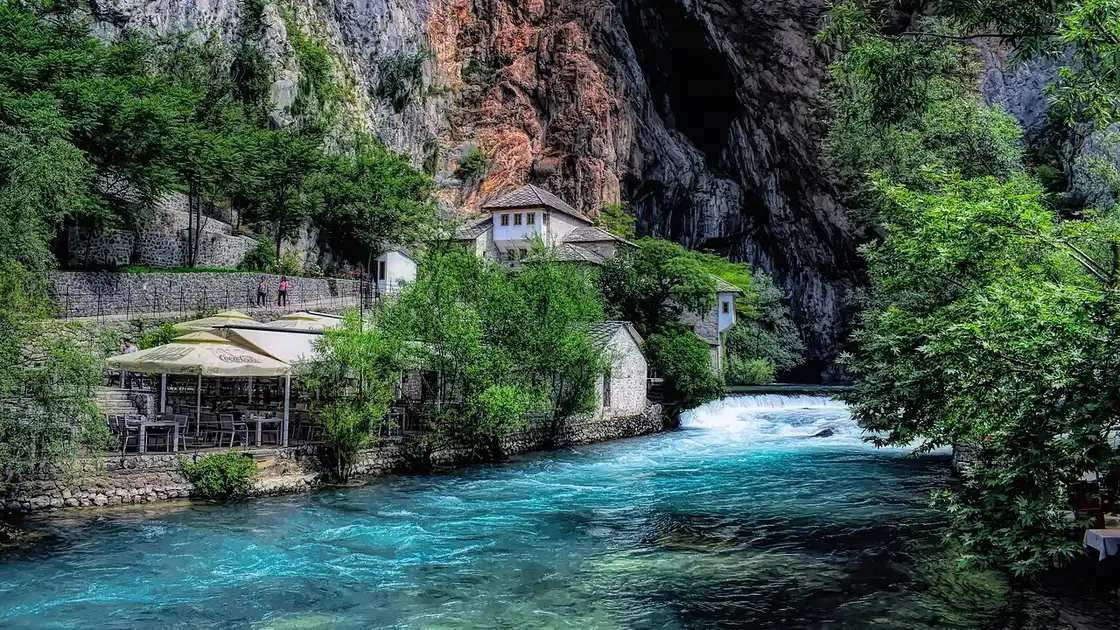
Blagaj Tekke is a small white dervish house built flush against a 200-metre limestone cliff, 12 kilometres southeast of Mostar, at the exact spot where the Buna river bursts out of a cave in the rock. It’s a working Sufi lodge, roughly 500 years old, and the single most photographed sight in Herzegovina after Mostar’s Old Bridge - you turn a corner in the village and the whole scene lands at once: green water, sheer grey wall, and the house tucked improbably beneath it. This guide covers what it actually is, how to get there from Mostar, how the entry fee and hours work, the dress code, and the two things most day-trippers miss - the boat into the cave and the ruined fortress above.
What is Blagaj Tekke?
A tekke (or tekija; in Arabic, a khanqah) is a lodge for a Sufi order - part monastery, part guesthouse, a place for retreat, for putting up travelling dervishes, and for zikr, the rhythmic devotional chanting at the heart of Sufi practice. The Blagaj lodge does all of that still: anyone who wants to attend or join a group zikr is asked to contact the lodge in advance, which tells you how seriously it’s still used. It isn’t a museum. It’s a live place of worship that happens to sit in one of the most theatrical settings in the Balkans.
Nobody can give you a firm build date. It went up in the early Ottoman period - usually placed around 1520 - on the site of an older Bogomil sanctuary, with Late-Antique remains found on the same spot, so the rock has drawn people for a very long time. The first written mention comes from the Ottoman traveller Evliya Çelebi in 1664. The order behind it shifted over the centuries; it’s linked by tradition to the Bektashi and later the Halveti dervishes, and to the wandering saint Sari Saltuk, whose tomb tradition attaches to the site - so if you see the order named flatly as one thing on a sign or a blog, treat it as shorthand for a tangled history. Today it’s a National Monument of Bosnia and Herzegovina; after being shut down following the Second World War, the Islamic Community began restoring it from the 1970s.
Inside, it’s smaller than the photos suggest. Low divans, timber ceilings, a modest prayer room, and the turbe (tombs) - you’ll be through it in ten or fifteen minutes. The building is the frame; the setting is the picture, and the setting is the river.
The Buna spring: one of Europe’s mightiest karst sources
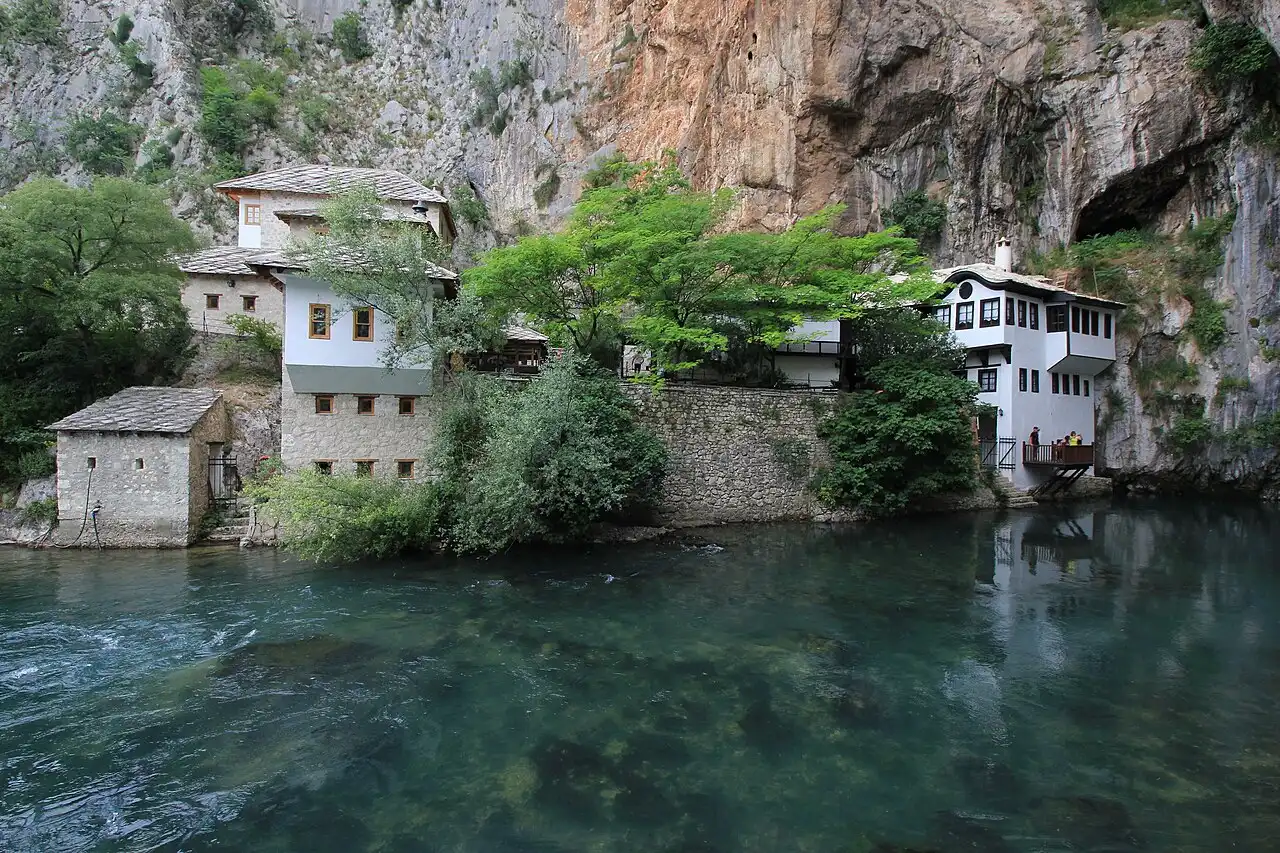
The reason the tekke is here and not anywhere else is the water. The Buna doesn’t build up from streams - it arrives all at once, welling out of a flooded cave at the foot of the cliff, already a full river. It’s one of the largest karst springs in Europe, and by peak discharge it ranks among the top five springs in the world: the flow averages around 24,000 litres a second, swings with the seasons from about 3,000 up to 120,000 (a surge in January 1971 hit an extraordinary 380,000), and holds a steady ~8°C year-round. That cold is not a detail - stand near the cave mouth in July and you feel the temperature drop. Most people treat the tekke as an outing from Mostar and leave dinner already in the city; the Mostar dining guide covers that sitting.
Where does that much water come from? It’s a resurgence: rain and snowmelt sink into the limestone plateau to the east, around Nevesinjsko Polje, where the Zalomka river disappears underground, and travel through the karst to surface here. The submerged cave behind the portal has never been fully explored. The upshot for a visitor is simple - the Buna is startlingly clear and green, and it comes out fast. Come in spring, after the snowmelt, and the spring is at its most dramatic; by late summer the flow drops and the scene is calmer but still beautiful.
Getting to Blagaj from Mostar
Blagaj sits 12 km southeast of Mostar, and getting there is easy:
- By car - about 15-25 minutes on the regional road (R-435) out of Mostar. There’s paid parking a short walk from the tekke. This is the flexible option, and the one that lets you fold Blagaj into a proper day trip.
- By bus - the city buses to Blagaj are lines 10 and 12, run by JP Mostar bus from the Sjeverni logor terminal; there is no #11, whatever older blogs tell you. The ride takes roughly 30 minutes. In summer 2026 the canton’s tourist board and Mostar bus added a promotional Sunday-only Mostar-Blagaj run, four times a day (out at 09:45, 11:30, 15:30 and 18:00, back at 10:15, 12:00, 16:00 and 18:30) at 1.80 KM (~€1) one way, from 21 June for three summer months. That was a summer promotion; outside it you’re on the regular lines, so check the current timetable and, crucially, when the last one back leaves.
- By taxi - Mostar’s firms set their own fares, about 3 KM to start plus 1.80 KM a kilometre when local reporters asked in March 2026, so agree the price for the ride before you get in. Reasonable if there are a few of you, or if you’ve missed the bus back.
There is a practical catch, though. Blagaj on its own is a half-day at most, and the sights people naturally pair it with - Počitelj and the Kravice waterfalls - aren’t linked to it by any useful public transport. If you want the classic Herzegovina loop in a day, you really want your own wheels or a driver; the bus does Blagaj and only Blagaj. The same goes for Medjugorje, the busy pilgrimage town just 20 km further southwest, which pairs easily with Blagaj if you have a car. Our Mostar guide lays out that full day-trip loop and how the pieces fit together, and a hire car is the single best way to do it (see the box below).
Entry, hours and the dress code
You pay a fee at a small ticket booth before you reach the house, and here’s the odd part: neither the lodge nor the Islamic Community council in Mostar that manages it publishes the amount anywhere online, and the figures floating around blogs and travel portals disagree with each other, so we’d rather not print one. Ask at the booth, and pay in convertible marks; euros are patchy here, so draw marks from an ATM in Mostar before you come.
The lodge’s own contact page gives its visiting hours as 08:30-20:30, every day (checked 25 September 2026). It lists one timetable for the whole year, with no separate winter hours, but that page hasn’t been updated since 2018, so if you’re planning an evening or off-season visit, ring ahead on +387 61 371 005.
Because it’s an active lodge, the dress code is real and enforced: shoulders and knees covered for everyone, and you take your shoes off before the inner prayer rooms. Women are sometimes asked to cover their heads. If you rock up in shorts or a vest, don’t panic - wraps and scarves are lent free at the entrance. Keep your voice down inside, don’t photograph people at prayer, and the whole thing stays respectful. It costs nothing to be a good guest at somebody’s place of worship, and the staff are used to visitors who get that.
What else is there: the fortress and the trout
Two things reward you for staying longer than the standard photo-and-coffee stop.
The first is Stjepan-grad, the ruined Blagaj Fortress, on the karst hill directly above the tekke. It’s a stiff 20-40 minute walk up a rough path, it’s free, and there’s usually no one at the gate - and the reward is a view straight down over the tekke, the emerald river and the whole plain from 310 metres up (about 266 metres above the spring). The history is the good part: the fort is named after Herzeg (Duke) Stjepan Vukčić Kosača, who held court at Blagaj in the 1400s - and it’s his German-styled title, Herzog, that gives Herzegovina its name. You are, quite literally, standing on the hill the region is named after. Wear proper shoes; the karst is sharp and there are no railings.
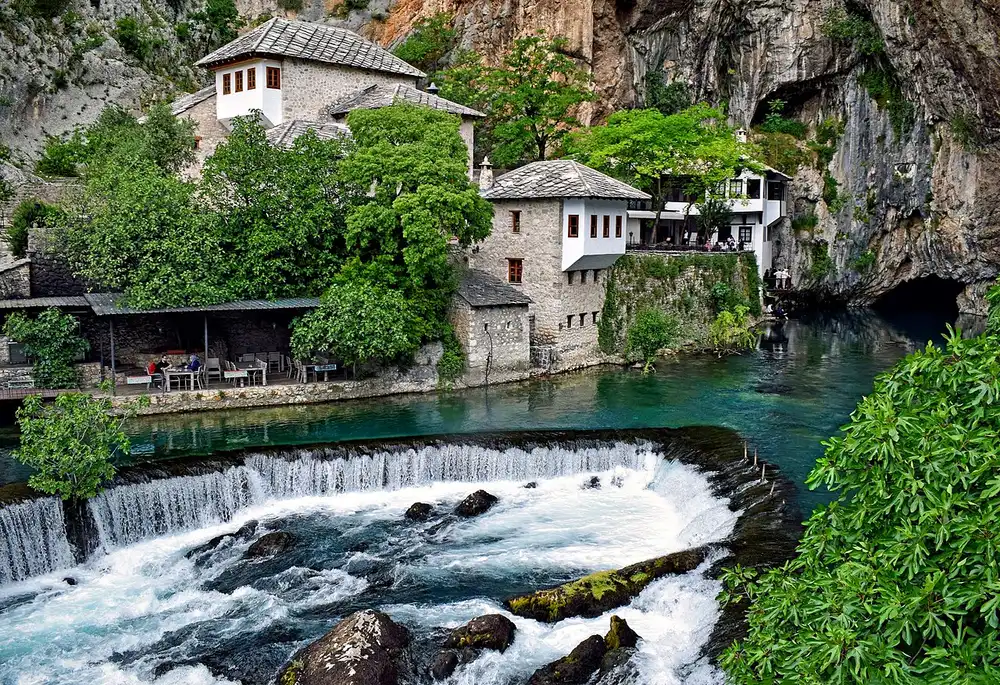
The second is the boat into the cave. Visit Blagaj runs small boats, six adults at most, from the waterside to the mouth of the spring cave - a trip of 15-20 minutes for 6 KM an adult and 4 KM a child, the prices on the operator’s own page (checked 25 September 2026). It’s touristy and brief, but slipping into the cool dark under that cliff, on water this clear, is genuinely worth the small change. The operator doesn’t publish a season or a timetable, so ask on the day whether the boats are going in rather than planning around it.
The food is the third draw. A short row of restaurants - Restoran Vrelo and its neighbours - sit right over the turquoise water and specialise in Buna river trout (pastrmka), the local dish to order. Be clear-eyed about it: these places trade on the setting first and the cooking second. Read the menu at the door before you sit down, because part of what you pay for is the view, and the food is decent rather than dazzling - but a plate of grilled trout at a table hanging over that river, with the mill wheel turning nearby, is one of those meals you remember for where you ate it. If you want a serious dinner, do it back in Mostar; if you want the view, do it here.
When to go
Blagaj rewards timing more than most sights. The terrace and the ticket queue fill up when the tour buses roll in from Mostar and the coast - usually late morning to early afternoon - so aim for early morning or late afternoon, and pick a weekday over a weekend if you can. Late in the day has a bonus: as the sun drops, the cliff face catches the light and turns gold above the water, which is when the photograph everyone comes for actually works. Midday is the opposite - flat, harsh, and the terrace at its most crowded.
For season, spring is the sweet spot: the snowmelt has the spring roaring, the light is soft, and it’s before the summer crush. Autumn is quieter and lovely too; ask on the day whether the boat is running. High summer is hot and busy; the lodge’s own site lists the same 08:30-20:30 whatever the month, so the season changes the crowd rather than the opening hours on paper. For the wider month-by-month picture of visiting Herzegovina, see our trip-planning guides, and if you’re driving the region, the car rental section covers hiring and the roads down here. Give Blagaj a couple of unhurried hours rather than a ten-minute stop, climb to the fortress, and it will likely be the quietest, loveliest hour of your whole Herzegovina trip.
Photos
On the map
The map loads on click - to keep the page lightweight.
The map didn’t load. Check your connection and refresh the page.
Admission and opening hours
- Admission price
- Entry fee paid at the booth before the house; neither the lodge nor the Islamic Community council in Mostar that runs it publishes the amount online (checked 25 September 2026), so carry convertible marks in cash and ask at the booth.
- Opening hours
- 08:30-20:30 every day, per the lodge's own contact page (checked 25 September 2026). It gives one timetable for the whole year and no winter hours, but the page was last updated in 2018, so ring +387 61 371 005 before a late or off-season visit.
Active Sufi lodge: to attend or join a group zikr, the lodge asks you to contact it in advance. Dress code enforced: shoulders and knees covered, shoes off in the prayer rooms; wraps and scarves are lent free at the entrance. The boat into the cave (6 KM adults, 4 KM children on the operator's page) has no published season - ask on the day.
Details checked: September 25, 2026
Distance
- Mostar ≈12 km · ~15-25 min by car Regional road R-435 southeast; paid parking near the site. City buses 10 and 12 (JP Mostar bus) run from the Sjeverni logor terminal, about 30 min; in summer 2026 a promotional Sunday-only Mostar-Blagaj service added four runs a day at 1.80 KM one way, from 21 June for three months. Mostar taxis price freely, about 3 KM to start and 1.80 KM a km when local reporters asked in March 2026, so agree the fare before you set off.
- Dubrovnik ≈143 km · ~2.5-3 h by car One border crossing since the Pelješac Bridge opened; EU/EEA/Schengen citizens can use a national ID card, others need a passport. Most people pair it with Mostar rather than driving down just for Blagaj.
Read also

What to see · 15 min read
Via Dinarica Bosnia: Huts, Stages & Logistics
Verified · September 12, 2026Plan the Via Dinarica White Trail in Bosnia: 12 stages, 334 km, hut booking, trailheads, closures and three workable section packages.

What to see · 10 min read
Jablanica: Neretva Bridge & Roast Lamb Stop
Verified · September 4, 2026Jablanica on the Sarajevo-Mostar road: Battle for the Wounded museum (5 KM), the 1943 bridge, roast lamb lunch. Hours, parking, how long to stop.

What to see · 8 min read
Prokoško Lake: Shepherd Huts High Above Fojnica
Verified · September 3, 2026Prokoško on Vranica at 1,636 m: katuni, gate prices for foreigners, no swimming, and the 2026 asphalt climb from Fojnica.

What to see · 11 min read
Franz Ferdinand's Sarajevo: Latin Bridge & 1914 Site
Verified · August 29, 2026The Latin Bridge corner in Sarajevo where Franz Ferdinand was shot in 1914: what happened, the Museum of Sarajevo 1878-1918 inside, hours and tickets.