Počitelj: Bosnia's Ottoman Hilltop Town
Počitelj, the Ottoman hilltop town on the Neretva south of Mostar: the Kula fortress, the 1563 mosque, the clock tower, how to visit and the day trip.
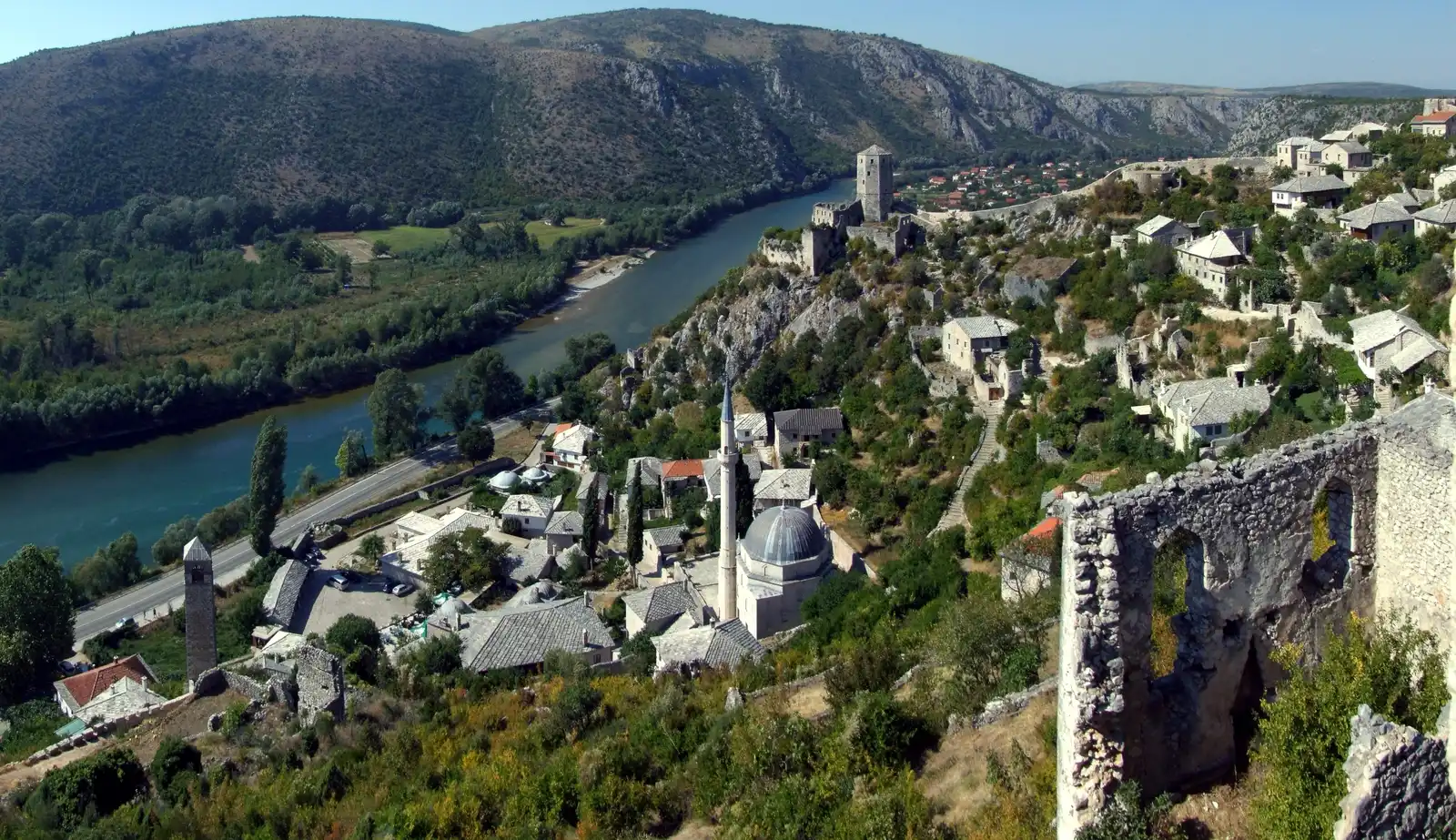
Počitelj is a walled Ottoman town that climbs a limestone cliff above a bend in the Neretva, about 30 kilometres south of Mostar - a stack of pale stone houses, a domed mosque and a silo-shaped fortress tower, all frozen more or less as the 17th century left them. It’s on the old road down to the coast, it’s free to walk into, and it’s the kind of place that stops a car: you round the river bend and the whole thing rises up the hillside in front of you. This guide covers what you’re looking at - the fortress, the mosque, the clock tower - how to get here from Mostar, how long to give it, and how it slots into the classic Herzegovina day-trip loop. Give it a half day from Mostar and you’re back in time for lunch spots in Mostar.
What Počitelj actually is
Think of it as a complete little Ottoman kasaba - a fortified market town - preserved on a hillside. It grew inside a set of medieval walls that step up the cliff to a citadel, with a mosque, a clock tower, a religious school and rows of stone houses threaded together by steep cobbled lanes and stairways. Because it was abandoned as a working town long ago, almost nothing modern intrudes; walking it is about as close as you’ll get to stepping into an Ottoman frontier settlement.
The setting is half the point. The houses are built from the same grey limestone as the cliff, roofed in stone slabs, and the whole ensemble sits in a natural amphitheatre with the river curling below and karst hills rising behind. Fig, grape and pomegranate trees grow out of the terraces between the walls - a detail you’ll be reminded of at the fruit stalls on the way up. It’s compact: the entire town is a fifteen-minute climb from bottom to top.
A quick history: medieval fort, Ottoman town
The dates need a little care, because the record is thin. The fortified town was probably founded in the late 14th century - tradition credits the Bosnian king Tvrtko I around 1383, who is said to have raised the first tower to control the merchant traffic up the Neretva valley - though the earliest firm written mentions only come in the 1440s. For a stretch in the 1460s it was a Hungarian border stronghold under Matthias Corvinus, and heavily fortified.
Then, in 1471, the Ottomans took it, and Počitelj became what you see today. Over the next couple of centuries - roughly to 1698 - they built it out with all the trappings of an Ottoman town: the mosque, a mekteb and medresa (schools), an imaret (charity kitchen), a hamam, a han (inn) and the clock tower. It sat on the main caravan road and mattered.
Its decline was long and its 20th century was brutal. It lost its purpose under Austro-Hungarian rule after 1878 and slowly emptied, and it was badly damaged in the 1990s war, when the population was expelled and monuments were wrecked. In 1996 the World Monuments Fund listed it among the world’s 100 most endangered sites, and a restoration programme has been rebuilding it since 2000. That’s worth knowing as you walk: this is a recovered place, carefully patched back together, not a fairy tale that survived untouched. Today it’s on the UNESCO tentative list and slowly repopulating.
The Kula: fortress and the climb
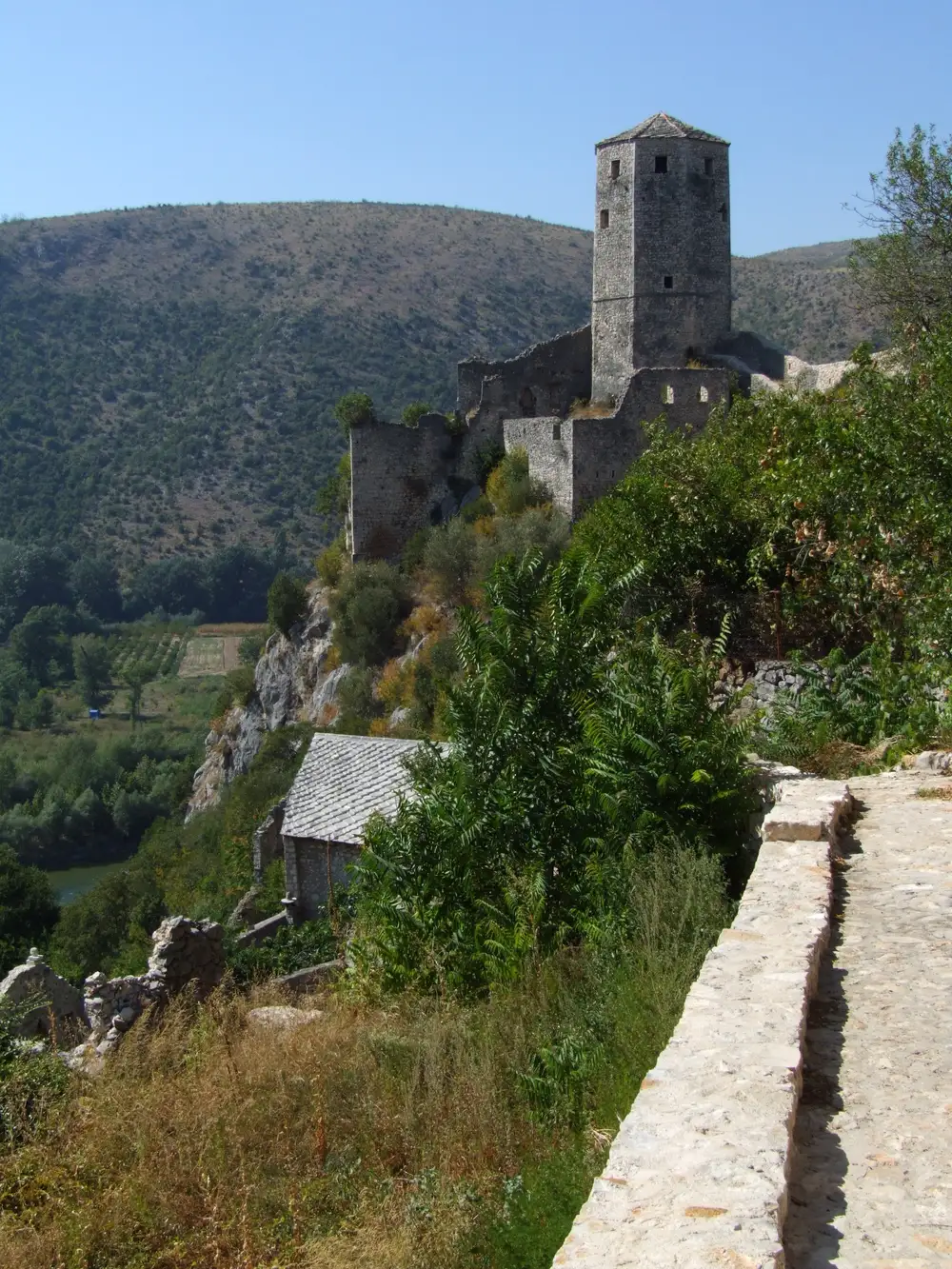
The thing crowning the whole town is the Kula - a tall, cylindrical, silo-shaped keep at the highest point of the citadel, ringed by ruined walls and towers. It’s the oldest part, the one tradition ties to Tvrtko I, and it’s what you climb for. Follow the lanes and stairways up through the town and you reach the fortress at the top; the reward is the view everyone comes for - the Neretva bending far below, the road threading the valley, the mosque dome and minaret directly beneath you, and the karst hills stretching away.
Fair warning: the way up is steep, the steps and stone are worn and uneven, and there are no railings or safety barriers around the walls and tower. Wear proper shoes rather than sandals, watch your footing near the edges, and take it slowly in the heat - there’s very little shade on the climb.
The mosque and the clock tower
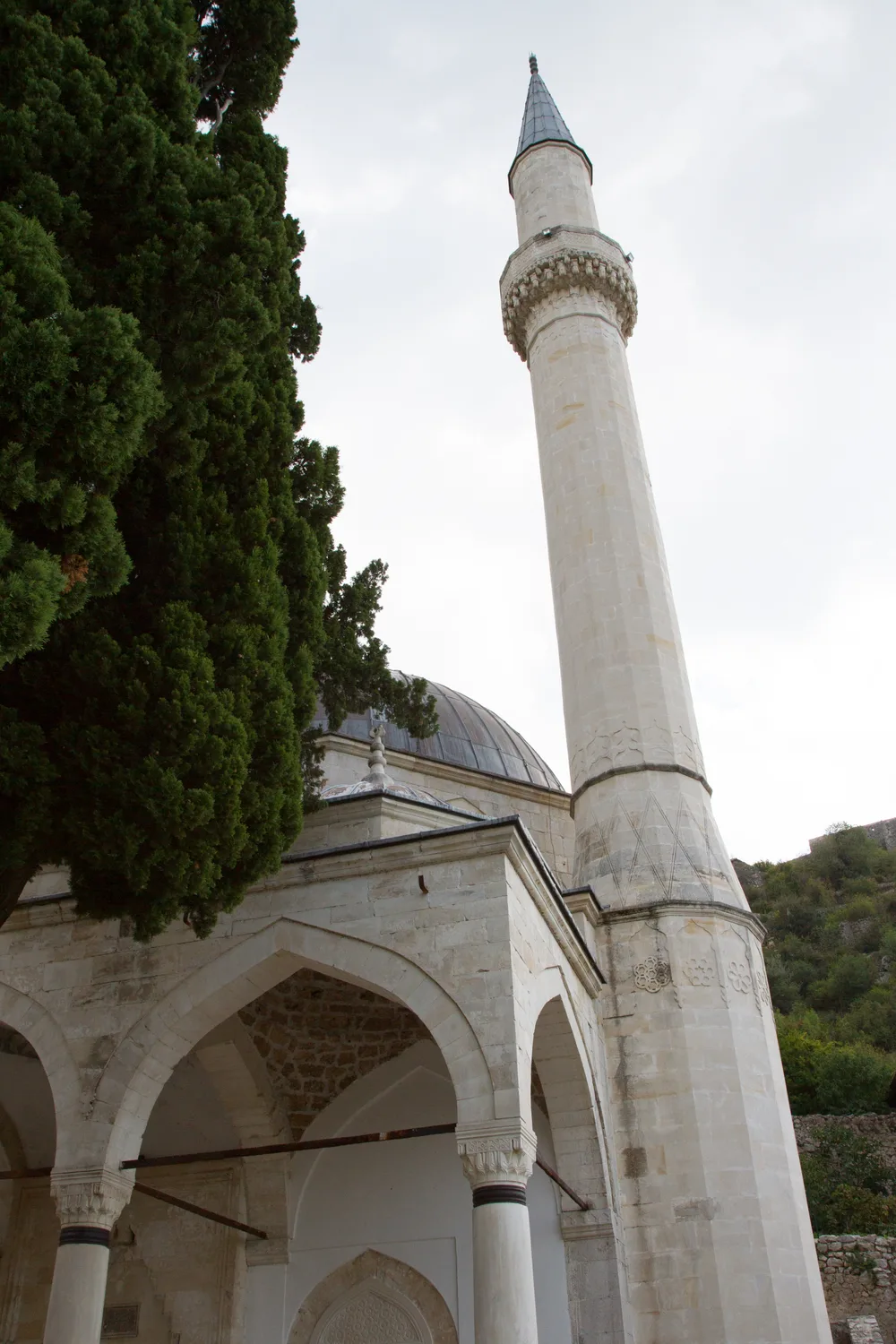
Halfway up sits the town’s finest building, the Šišman Ibrahim-Pasha Mosque. It was built in 1563 by a man recorded as Hadži Alija, son of Musa - which is why you’ll also see it called the Hajji Alija Mosque - and it later took the name of Šišman Ibrahim-Pasha, who restored and endowed it in the 17th century. It’s a classic single-room domed Ottoman mosque, one of the best of its kind in the country, with a slender stone minaret and a small arched portico; it’s known locally for its acoustics, and it was itself restored in 2002 after war damage. You can usually step inside outside prayer times - dress modestly, take your shoes off, keep it quiet, and a small donation is a polite gesture.
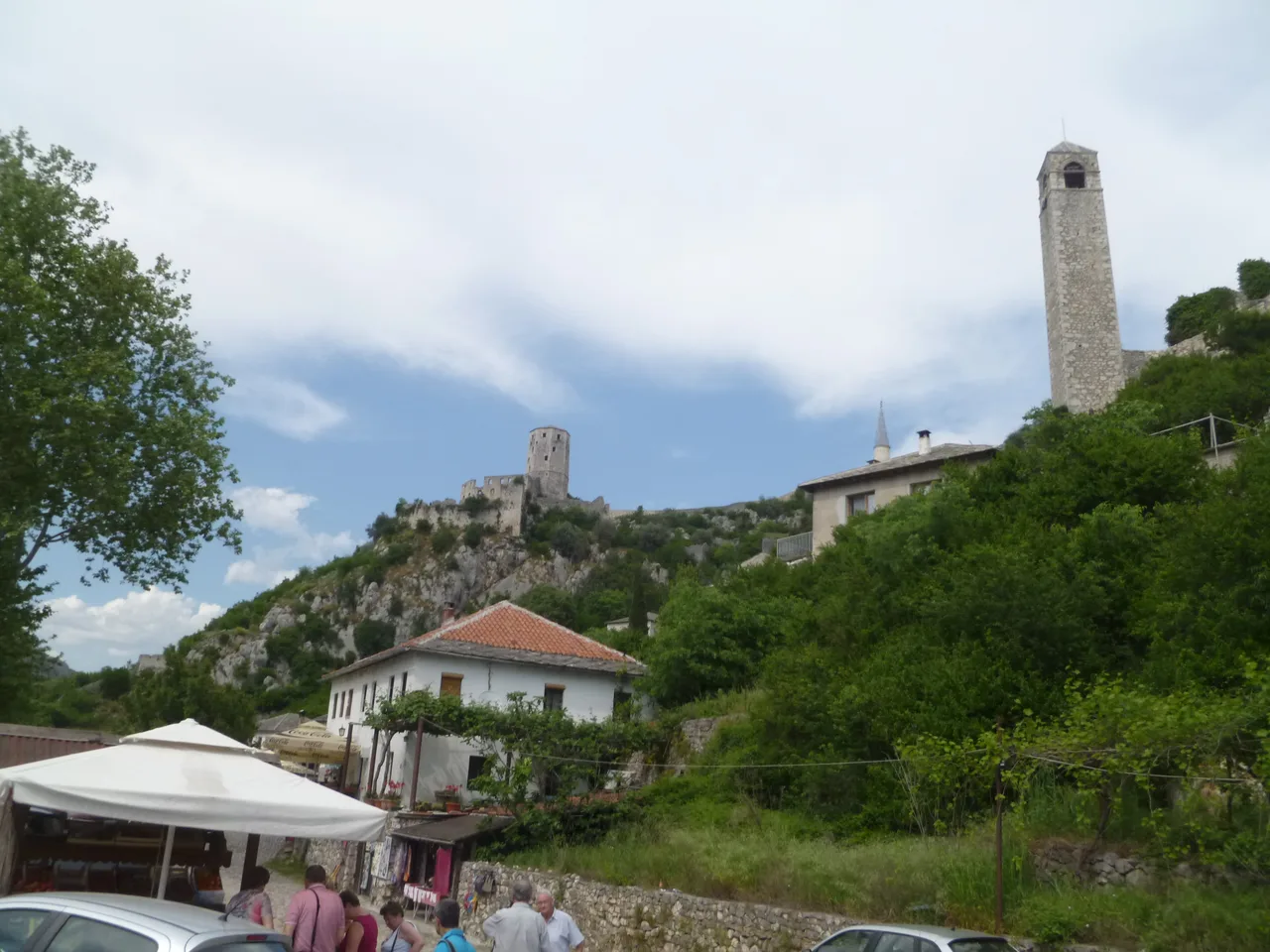
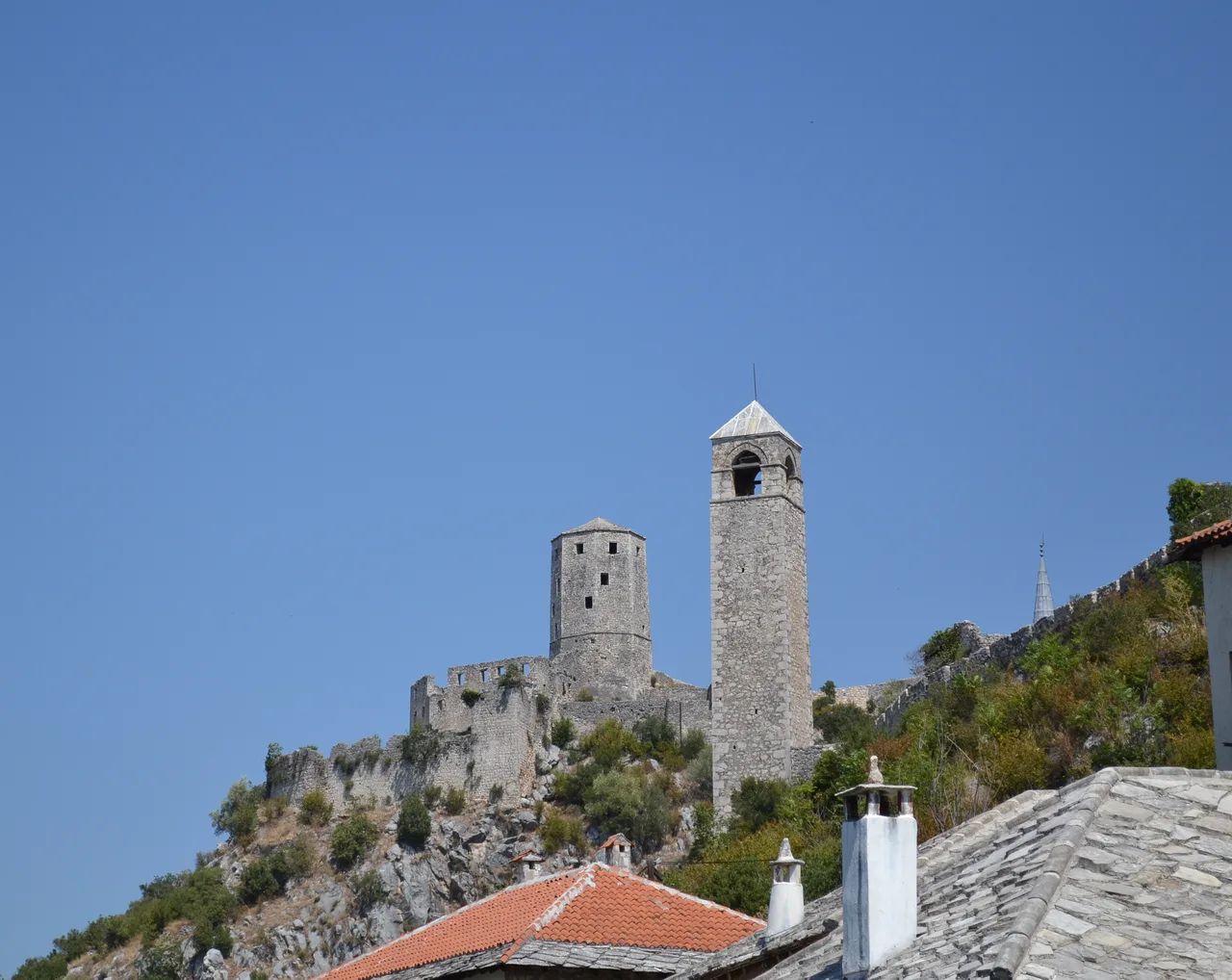
Standing apart from the Kula, closer to the river and the southern walls, is the Sahat-kula - the Ottoman clock tower, a square stone shaft that’s one of Počitelj’s defining silhouettes. Between the two towers you’ll also find the old medresa by the mosque, and, lower down, the Gavrankapetanović House, a grand late-16th-century Ottoman residence. That last one has a quiet claim to fame: from 1961 to 1975 it housed an artists’ colony, and Počitelj’s light and stone drew painters here for years - which, once you’ve seen it, makes complete sense.
How to get to Počitelj from Mostar
Počitelj sits about 30-32 km south of Mostar on the M17, the main road down the Neretva toward the coast, and getting here is easy enough with wheels and fiddly without them.
- By car - roughly 30 minutes down the M17. There’s free parking at both the bottom and the top of the site, so you can save the climb or not, as you like. This is the sensible option and the one that lets you build a proper day around it.
- By bus - buses running Mostar to Čapljina stop on the road at Počitelj, but neither the Mostar bus station nor the buskarta.ba booking site listed the run or its fare when we checked in October 2026. Ask at the ticket window for the times and the fare before you rely on it - and above all for when the last one back leaves.
- By taxi - Mostar taxis price freely, about 3 KM to start plus 1.80 KM a kilometre when local reporters asked in March 2026, so agree the fare before you set off; workable if the bus times don’t fit, or if there are a few of you splitting it.
There’s no entry fee - walking into the town, and into the mosque, is free, and there’s no ticket for the citadel. You’ll spend a little on fruit or juice from the stalls and, ideally, leave a small donation at the mosque, but that’s it.
How long to spend, and when to go
Give it an hour and a half to two hours to do it justice - the climb to the fortress, the mosque, a wander through the lanes, and time to just sit and take in the river view. Tour groups routinely blitz Počitelj in twenty or thirty minutes, which is exactly why arriving on your own schedule pays off: linger past their photo stop and you often get the upper town largely to yourself.
On timing, the enemy here is heat as much as crowds. This is southern Herzegovina, and in July and August it bakes - the exposed stone climb is punishing at midday, with no shade. Aim for morning or late afternoon, and favour spring and autumn, when it’s cooler and greener; autumn has the bonus of pomegranate season, when the fruit is ripe on the terraces and pressed fresh at the stalls. A cup of tart, cold pomegranate juice at the top of that climb is a small Počitelj ritual worth having.
Počitelj on the Herzegovina day-trip loop
Most people should see it not on its own, but as one stop on a loop. Počitelj is one of the “three pearls” of a Herzegovina day trip out of Mostar, alongside the Blagaj Tekke - the dervish house at the source of the Buna - and the Kravice Waterfalls, the region’s great swimming hole. All three lie within a short drive of each other south of the city, and Počitelj sits right on the road between Mostar and Kravice, which makes it the natural mid-loop stretch of the legs. Further south down the same valley road, the reed channels and boat safari of Hutovo Blato add a wetland to the day if you have the hours to spare. Turn east instead of south and you are on the Stolac road, where the Radimlja necropolis puts a field of carved medieval stecci within half an hour of Počitelj.
The snag is that no useful public transport strings the three together - the bus does one at a time and awkwardly. To do the loop properly in a day you really want your own car or a private driver, which lets you time each stop around the light and the crowds rather than a timetable. Our Mostar city guide lays out how the pieces of that day fit together, and a hire car is the single easiest way to link them (see the box below). Do it that way and you trade a rushed coach halt for what Počitelj is meant to be - a slow, quiet hour in a 500-year-old town above the river.
Photos
On the map
The map loads on click - to keep the page lightweight.
The map didn’t load. Check your connection and refresh the page.
Read also

What to see · 15 min read
Via Dinarica Bosnia: Huts, Stages & Logistics
Verified · September 12, 2026Plan the Via Dinarica White Trail in Bosnia: 12 stages, 334 km, hut booking, trailheads, closures and three workable section packages.

What to see · 10 min read
Jablanica: Neretva Bridge & Roast Lamb Stop
Verified · September 4, 2026Jablanica on the Sarajevo-Mostar road: Battle for the Wounded museum (5 KM), the 1943 bridge, roast lamb lunch. Hours, parking, how long to stop.

What to see · 8 min read
Prokoško Lake: Shepherd Huts High Above Fojnica
Verified · September 3, 2026Prokoško on Vranica at 1,636 m: katuni, gate prices for foreigners, no swimming, and the 2026 asphalt climb from Fojnica.

What to see · 11 min read
Franz Ferdinand's Sarajevo: Latin Bridge & 1914 Site
Verified · August 29, 2026The Latin Bridge corner in Sarajevo where Franz Ferdinand was shot in 1914: what happened, the Museum of Sarajevo 1878-1918 inside, hours and tickets.