Kravice Waterfalls: Complete Visiting Guide (2026)
Kravice Waterfalls, Herzegovina: entry fee, swimming season and water temperature, how to get there from Mostar, the boat, and when to beat the crowds.
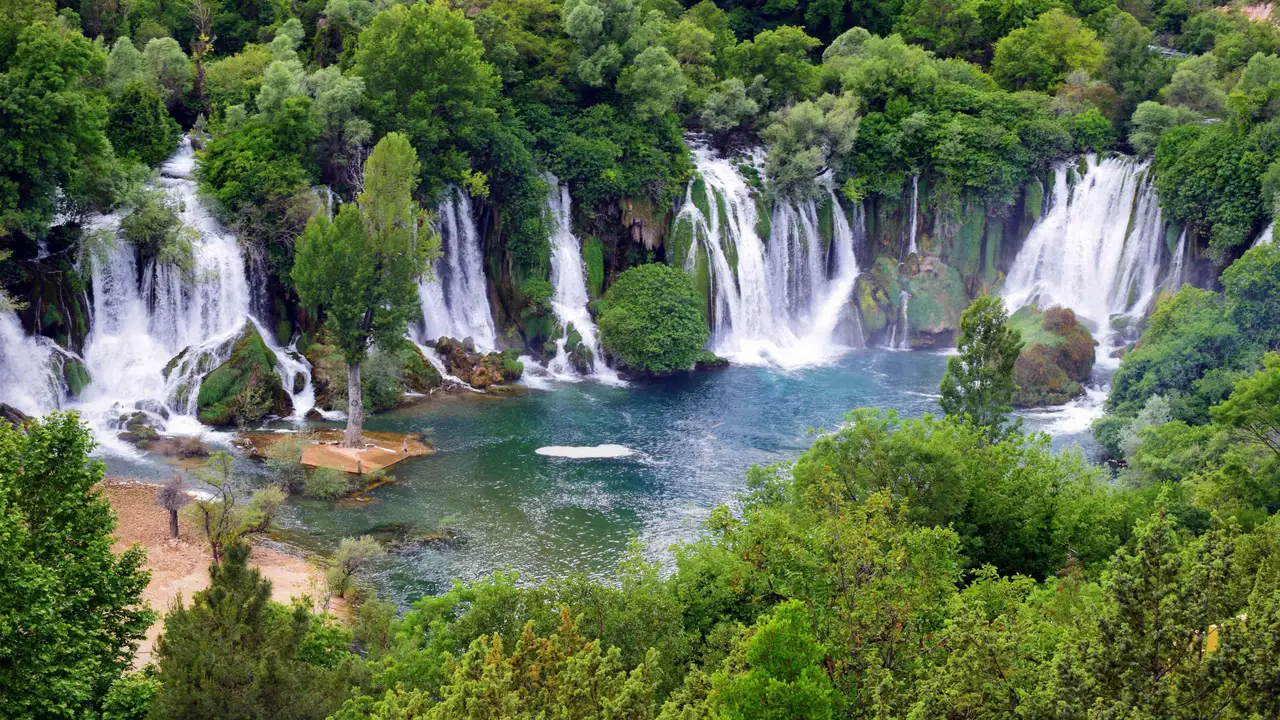
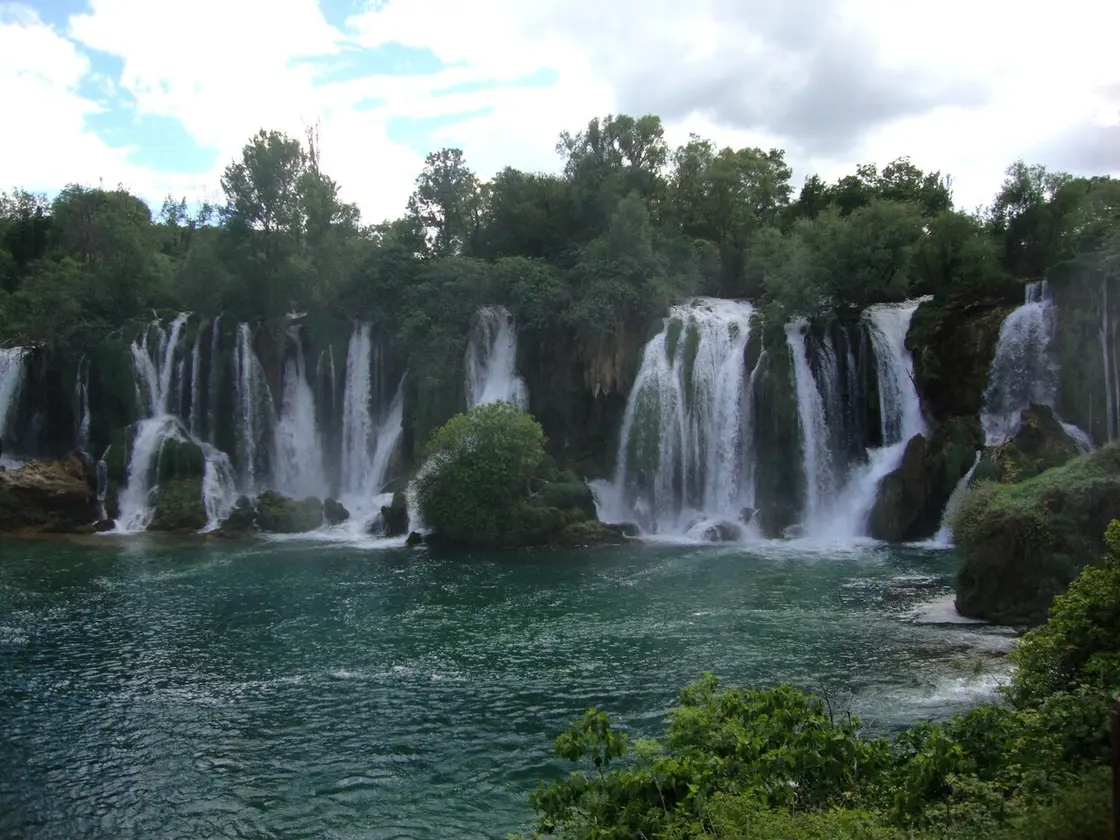
Kravice is a broad, horseshoe-shaped wall of waterfalls on the Trebižat river in southern Herzegovina - about 28 metres high and roughly 120 metres across - that pours over a curved travertine ledge into a wide green pool you can actually swim in. It sits some 40 kilometres south of Mostar and 10 south of Ljubuški, and in high summer it turns into the region’s best swimming hole. Entry is 20 KM (around €10) year-round, swimming runs roughly June to September, and you really want your own car to get here. This guide covers the fee, the water, the boat, how to arrive, and - the part that makes or breaks the day - when to come so you’re not sharing it with a thousand other people.
What Kravice actually is
Most waterfalls are a single drop. Kravice is a whole amphitheatre of them: dozens of separate cascades spilling side by side over a semicircular lip of tufa - a soft, porous limestone the river lays down out of its own mineral load, still slowly building the ledge today. The Trebížat spreads across the top and comes down as ribbons and curtains rather than one thundering column, which is exactly why the scene photographs the way it does - green moss on grey rock, white water everywhere, a turquoise basin at the bottom. The pool at the base is about 120 metres wide, the falls around 28 metres at their tallest.
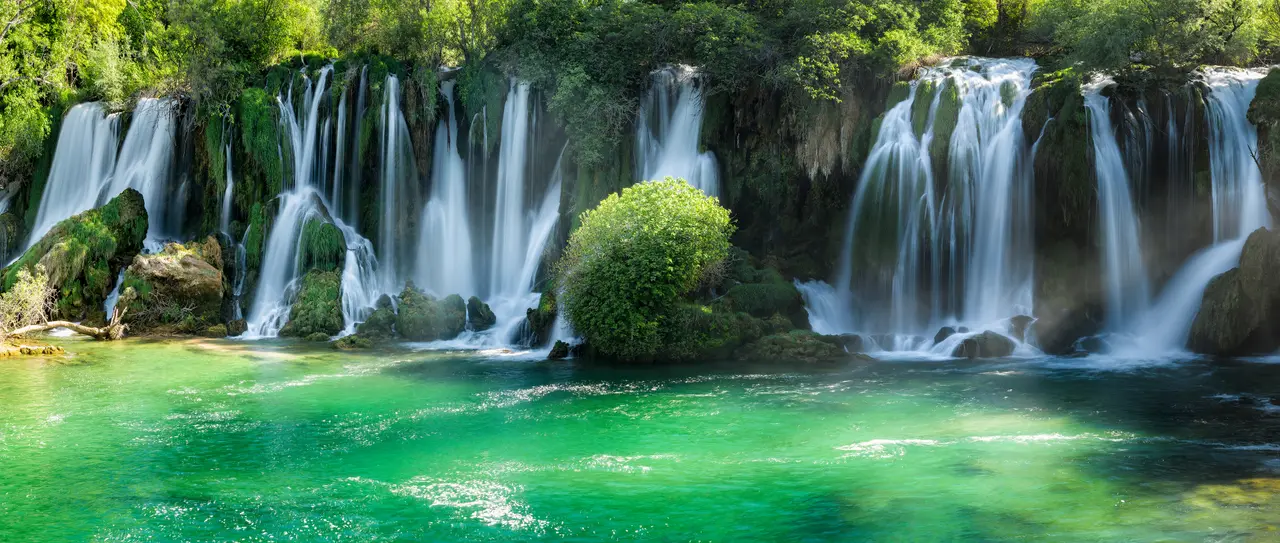
You’ll see it spelled both ways. Kravica (singular) is the official local name - Vodopad Kravica or Slap Kravica - while Kravice (plural) is what most English guides and tour operators use, presumably because it looks like a lot of waterfalls, which it is. Same place; don’t let the two spellings throw you.
Can you swim at Kravice, and when?
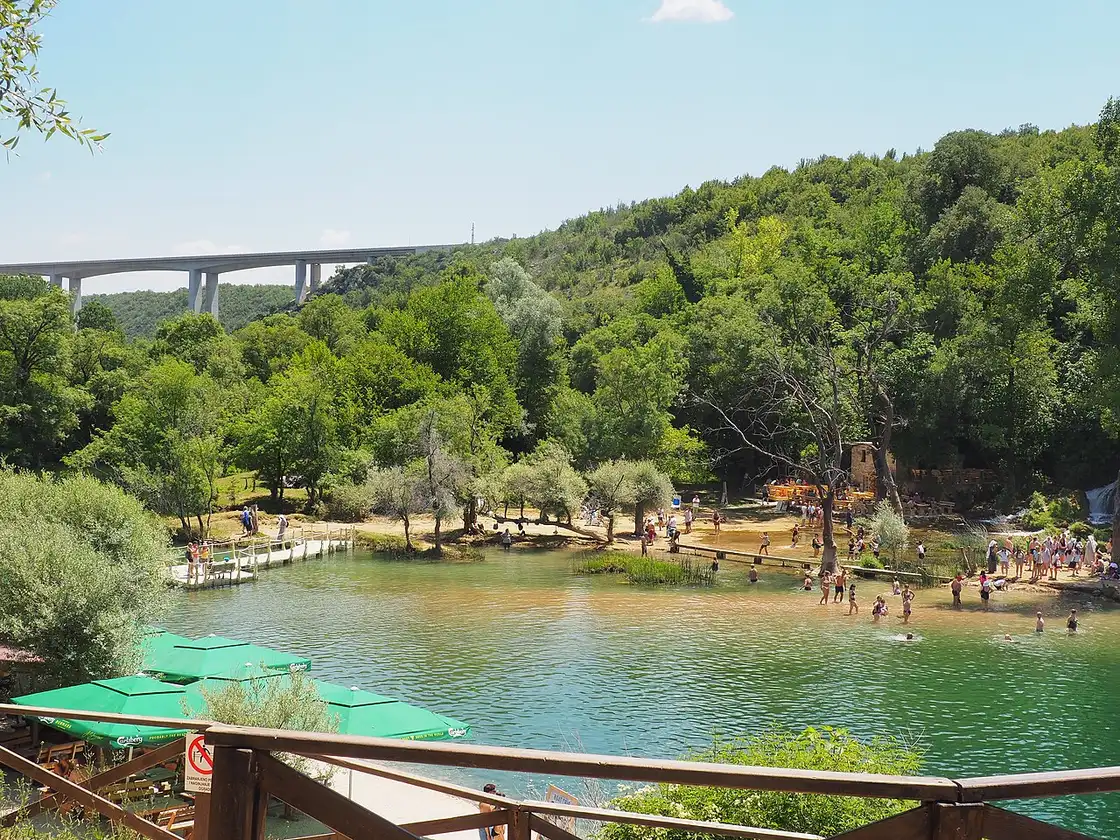
Yes - and that’s a big part of the appeal. Kravice is one of the few waterfalls in Europe where you’re still allowed to swim right at the base, and on a hot Herzegovina afternoon it’s glorious. There’s a roped-off shallow zone with a sandy entry near the restaurants, and deeper water further out toward the falls themselves.
The practical swimming window is roughly June through September. The pool is technically ice-free from about April, but the water is fed by a spring some 30 km upstream and stays cold: figure around 17°C in June, 19°C in July, 20°C in August, dropping back to about 17°C by late September. In other words, it never gets properly warm - bracing is the honest word - but under a 35°C sun it’s the best feeling in the country. There are no lifeguards, the pool is unsupervised, and the current near the cascades is stronger than it looks, so keep children in the shallow end and don’t swim right up under the falling water.
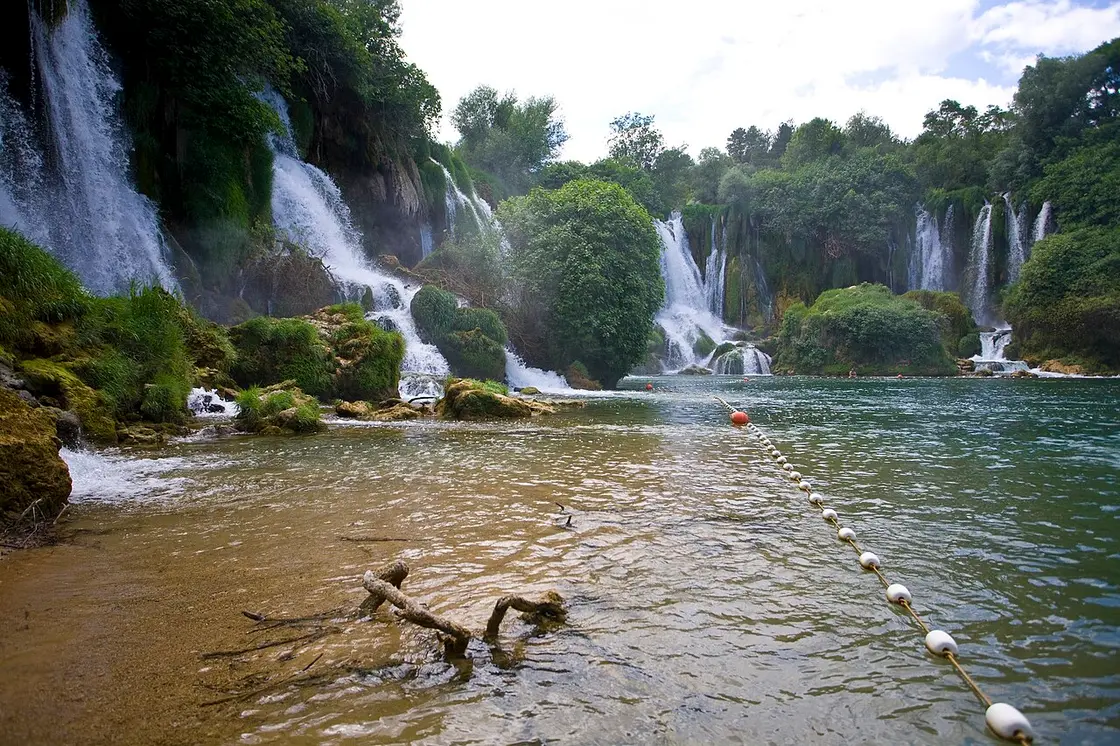
Bring water shoes if you have them - the bottom is a mix of sand, pebbles and tufa shelves, and the rock can be slippery. A towel, and a bit of cash for a drink afterward, and you’re set.
Entry fee, opening hours and parking
Entry is 20 KM per adult (about €10), and the ticket applies year-round. Groups of students aged 7-18 pay 10 KM (5 KM if you’re resident in Bosnia and Herzegovina), and children under seven are free. It’s a single fee at a staffed gate, so there’s no dodging it in season - the trick is timing your visit, not skipping the ticket.
Two things to get right before you go:
- Bring cash, in convertible marks. Card terminals at the gate are notoriously unreliable, and euros aren’t dependably accepted. Draw KM from an ATM in Mostar or Ljubuški first. Full-day re-entry is allowed, so you can nip out to the car and come back.
- Parking is charged - about 3 KM per started hour, or a 6 KM day ticket for a car, in the lot on the plateau above the falls. (A few older guides call parking “free”; the official site lists a fee, so budget for it.)
On the hours, the official site gives a 07:00 opening year-round with a seasonal closing time - around 22:00 in high summer, down to roughly 17:00-18:00 in winter. Older blogs quote other figures, so if you’re banking on a sunrise or after-dark visit, confirm the current hours before you go.
From the entrance it’s a short walk and a set of steps down into the basin; it’s steep in places and not step-free, so it’s worth knowing if mobility is a concern.
The boat, the restaurants and the rest
Once you’re down at the water, there’s more to Kravice than the swim. Small boats run across the pool and a short way downriver in season: a standard trip of about 20 minutes costs roughly €5 a head, and a longer 40-minute run down toward the smaller falls known as Mala Kravica (“Little Kravice”) is about €10, peak season only. It’s brief and touristy, but drifting out under that curtain of water, on a river this clear, is worth the small change. There are also paddle boats to rent, plus changing rooms and toilets near the swimming area.
Three restaurants sit around the base and trade, frankly, on the setting first - you’re paying for a table over the water, not for fine dining. They do grilled trout from the Trebížat, čevapi, salads and the usual Bosnian grill; mains run roughly 18-25 KM (€9-13). It’s decent rather than dazzling, but a plate of trout with your feet almost in the pool is a fair trade. There’s a café up by the car park too.
How to get to Kravice from Mostar
Be warned: there’s no useful direct public transport from Mostar to the falls, so getting here comes down to a car, a driver, or a bit of a scramble.
- By car - about 40-45 km and 45 minutes to an hour south of Mostar. The quick way is the R424; the slower line down the M17 and M6 adds 15-20 minutes but rolls past the Ottoman hilltop town of Počitelj and near Blagaj, which is why so many people fold all three into one loop. Roads down here are quiet and easy to drive.
- By bus, the workaround - buses run to Ljubuški, about 7 km from the falls (roughly €5-8, 30-40 minutes), and from there you take a taxi the last stretch for about €15-20. Doable, but fiddly, and you’re at the mercy of return times.
- By taxi or tour - Mostar taxis price freely, about 3 KM to start plus 1.80 KM a kilometre in town when local reporters asked in March 2026, but a run out to the falls is priced by agreement and can include the empty drive back, so agree a fixed return fare, waiting time included, before you set off; an organised day trip is about €40-70 per person; a private transfer is around €80-120 for the vehicle.
From the Croatian coast, Kravice is about 130 km / 2.5 hours from Dubrovnik (one border crossing since the Pelješac Bridge opened - EU/EEA/Schengen travellers can use a national ID card, others need a passport for Bosnia), and it’s a long ~3 hours from Sarajevo. It sits right on the Dubrovnik-Mostar corridor, so it is the easiest stop to add to that run: our Dubrovnik to Mostar guide covers the drive and the border, and the Dubrovnik guide on our sister Croatia Guidebook covers that end.
The takeaway: Kravice is the anchor of the classic Herzegovina day-trip loop, and the single best way to do it - Blagaj, Počitelj and the falls in one relaxed day - is with your own wheels. Our Blagaj Tekke guide and the Mostar guide lay out how the pieces fit together; a hire car or a private driver for the day pays for itself in freedom (see the box below).
When to go: spring flow vs summer swim
This is the decision that shapes your visit, because Kravice is genuinely two different places depending on the month.
Come in spring - roughly March to May, after the snowmelt and rains - and the falls are at full power: the whole ledge runs, the spray drifts across the basin, and the noise is several times what you get later in the year, with the dry Herzegovina hills turned bright green around it. It’s the most dramatic Kravice, and the most photogenic. The trade-off: the water is far too cold to swim, and the pool can run high and murky.
Come in high summer - July and August - and the flow is gentler, the pool is calm and swimmable, and the place is at its warmest. It’s also at its most crowded: this is a hugely popular spot, drawing hundreds of thousands of visitors a season, and midday in August the basin and its car park are heaving.
The sweet spot for most people is the shoulder of summer - June and September - when it’s warm enough to swim but before or after the peak crush. Whenever you come, time of day matters more than anything: the tour buses pour in from about 11:00 to 15:00, so aim to arrive before 11 or after 17:00, and pick a weekday if you can. Early morning, with the light still soft and the pool half to yourself, is when Kravice is at its absolute best.
Practical tips
A few last things worth knowing:
- Money. Prices here - the gate, the boat, parking, lunch - all run on convertible marks (KM/BAM), pegged at about 1.96 to the euro. Euros are patchy and the card machines flaky; carry cash. Our trip-planning guides cover the wider month-by-month picture of visiting Herzegovina.
- Wear real shoes. The path down is steep and the tufa around the pool is slippery when wet; flip-flops will let you down. Water shoes for the swim are ideal.
- Give it half a day. Kravice rewards more than a photo-and-go: a swim, a wander around the basin, a slow lunch over the water, maybe the boat. Pair it with Blagaj and Počitelj and you’ve got one of the best days in the country. Want the whole southern circuit timed out, Kočuša and Medjugorje included? Our Herzegovina highlights loop lays out the order and the clock, and it’s worth knowing your Kravice ticket already covers Kočuša.
- Want the falls without the swim? Bosnia’s other headline waterfall drops through the middle of a medieval town rather than into a swimming pool - see our Jajce guide for the town-in-a-gorge version up north. For rafting under bigger falls, the emerald Una in the northwest is the place - our Una National Park guide covers Štrbački buk and Bihać. For the full picture, our round-up of the best waterfalls in Bosnia compares all five and where you can actually swim.
- Driving the region? The car rental section covers hiring and the roads down here, and the attractions hub has the rest of Herzegovina’s headline sights. With a car and a spare day or two, you can also swap the busy south for the empty mountain west: our wild west Herzegovina route climbs from Mostar to the Blidinje plateau and the Livno wild horses, the half of the region the day-trippers never see. For a complete change of landscape, the wetland boat safari at Hutovo Blato lies a short drive east near Čapljina - reed channels and herons instead of falling water.
Time it right - a June or September weekday, arriving early - and you get Kravice as the photos promise, minus the coach-tour scrum: a green amphitheatre of falling water with a swim at the bottom, and one of the finest half-days in Herzegovina.
Photos
On the map
The map loads on click - to keep the page lightweight.
The map didn’t load. Check your connection and refresh the page.
Admission and opening hours
- Admission price
- Adults 20 KM (~€10) year-round; students 7-18 in groups 10 KM (5 KM for BiH residents); under-7s free. Cash (BAM); card machines are unreliable. Parking 3 KM/hour or 6 KM for the day.
- Opening hours
- Open from 07:00 year-round; closing is seasonal - around 22:00 in high summer (Jun-Sep), earlier in spring and autumn, and about 17:00-18:00 in winter. Confirm current hours before a dawn or dusk visit.
Swimming is allowed at the base, roughly June-September, in water that tops out around 20°C - no lifeguards. Currency is the convertible mark (KM); euros are not reliably taken at the gate, so bring cash.
Details checked: July 3, 2026
Distance
- Sarajevo ≈200 km · ~3 h by car A long day trip from the capital; most people visit from Mostar or the Croatian coast instead.
- Mostar ≈40 km · ~45 min - 1 h by car No useful direct bus. Fast route via the R424; the M6/M17 line adds 15-20 min but passes Počitelj and near Blagaj. Mostar taxis price freely, about 3 KM to start plus 1.80 KM a km in town (March 2026); a run out of town is priced by agreement and can include the empty drive back, so agree a fixed return fare with waiting first.
- Dubrovnik ≈130 km · ~2.5 h by car One border crossing since the Pelješac Bridge opened; EU/EEA/Schengen citizens can use a national ID card, others need a passport. Usually paired with Mostar rather than driven to on its own.
Read also

What to see · 15 min read
Via Dinarica Bosnia: Huts, Stages & Logistics
Verified · September 12, 2026Plan the Via Dinarica White Trail in Bosnia: 12 stages, 334 km, hut booking, trailheads, closures and three workable section packages.

What to see · 10 min read
Jablanica: Neretva Bridge & Roast Lamb Stop
Verified · September 4, 2026Jablanica on the Sarajevo-Mostar road: Battle for the Wounded museum (5 KM), the 1943 bridge, roast lamb lunch. Hours, parking, how long to stop.

What to see · 8 min read
Prokoško Lake: Shepherd Huts High Above Fojnica
Verified · September 3, 2026Prokoško on Vranica at 1,636 m: katuni, gate prices for foreigners, no swimming, and the 2026 asphalt climb from Fojnica.

What to see · 11 min read
Franz Ferdinand's Sarajevo: Latin Bridge & 1914 Site
Verified · August 29, 2026The Latin Bridge corner in Sarajevo where Franz Ferdinand was shot in 1914: what happened, the Museum of Sarajevo 1878-1918 inside, hours and tickets.