Best Waterfalls in Bosnia
The best waterfalls in Bosnia compared: Kravice, Štrbački buk, Pliva at Jajce, tall Skakavac and wide Kocusa - which to pick, where to swim, when to go.
Bosnia’s best waterfall depends entirely on what you want from the day. For a swim, it’s Kravice in Herzegovina, the one everyone photographs. For sheer height, it’s Skakavac above Sarajevo, a thin 98-metre ribbon you have to hike to. For something genuinely odd, it’s the Pliva at Jajce, which drops through the middle of a town. Add the wide rafting-country cascades of Štrbački buk on the Una and the quiet, free water slide of Kocusa, and you have five very different days out. This round-up sorts which is which, where you can actually get in the water, and how they fall by region and season - so you don’t drive four hours for the wrong one.
One thing ties most of them together, and it’s worth knowing before you start comparing. Bosnia’s rivers are karst rivers - the Trebižat, the Una, the Pliva - running out of limestone country and loaded with dissolved calcium carbonate. As the water tumbles and aerates, that mineral drops out as tufa (also called travertine), a soft, porous rock the river slowly lays down over its own bed. That’s why so many Bosnian falls are wide curtains and stepped staircases rather than single plunges: the rock is building the ledges as you watch. Skakavac near Sarajevo is the exception that proves the rule, a tall clean free-fall off a hard rock lip. Once you notice the tufa, you see it everywhere down here.
Kravice: the one you swim in
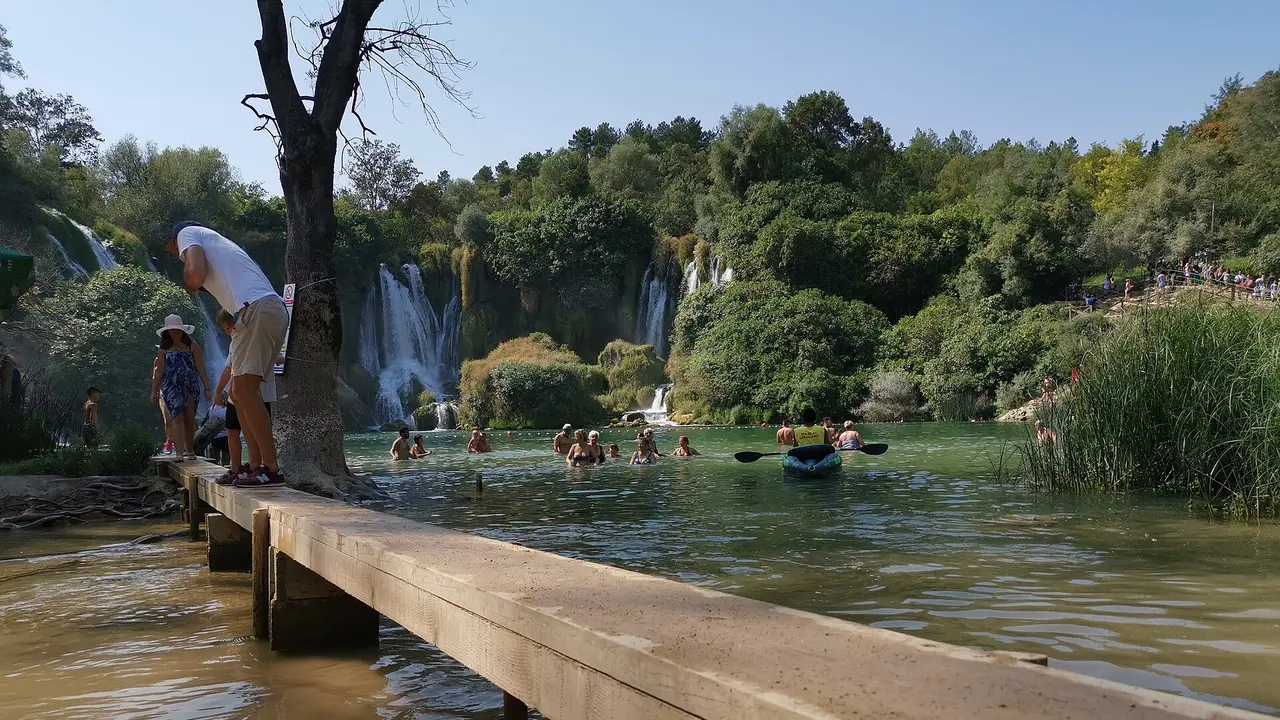
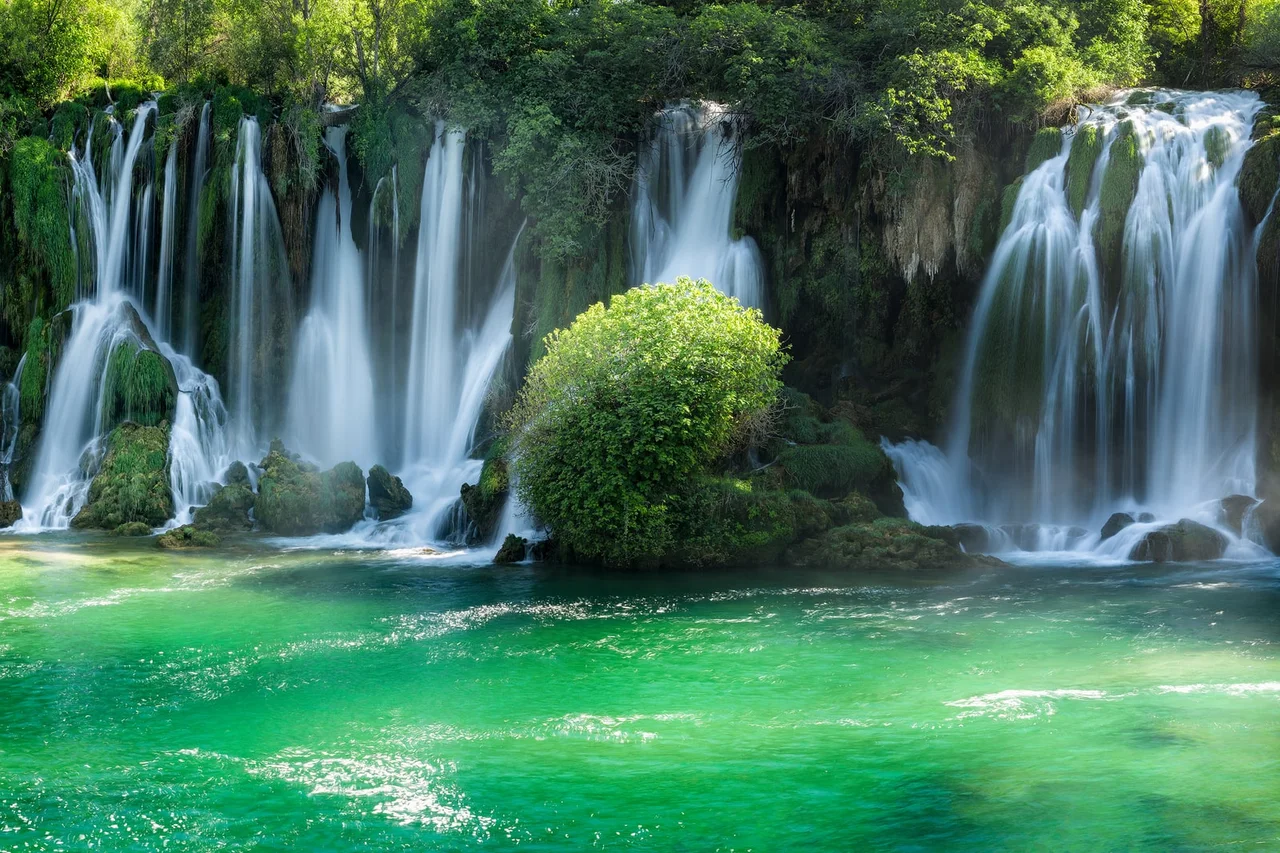
If you only see one waterfall in Bosnia, this is it. Kravice (you’ll also see it as Kravica) is a broad horseshoe of falling water on the Trebižat river in southern Herzegovina, roughly 28 metres high and about 120 metres across, where dozens of separate cascades spill side by side into a wide green pool. And the pool is the point: this is one of the few waterfalls in Europe where you’re allowed to swim right at the base, in a roped-off shallow zone off a sandy shore, roughly June to September.
The water never gets properly warm - it’s spring-fed and tops out around 20°C - but under a 35°C Herzegovina sun that’s exactly what you want. It’s also the busiest waterfall in the country, drawing hundreds of thousands of visitors a season, so timing matters more here than anywhere else. There’s an entry fee year-round, paid in cash, plus a boat across the pool and a few restaurants trading on the setting.
I won’t rehash the fee, the hours, the boat and the crowd-beating tactics here, because our full Kravice waterfalls guide covers all of it in detail. The short version for planning: give it half a day, bring cash in convertible marks, and it’s the anchor of the classic Herzegovina loop with Blagaj and Počitelj.
Štrbački buk: the wide one on the Una
Up in the far northwest, on the improbably green Una river, Štrbački buk is the country’s other headline waterfall - and the one Lonely Planet once called a strong contender for Bosnia’s most impressive. It’s a wide staircase of white water stepping over terraced tufa ledges rather than a single drop, about 25 metres top to bottom (you’ll see 24 quoted too; call it mid-twenties). Boardwalks and viewing platforms run along both banks, and a footbridge gives you the whole thing head-on.
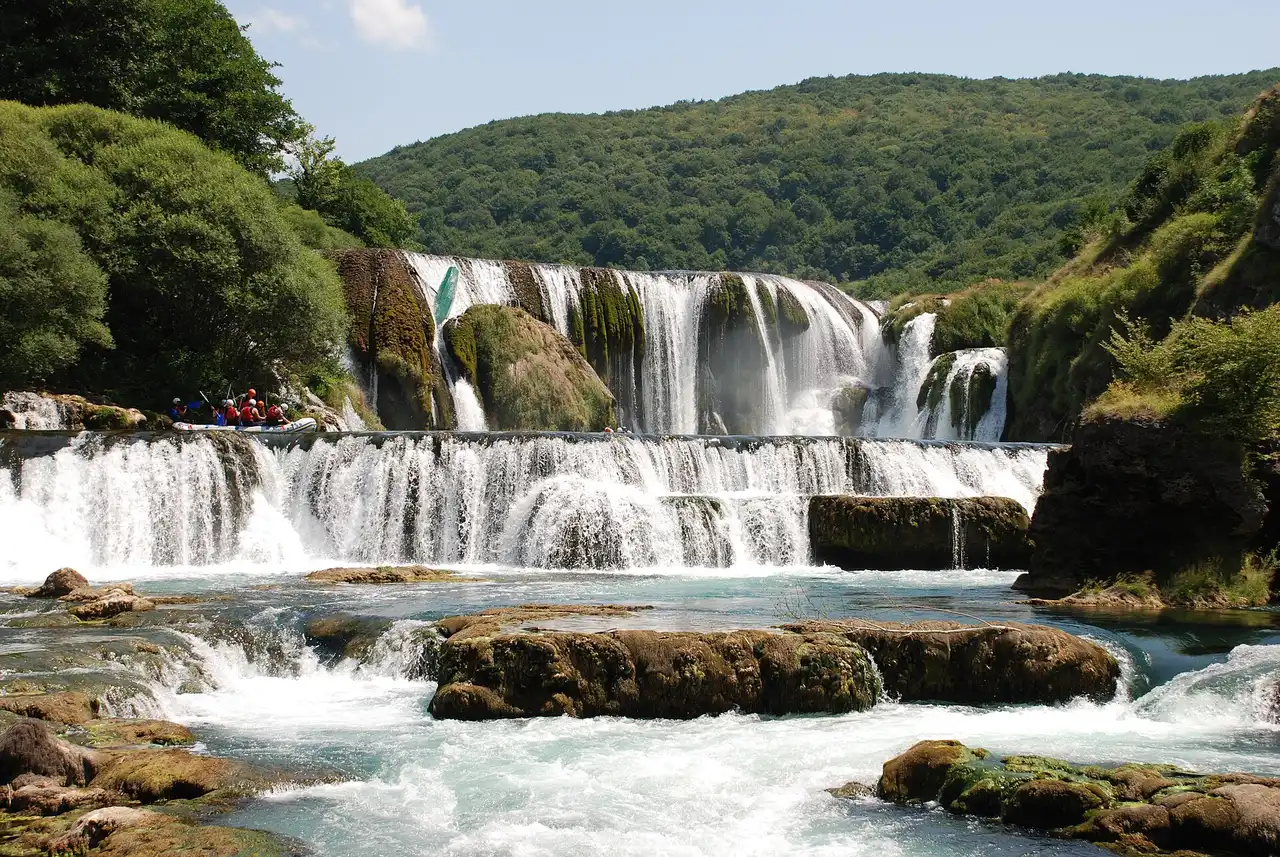
Two things set this one apart. First, it sits right on the Croatian border - the frontier runs down the middle of the river here, so half the falls are in another country. Second, this is rafting country, not swimming country: the Una is the reason people bring a wetsuit to Bosnia, with a wilder white-water stretch by the falls and gentle family floats downstream. You don’t swim at Štrbački buk the way you do at Kravice; you raft past it or admire it from the boardwalk.
What holds it back is the distance. Bihać, the base for the Una, is out on a limb - roughly 300 km and four and a half hours from Sarajevo, genuinely closer to Zagreb, and barely an hour from Plitvice Lakes across the border. That reframes the whole trip. Our Una National Park and Bihać guide covers the falls, the rafting sections and the fees, and if you’re weighing the rivers, the rafting in Bosnia guide compares the Una with the Tara and the Vrbas.
Pliva at Jajce: the waterfall inside a town
This is the strange one, and my personal favourite for the sheer surprise of it. At Jajce in central Bosnia, the Pliva river pours over a tufa ledge at the exact point it meets the Vrbas - right at the foot of a walled medieval old town. Instead of hiking to a waterfall, you more or less walk up to the edge of the streets and look down at it. There is nowhere else in the country, and few places anywhere, where a proper waterfall sits in a town centre like this.
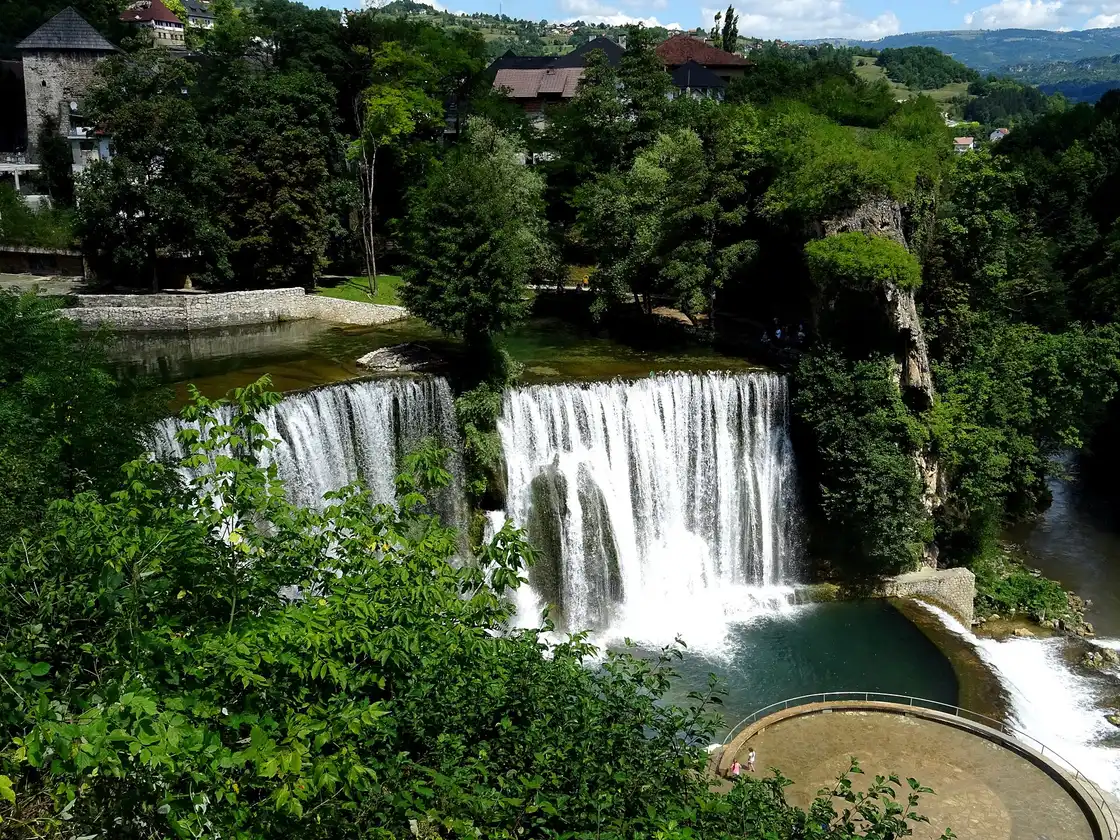
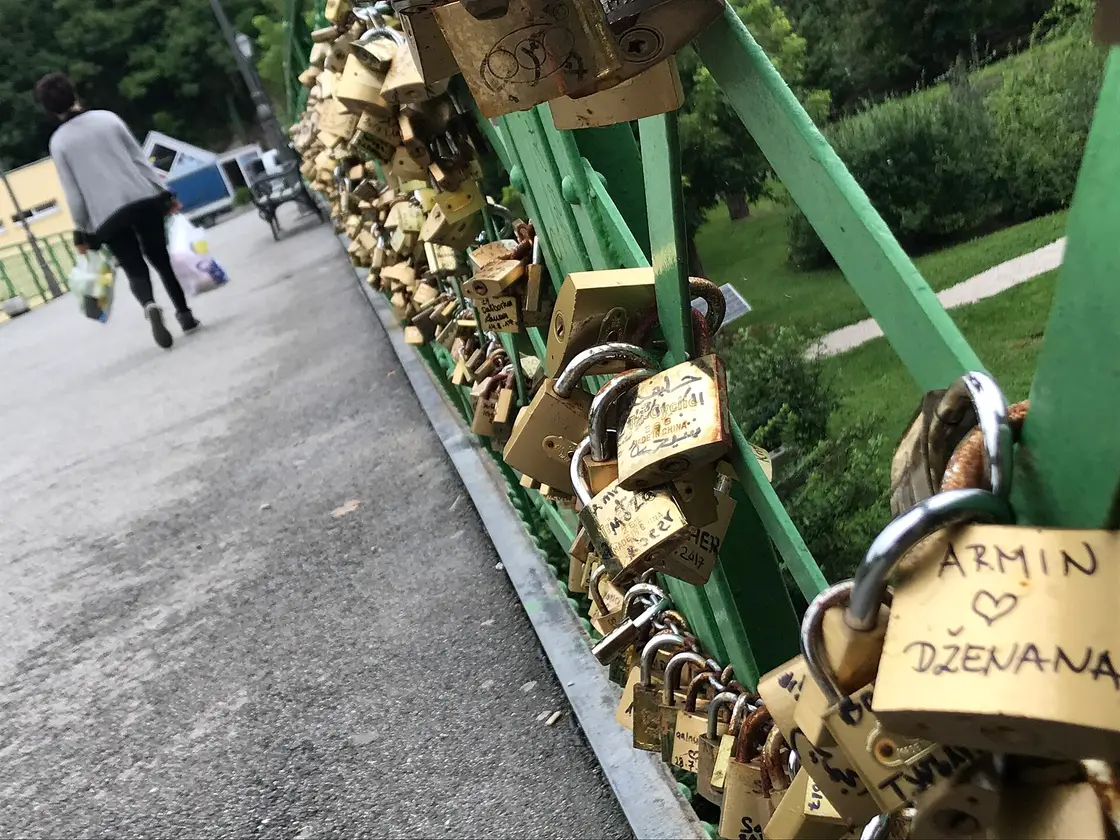
How tall is it? The answer has shifted over the years. Today it’s usually given as around 20 to 22 metres, but older sources put it closer to 30. The drop shrank after the 1990s war: damage to a hydro plant upstream and later flooding raised the pool at the base and swallowed part of the height. Take roughly 22 metres as a fair working figure, and don’t be surprised if a local sign disagrees. You get the best head-on view from a lower platform, and the top of the drop from a footbridge above, its railings weighed down with lovers’ padlocks.
You don’t swim here - the Pliva falls are for looking at - but 3 km upstream the Pliva Lakes are where the town goes to paddle in summer, complete with a photogenic huddle of little wooden watermills. And Jajce throws in a medieval fortress, a Roman temple and a rock-cut crypt within a few walkable blocks, which makes it one of the most layered half-days in the Balkans. The full picture is in our Jajce guide.
Skakavac: the tall one near Sarajevo
For height, nothing else comes close. Skakavac - the name means “grasshopper” - drops a single 98-metre column through the forest about 12 km northeast of Sarajevo, above the village of Nahorevo. That makes it, by most counts, the tallest waterfall in Bosnia and Herzegovina and one of the tallest in the Balkans (a few sources hedge the exact figure, and one old plaque even reads 86 m, but 98 is the number that sticks). The falls and their forest have been a protected natural monument since 2002.
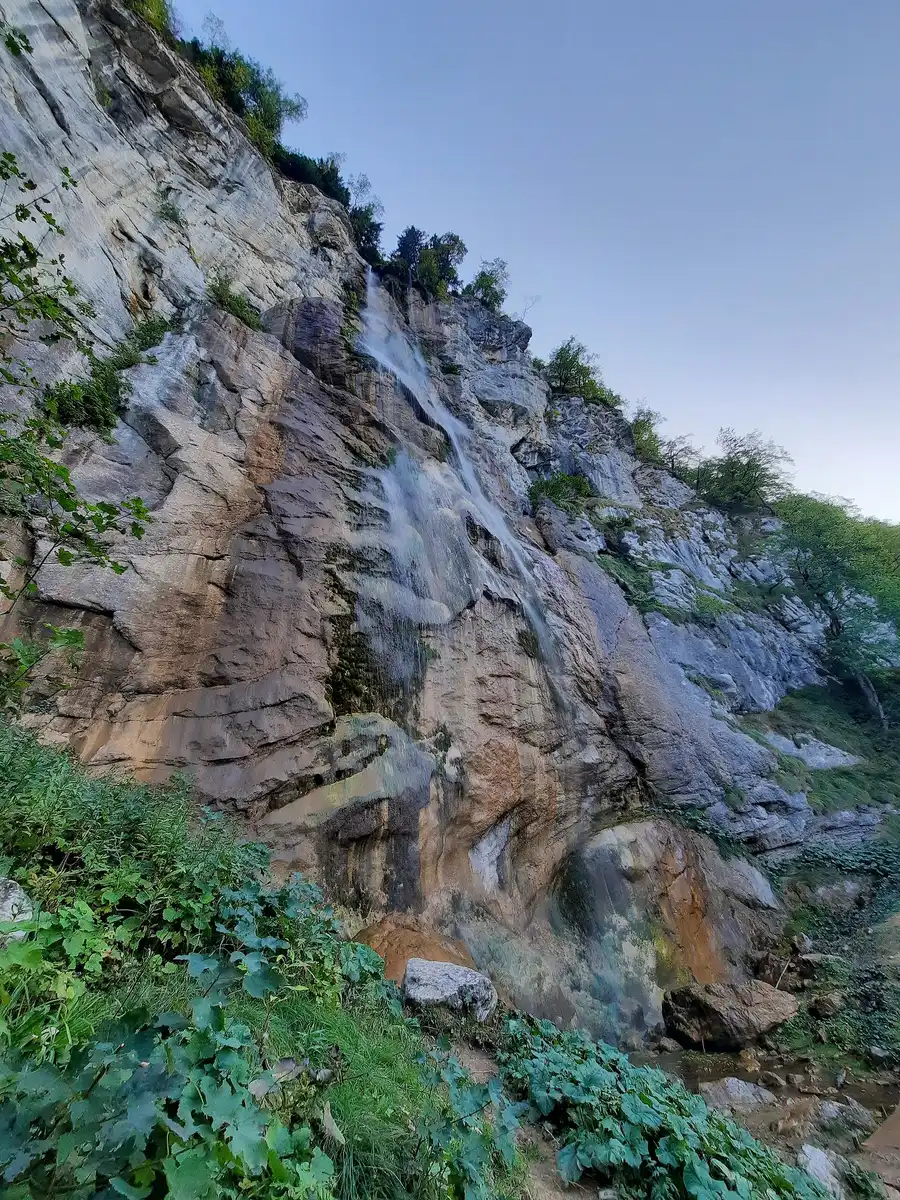
Two honest cautions. First, this is a hike, not a drive-up: you reach the trailhead by car or bus to Nahorevo and then walk in through the nature preserve, so treat it as a half-day outing from the capital rather than a quick photo stop. Our full Skakavac waterfall hike guide covers the loop, the upper and lower viewpoints, and how to reach the trailhead without a car. It’s at its most dramatic after the spring melt and, oddly, freezes into strange shapes in the depths of winter; in a dry late summer it can thin to a trickle. Second, and this trips people up constantly: there are two Skakavacs. This one is near Sarajevo. A completely different Skakavac, about 75 metres, hides deep inside the Perućica primeval forest in Sutjeska National Park, down in the southeast, viewable only from a distant lookout - covered in our Sutjeska National Park and Maglić guide. Same name, opposite ends of the country; don’t plan a trip around the wrong one.
Kocusa: the wide, quiet, free one
The one the tour buses skip. Kocusa (sometimes spelled Kočuša) sits on the same Trebižat river as Kravice, in the village of Veljaci about 10 km from Ljubuški and only a 15-minute drive north of Kravice itself. It’s the opposite shape to its famous neighbour: barely 5 metres high but more than 50 metres wide, a broad low water slide sheeting over green tufa. It won’t stop you in your tracks the way Kravice does, but it has something Kravice long since lost - peace. Turn up and you’ll often share it with nobody but a few locals having lunch, and there are old stone watermills strung along the path, some still turning.
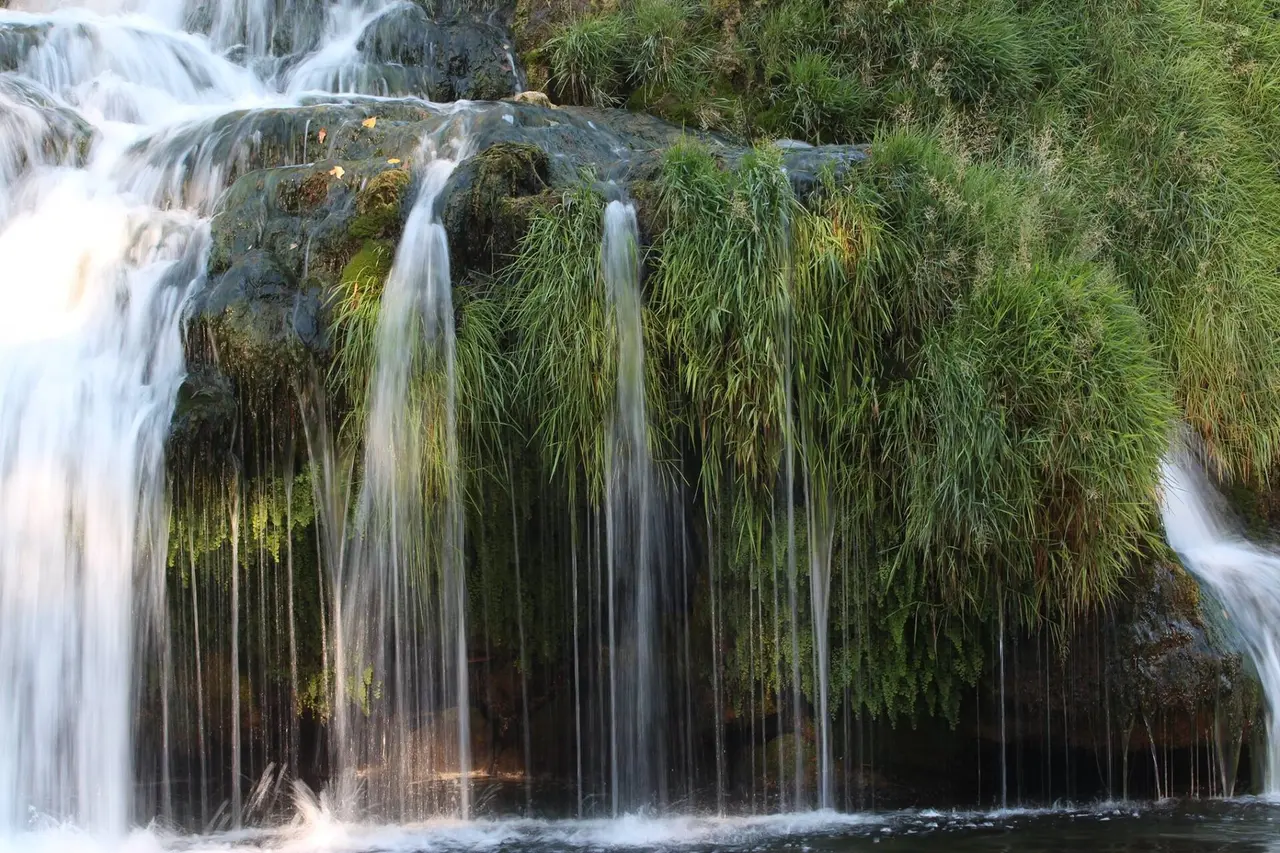
Can you swim? Not really - be honest with yourself here. The pool is rocky and shallow, fine for wading and for kids to splash about, but there’s no proper swimming hole and no sandy entry like Kravice. It’s free to visit, unstaffed, and best from May to September (spring runs fullest but the ground turns muddy). Think of it as the calm, cheap bookend to a Kravice morning rather than a destination in its own right.
Where can you actually swim?
This is the question that decides a hot-weather day, so here it is plainly. Of the five, only Kravice is a true swim - a designated, roped shallow zone off a sandy shore, roughly June to September. Kocusa is wading only, shallow and rocky. The other three are look, don’t swim: Štrbački buk is a rafting river you paddle past, the Pliva at Jajce drops into a town, and Skakavac is a forest hike. If your Bosnia trip is built around cooling off under falling water, point yourself at Herzegovina and the Trebižat - Kravice for the swim, Kocusa for the quiet.
Which waterfall, by region
The falls are scattered across three corners of a country with no through public transport between them, so geography does a lot of the deciding for you.
- Herzegovina (south): Kravice and Kocusa, both on the Trebižat, 15 minutes apart. This is the easy, swimmable cluster, and it folds straight into a day with Mostar, Blagaj and Počitelj. If you have limited time, this is the waterfall region to pick.
- Central and northwest Bosnia: the Pliva at Jajce (about 2.5 to 3 hours northwest of Sarajevo) and Štrbački buk on the Una (a good 4.5 hours out, up by the Croatian border). These are not near each other and not near Herzegovina - each is its own trip, best folded into a longer northern loop or, for the Una, a Croatia crossing.
- Around Sarajevo: Skakavac, a half-day hike from the capital and the only one of the five you can pair with a city break without a long drive.
For how these fit a full trip, our best time to visit Bosnia guide breaks the seasons down, and the attractions hub has the rest of the country’s headline sights.
When to go: spring flow or summer swim
Bosnia’s waterfalls are effectively two different sights depending on the month, and the trade-off is the same across all five. Come in spring - roughly March to May, after the snowmelt and rains - and they run at full power: the whole ledge going at Kravice, the Pliva thundering through Jajce, Skakavac at its most dramatic. It’s the loudest, fullest, most photogenic version. The price is cold, high water you can’t swim in, and pools that can run murky.
Come in high summer - July and August - and the flow eases everywhere, the water at Kravice warms enough to swim, and the light softens for photos. The price this time is crowds, at least at Kravice, and a real risk that the smaller falls like Kocusa and a dry-season Skakavac thin right out. For most people the sweet spot is the shoulder of summer, June or September: warm enough to swim at Kravice, quiet enough to enjoy it, and still plenty of water in the rivers. Wherever you land, a hire car is what turns these scattered falls into an actual itinerary - there’s no useful bus to Kravice or Kocusa, the Una needs wheels, and Skakavac ends at a trailhead.
If you had to do just one, I’d send a first-timer to Kravice: it’s the swim, the setting and the easy Herzegovina loop rolled into one. Save the tall hike to Skakavac, the town-waterfall at Jajce and the emerald Una for a second, slower trip - and when you go north, our Una guide and Jajce guide will have the details waiting.
Photos
Read also

Entertainment · 10 min read
Best Lakes in Bosnia for Swimming & Road Trips
Verified · September 3, 2026Five Bosnian lakes for swimming and road trips: Pliva, Boračko, Blidinje, Prokoško and Pannonica - which warm up, which ban bathing, how to link them.

Entertainment · 11 min read
Sarajevo Nightlife: Best Bars, Pubs & Clubs
Verified · August 10, 2026Where Sarajevo goes after dark: Bascarsija bars, Ferhadija pubs, live jazz, Sloga club nights and 06:00 closing times - all walkable, all cash-friendly.

Entertainment · 14 min read
Bosnia Events Calendar: Month by Month 2026-2027
Verified · September 23, 2026What happens in Bosnia each month: Bascarsija Nights all July, the film festival 14-21 August 2026, Jazz Fest 4-7 November, and the holiday trap.

Entertainment · 8 min read
Sarajevo Film Festival 2026: A Visitor's Guide
Verified · July 18, 2026The Sarajevo Film Festival runs 14-21 August 2026: what it is, the open-air cinema, how tickets work, the guests and where to stay.