Stari Most: Mostar's Iconic Old Bridge
Stari Most, the Ottoman Old Bridge of Mostar: its 1566 origins, the 1993 destruction and 2004 rebuild, UNESCO status, the divers, and how to see it.
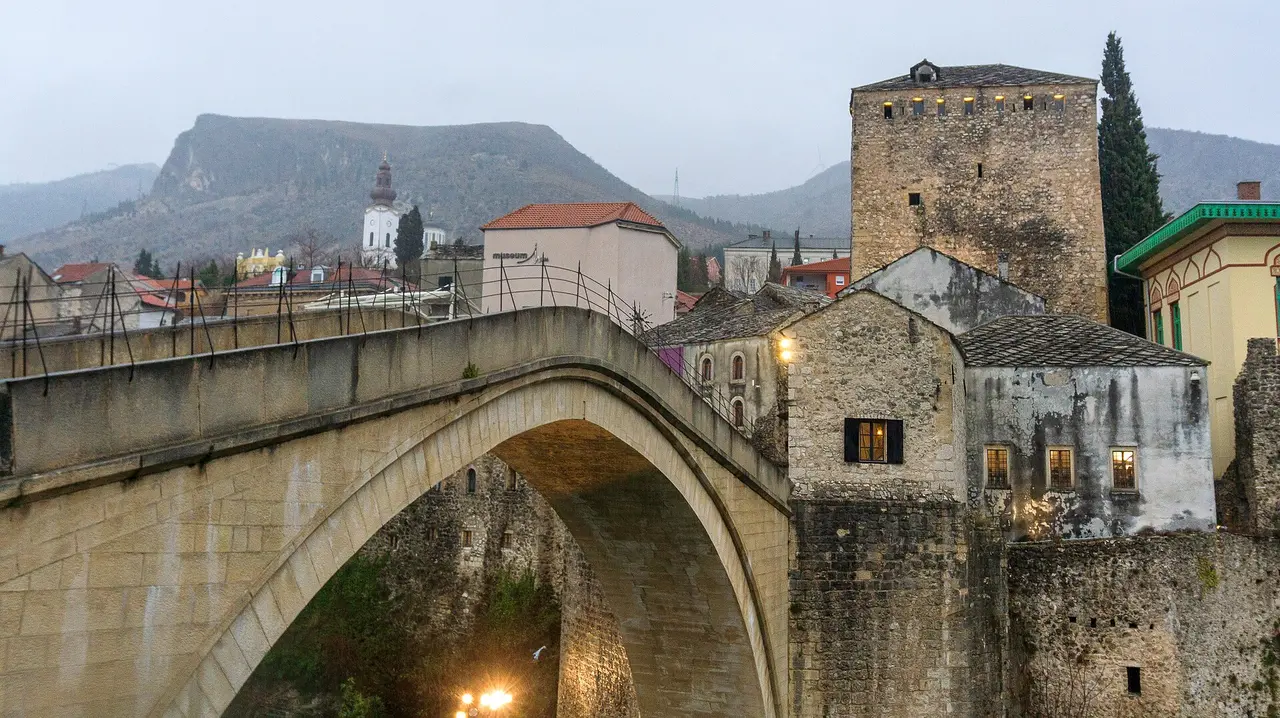
Stari Most - literally “the Old Bridge” - is the single stone arch that leaps the Neretva in the heart of Mostar, and it’s the reason the town exists and the reason you’ve heard of it. Built for the Ottomans and completed in 1566, shelled to rubble in the 1993 war, then rebuilt stone by stone and reopened in 2004, it’s now a UNESCO World Heritage Site and the most famous sight in Bosnia and Herzegovina. This guide covers what actually makes it worth the trip: its story, the divers who throw themselves off it, when to come, and the honest practical bits - starting with the fact that crossing it costs nothing.
What is Stari Most, exactly?
It’s a bridge - one perfect humpbacked arch of pale limestone, springing bank to bank over green water - but calling it “a bridge” undersells why people cross a continent for it. For four centuries it was one of the widest man-made arches in the world, an Ottoman engineering flex that looked, and still looks, like it shouldn’t quite stand up. The name of the whole city grew out of it: Mostar comes from the mostari, the bridge keepers who guarded and manned the crossing in Ottoman times. The bridge came first; the town is named after the people who looked after it.
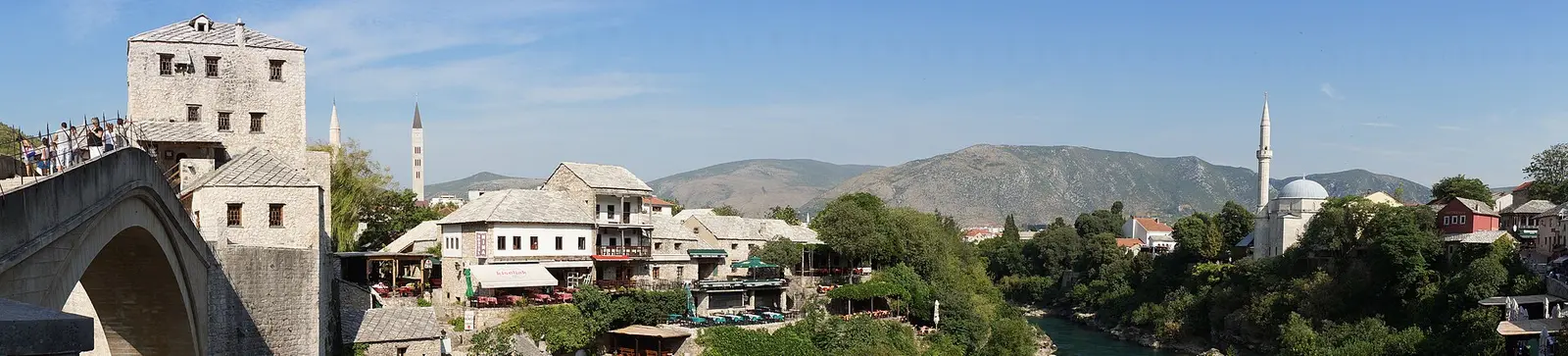
The setting does half the work. On both banks a warren of cobbled lanes, coppersmiths’ stalls and minarets climbs away from the river, so you don’t come upon the bridge in isolation - you thread through the bazaar, turn a corner, and the arch is suddenly there, framed by two stone towers, with the Neretva running an improbable jade-green underneath. It photographs beautifully from every angle, which is why every angle already has someone standing in it by mid-morning.
The history: built 1566, destroyed 1993, reborn 2004
Take the story in the order it happened, because the story is most of the point.
The bridge was commissioned by Sultan Suleiman the Magnificent in 1557 and completed in 1566, after roughly nine years’ work, replacing a rickety wooden suspension bridge that had scared travellers for generations. The architect was Mimar Hayruddin, a pupil of the great Ottoman master-builder Mimar Sinan - the man behind the imperial mosques of Istanbul - and the local legend, told to this day, is that Hayruddin was so unsure his single span would hold that he prepared his own funeral before the scaffolding came down. It held. He built it from tenelija, a soft local limestone that hardens in the air and shifts colour with the light, quarried from the hills around the town.
For 427 years it simply stood there, surviving empires and earthquakes. Then it fell in a single day. On 9 November 1993, during the Croat-Bosniak war - a conflict within the wider Bosnian War - it was shelled to collapse by forces of the Croatian Defence Council (HVO). The bridge had no real military value; its destruction was symbolic, and it landed as one. Footage of the arch dropping into the river became one of the defining images of the whole conflict.
What you cross today is a faithful reconstruction, and the way it was rebuilt matters. Between 2001 and 2004, a coalition led by UNESCO with the World Bank, the Aga Khan Trust for Culture and the World Monuments Fund raised it again - not as a modern replica, but as the original: divers hauled the fallen stones up from the riverbed, the same tenelija was cut from the same quarry, and Ottoman-era techniques were used to set it. It reopened on 23 July 2004, and the following year (2005) UNESCO inscribed the Old Bridge area as a World Heritage Site under the name “Old Bridge Area of the Old City of Mostar.” Crucially, it wasn’t rebuilt as a museum piece behind a rope - the town wanted its bridge back, to walk across on the way to the shops - and that’s exactly how it feels now.
The bridge dimensions (and why the numbers disagree)
You’ll see the measurements quoted slightly differently everywhere, so treat any single figure with a pinch of salt. Stari Most is a single arch roughly 28-30 metres long and about 4 metres wide, rising in a steep hump so that its crown stands somewhere around 20 to 24 metres above the Neretva. The reason the height figure wanders - you’ll read 21 m in one place and 24 m in another - is simply that the river level swings a lot with the seasons and different sources measure to different waterlines. Don’t get hung up on the exact number; standing on the crown and looking down, it feels a very long way to the water, and that’s what the divers are betting on.
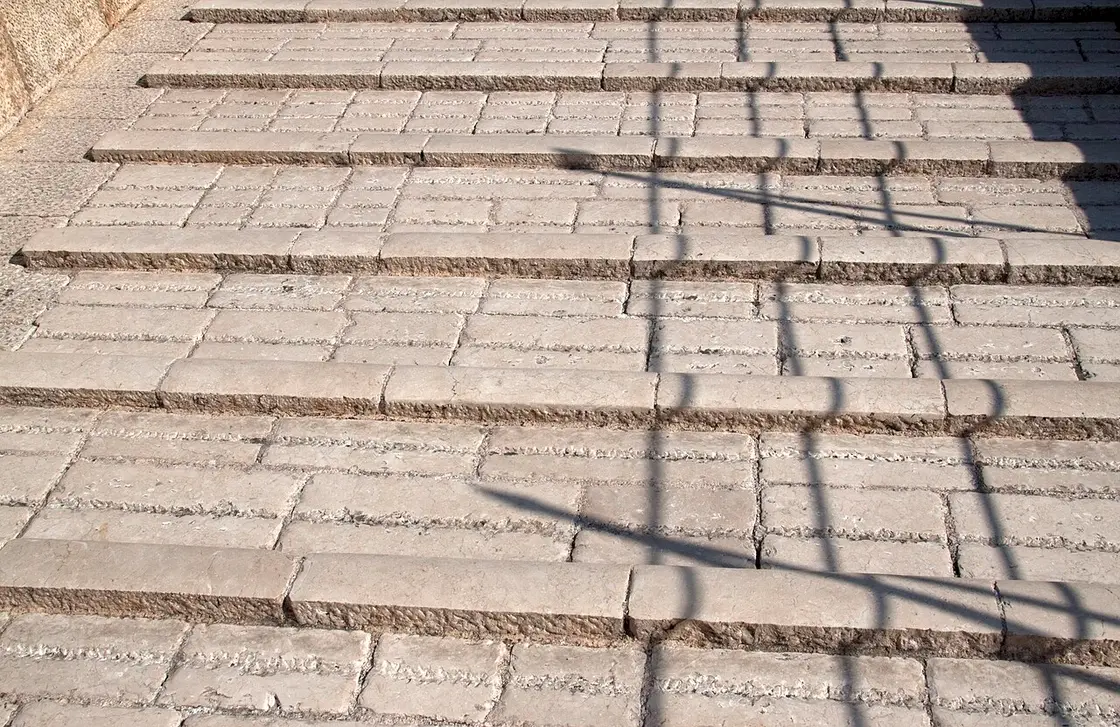
The deck itself is worth a close look while you cross. It’s paved in the same smooth limestone, worn glassy and domed by five centuries of feet, with raised stone ridges set across it like rungs so you don’t slide straight off. The pitch is genuinely steeper than photographs let on - in the wet it’s slick, and in leather-soled shoes you’ll be glad of the ridges. Take it slowly, both for your ankles and because it’s a nicer way to cross something this old.
The divers of Stari Most
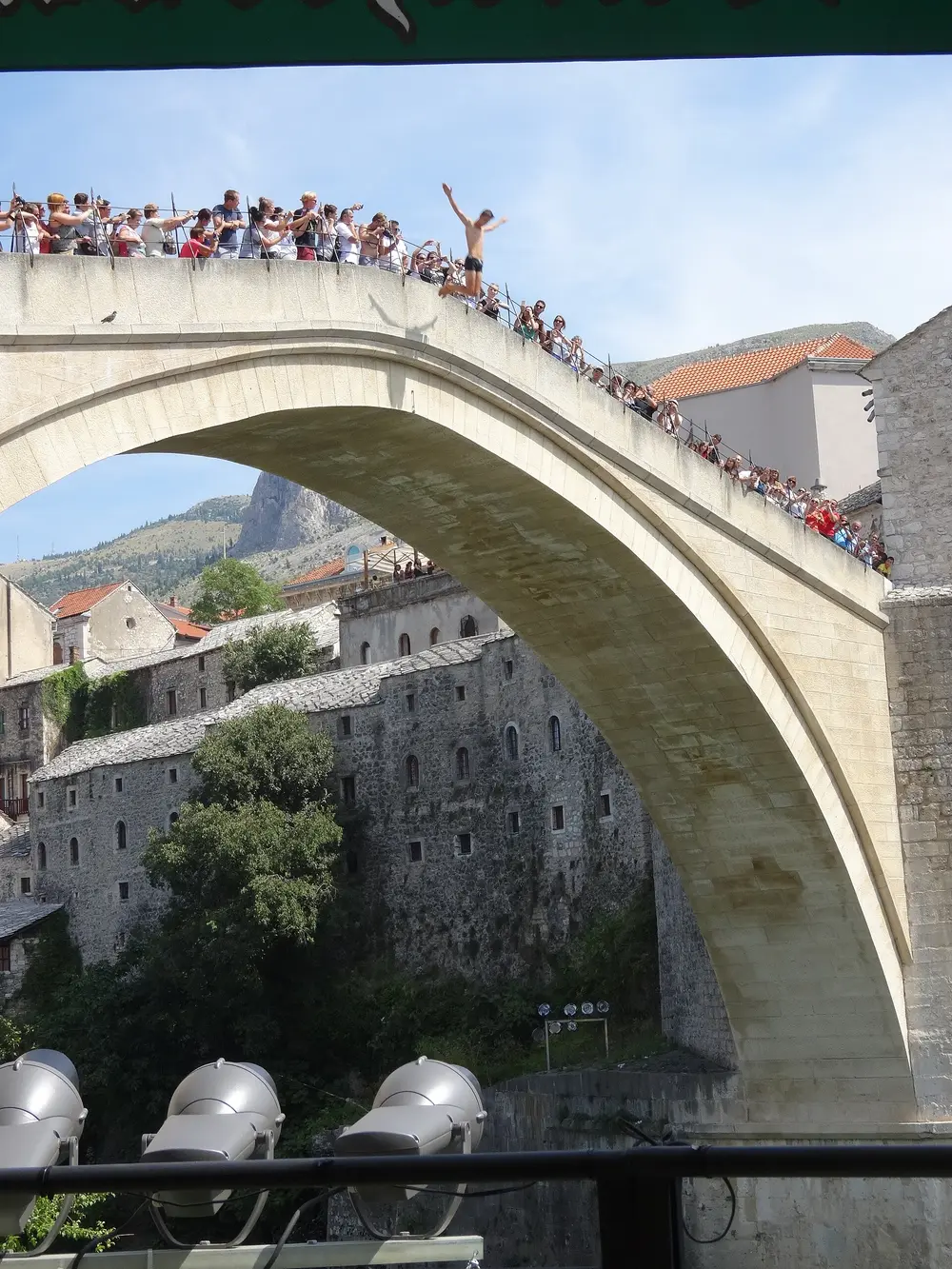
The other thing that happens on the bridge is the diving, and it’s not a tourist gimmick bolted on last season - it’s older than most countries. The first written account dates to 1664, when the Ottoman traveller Evliya Çelebi described young men of Mostar standing on the parapet and throwing themselves headfirst into the river below. They’ve been doing it, more or less continuously, ever since. A formal annual competition has run since 1968, held every July, and the tradition is kept alive today by the local divers’ club - the Mostari, sometimes called the Mostarski Ikari, “the Icarus jumpers” - who train for years and start as kids.
How it actually plays out for a visitor: on a warm day you’ll find a diver, in Speedos and not much else, perched on the rail collecting money in a bucket. He won’t jump on a schedule. He waits - sometimes a long, theatrical while - until the crowd’s tips add up to something worth the risk (a few dozen euros, locals reckon), then goes, feet-first or head-first, off the highest point of the arch into water that’s shockingly cold. To actually see a jump: be patient, stand near the towers for the angle, and drop a euro or two in the bucket to help fill it. If you’ve got money on it, don’t wander off.
In recent years the bridge has also hosted a stop on the Red Bull Cliff Diving World Series, when the world’s best high-divers come to leap from purpose-built platforms above the arch - a very different, professional spectacle held on a set date, so check our Bosnia events calendar if you want to catch it.
One firm piece of advice: don’t jump yourself. People ask, and every summer a few try. The Neretva here’s snowmelt-cold - around 10-15°C even in August - the drop is real, and hitting cold water badly from that height does serious damage. The club members train for years for a reason. Watch, tip, and keep your feet on the deck.
Do you have to pay, and what’s around it?
No. Crossing Stari Most is free and the bridge is open around the clock - it’s a working public crossing, not a ticketed attraction, so ignore anyone implying otherwise. What costs money is the view of the bridge from above: the best-known vantage is the minaret of the Koski Mehmed-Paša Mosque on the east bank, where a small fee (around 5 KM / €2.50 when we checked, sometimes split between courtyard and minaret - confirm at the window) buys you the climb and the postcard shot straight down the river to the arch.
The bridge is flanked by two medieval towers - Halebija on the west bank and Tara on the east - and one of them holds a small museum on the bridge’s history and the divers. Its opening hours and fee shift, so treat it as a check-locally extra rather than a fixed plan.
Around the bridge, the cobbled Kujundžiluk bazaar spills down both banks - coppersmiths, carpets, Turkish coffee and a good deal of tourist tat - and it’s genuinely pleasant to get lost in for an hour once you’ve had your fill of the arch. For everything beyond the bridge itself - the mosque views in full, where to eat, the still-visible scars of the war, and where to stay - see our things to do in Mostar guide. For a table with the arch in the frame, or a grill two minutes off it, see where to eat in Mostar.
When to visit - and the two things people miss
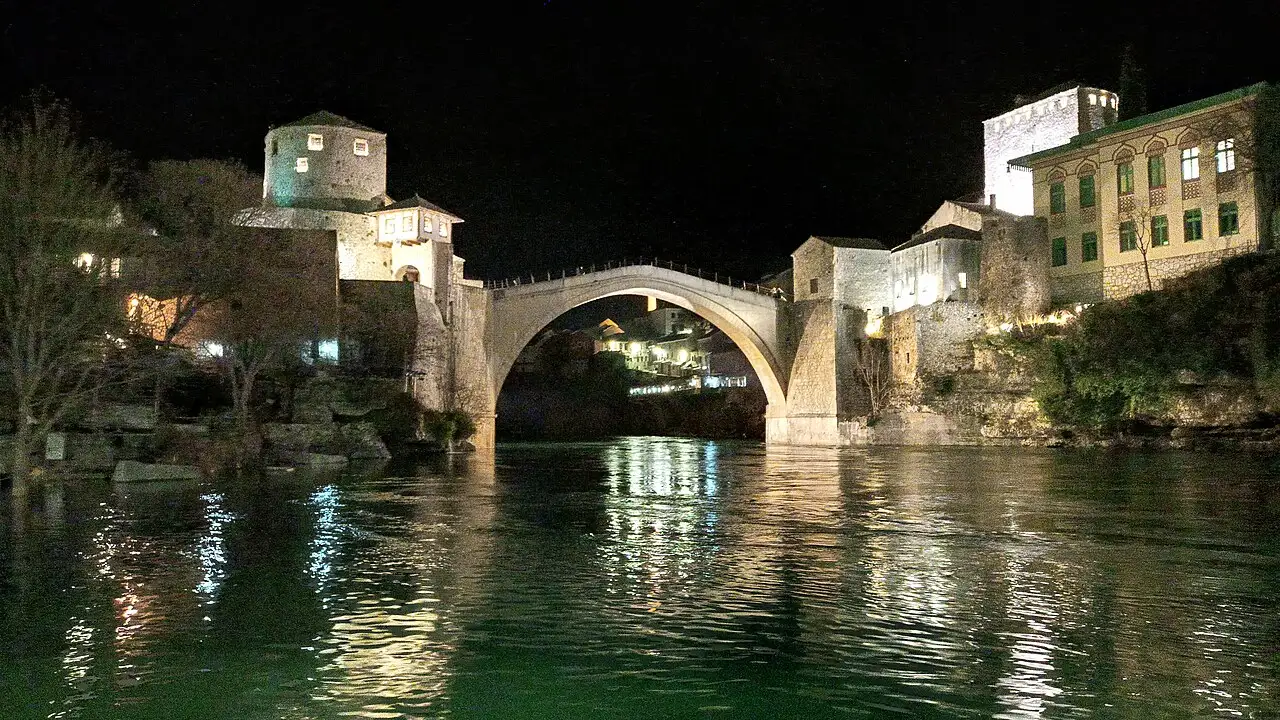
Timing makes or breaks a visit here. The bridge is at its worst in the middle of the day, when the coach tours from Dubrovnik, Split and Sarajevo all overlap and the arch is shoulder to shoulder. It’s at its best early in the morning, before the buses, and after dusk, once they’ve left and the bridge is floodlit and mirrored in the black river. If you can only do a day trip, aim to be on the bridge by nine; if you can stay a night in Mostar, you get the magic hour twice - sunset and early morning - with the town more or less to yourself. It’s the single best argument for sleeping here rather than day-tripping, and our guide to where to stay in Mostar sorts out which area, from the Old Town to the quieter east bank, gets you closest to that.
Which brings up the mistake most visitors make: treating Mostar as a two-hour photo stop. The bridge deserves an unhurried evening, and Herzegovina around it deserves a proper day. Two easy trips pair perfectly with the bridge and are covered in full in their own guides. Twelve kilometres out, the Blagaj Tekke is a white dervish house built against a cliff where the Buna river bursts, full-force and startlingly clear, out of a cave. And about 40 minutes south, the Kravice Waterfalls form a broad horseshoe of falls that doubles as the region’s best swimming hole in summer. Do the bridge slowly, sleep in the Old Town, drive out to Blagaj and Kravice the next day, and Mostar earns its place as the highlight of a Bosnia trip rather than a snapshot on the way through.
Photos
On the map
The map loads on click - to keep the page lightweight.
The map didn’t load. Check your connection and refresh the page.
Admission and opening hours
- Admission price
- Free - Stari Most is a public bridge, open around the clock with no ticket. For the classic view down the river to it, the minaret of the nearby Koski Mehmed-Paša Mosque charges about 5 KM (~€2.50); confirm at the window.
- Opening hours
- Open 24 hours. Busiest late morning to mid-afternoon when the day-trip coaches are in; early morning and after dusk (when it is floodlit) are quietest and best for photos.
Cross slowly - the domed limestone deck is worn glassy and steeper than it looks, with raised stone ridges for grip. In summer the local divers work the parapet for tips. Do not jump yourself: the Neretva is only about 10-15°C even in August, the drop is real, and tourists are hurt most years. Currency is the convertible mark (KM); the divers and the market want cash.
Details checked: July 3, 2026
Distance
- Sarajevo ≈130 km · ~2 h by train or car, ~2.5-3 h by bus The train down the Neretva canyon (about 2 hours, roughly 14 KM, twice a day each way) is one of the best rides in the Balkans and drops you a 15-minute walk from the bridge.
- Mostar ≈0 km · In the Old Town centre The train and bus stations sit together in the north of the city, about a 15-20 minute walk (mostly downhill) or a short, cheap taxi from the bridge.
- Dubrovnik ≈140 km · ~2.5-3 h by car One border crossing since the Pelješac Bridge opened in 2022; EU/EEA/Schengen citizens can use a national ID card, others need a passport. Popular as a long day trip from the Croatian coast.
Read also

What to see · 15 min read
Via Dinarica Bosnia: Huts, Stages & Logistics
Verified · September 12, 2026Plan the Via Dinarica White Trail in Bosnia: 12 stages, 334 km, hut booking, trailheads, closures and three workable section packages.

What to see · 10 min read
Jablanica: Neretva Bridge & Roast Lamb Stop
Verified · September 4, 2026Jablanica on the Sarajevo-Mostar road: Battle for the Wounded museum (5 KM), the 1943 bridge, roast lamb lunch. Hours, parking, how long to stop.

What to see · 8 min read
Prokoško Lake: Shepherd Huts High Above Fojnica
Verified · September 3, 2026Prokoško on Vranica at 1,636 m: katuni, gate prices for foreigners, no swimming, and the 2026 asphalt climb from Fojnica.

What to see · 11 min read
Franz Ferdinand's Sarajevo: Latin Bridge & 1914 Site
Verified · August 29, 2026The Latin Bridge corner in Sarajevo where Franz Ferdinand was shot in 1914: what happened, the Museum of Sarajevo 1878-1918 inside, hours and tickets.