Medjugorje: Pilgrimage & Practical Travel Guide
Visiting Medjugorje: the claimed apparitions and 2024 Vatican ruling, St James church, Apparition Hill, Cross Mountain, and how to get there.
Medjugorje is a small village in west Herzegovina that became one of the busiest pilgrimage destinations in the Catholic world after six local teenagers said the Virgin Mary began appearing to them on a hillside in June 1981. Whether or not you share the faith, it’s a genuinely interesting place to visit: a working shrine that draws over a million people a year, wrapped around two rocky hills you climb on foot, an hour from Mostar and easy to reach as a day trip from the Croatian coast. This guide covers what actually happened here, where the Church stands after its 2024 decision, the three things to see, and how to get here without losing a day to logistics.
What happened at Medjugorje
On 24 June 1981, on the hill of Podbrdo above the hamlet of Bijakovići, six young people said they saw a figure they came to call the Queen of Peace, or Gospa. The six - Vicka, Mirjana, Marija, Ivanka, Ivan and Jakov - were teenagers at the time. Some of them say the visions continued daily for years, and that a few still receive messages. That is what the visionaries report; the apparitions have never been proven, and this guide passes no judgement on them either way. What is not in dispute is the effect: a poor rural parish in communist Yugoslavia turned, within a decade, into a shrine that pulled in around a million pilgrims a year through the 1980s and has kept doing so since.
It helps to know the setting. This is a Franciscan parish - the friars of Herzegovina have run the church here for generations - in the Diocese of Mostar-Duvno, whose bishops have historically been openly skeptical of the whole phenomenon. That tension, Rome versus the local bishop versus the friars, ran for over forty years, and it’s part of why the story stayed unresolved for so long. If you read older signs or blogs stating things as settled fact, treat them with the caution you would give any contested claim.
Where the Church stands: the 2024 decision
This is the part most visitors get wrong, so it is worth being exact. On 19 September 2024 the Vatican’s Dicastery for the Doctrine of the Faith issued a note titled The Queen of Peace, approved by Pope Francis, granting Medjugorje a nihil obstat. In plain terms: the Church now formally permits public devotion and organised pilgrimages here, and it recognised the “abundant spiritual fruits” - conversions, confessions, renewed faith - connected with the place.
What it did not do is declare the apparitions supernatural or authentic. Under new rules the Vatican set out in May 2024, a nihil obstat is the top category available, but it’s a green light for devotion, not a verdict on the visions. Cardinal Víctor Manuel Fernández, who signed the note, said he asked the pope whether he wanted to go further and rule on their supernatural origin; the answer was “Not at all.” So the honest summary is this: you may come and pray with the Church’s blessing, and the Church has deliberately declined to say the visions are real. Pilgrims tend to hear only the first half, sceptics only the second. Both halves are true.
The Church of St James and the evening program
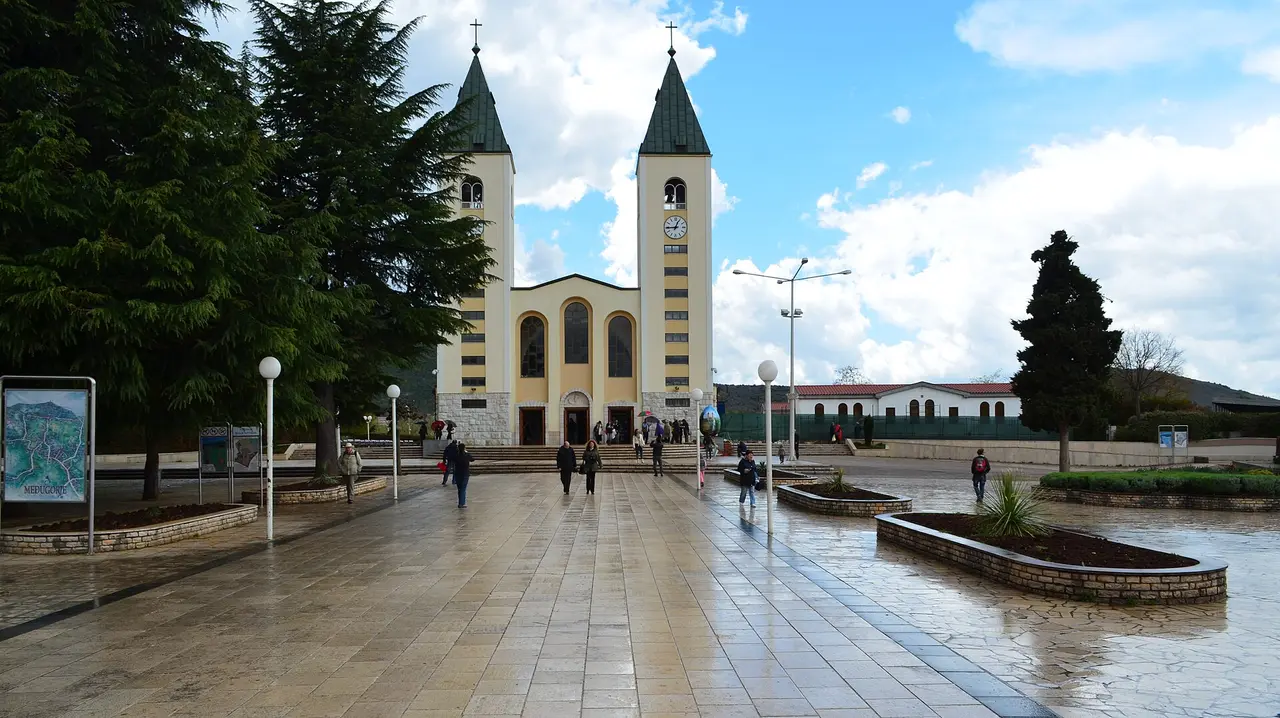
Everything in Medjugorje orbits the Church of St James (Sv. Jakov), the twin-towered parish church at the centre of the village. It is neither old nor architecturally special - the current building was finished in the late 1960s, before the apparitions - and it is far bigger than a village this size would ever need, which tells you a lot about how the place changed. Behind it run long banks of outdoor confessionals in a dozen languages, sometimes called the “confessional of the world,” and an open-air altar area for the summer crowds.
The heart of a visit is the evening prayer program. It builds through the late afternoon: the Rosary starts around 17:00 or 18:00 (the time shifts with daylight saving, so check locally), followed by the main evening Mass and then Eucharistic Adoration. The Mass is international, usually in Croatian with readings echoed in other languages, and in high summer thousands sit outside behind the church. Even if you’re not religious, the evening gathering is the one thing worth timing your day around - it’s when the village feels like what it is, rather than a street of souvenir shops.
Climbing the two hills
The two hills are the reason to give Medjugorje more than a couple of hours, and both are free and open at any time.
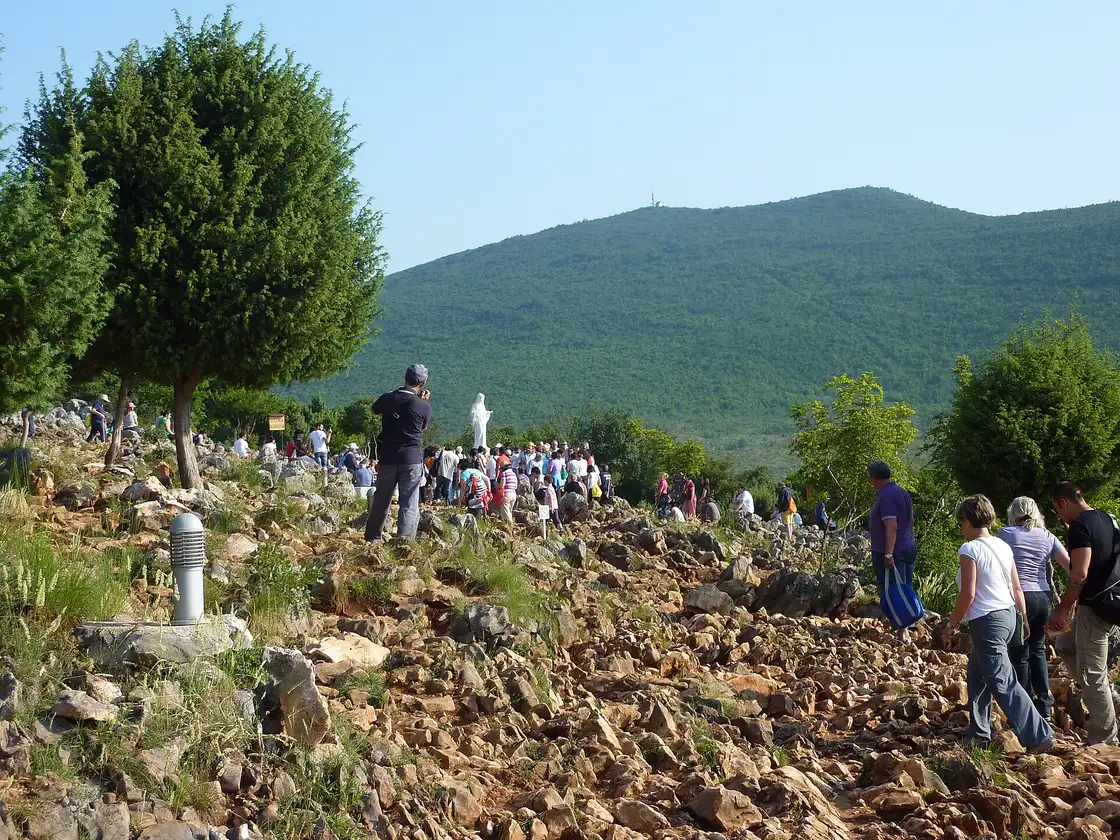
Apparition Hill (Podbrdo) is the lower one, above Bijakovići, where the visionaries say the first apparitions happened. The path is a rough scramble over loose, sharp limestone for roughly 1.5 to 2 kilometres, marked with bronze reliefs of the Rosary mysteries, with a white statue of the Virgin near the top and the Blue Cross prayer spot at the base. Take it slowly; people turn ankles here constantly, and you’ll pass pilgrims climbing barefoot as a penance, which tells you it is no gentle stroll.
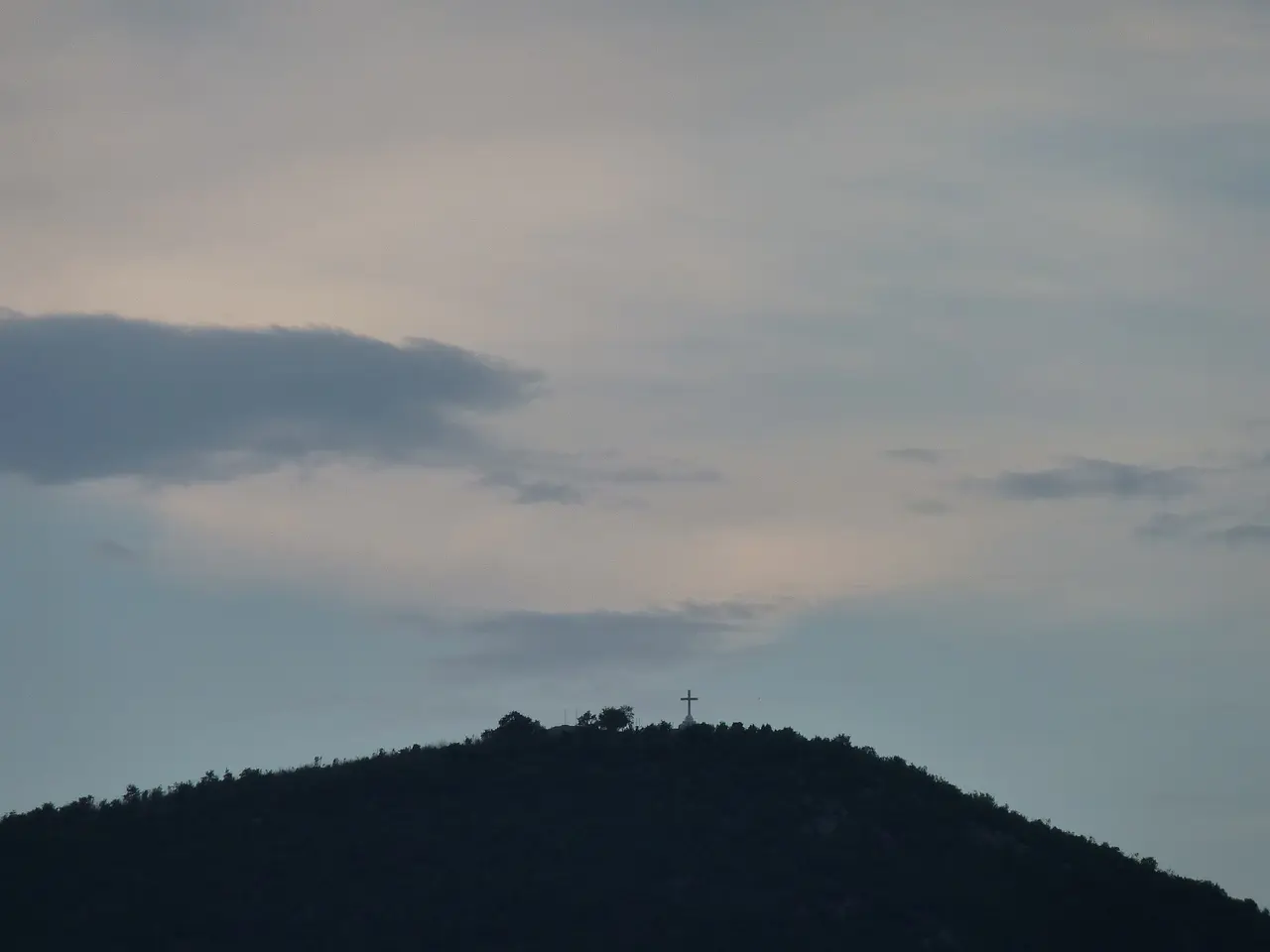
Cross Mountain (Krizevac) is the bigger challenge: a steeper, rockier climb of about 1.5 to 2 hours round trip to a summit near 520 metres, following the Stations of the Cross to a large white concrete cross that villagers erected in 1933 - well before any apparitions, as protection against storms and hail, marking 1,900 years since the Crucifixion. It gives you the widest view over the vineyards and the plain. Be sensible: the karst is sharp, there’s no shade and no water on the way, and in the July and August heat this climb genuinely catches people out. Start at dawn, or leave it for the cool of late afternoon, and carry more water than you think you need.
Getting to Medjugorje
Medjugorje is well connected for its size, mostly thanks to the pilgrim traffic.
- From Mostar - the easy one. It’s only about 25 km southwest, roughly 30 to 40 minutes by car via Čitluk, and local buses run several times a day for a few marks. If you’re already based in Mostar, Medjugorje slots neatly into a half-day; our guide to things to do in Mostar shows how the Herzegovina sights fit together.
- From Dubrovnik - the classic day trip. Reckon on 130 km and 2 to 2.5 hours by car with one border crossing, or a direct FlixBus at around 4 hours for about €15-25 (fares vary, so book ahead). The border is the variable that wrecks summer schedules, so a door-to-door transfer or a hire car is worth it if your time is tight. The mechanics of that crossing are in our Dubrovnik to Mostar guide, and Medjugorje pairs naturally with Mostar on the same run.
- From Split - around 130 km, about 2 to 2.5 hours by car, with Croatia Bus running a handful of services a week (roughly 3 hours, from about €25). Fewer departures than the Dubrovnik route, so check the timetable before you commit.
A private transfer is the box below if you want to skip the border queues and go door to door. Whichever way you come, remember the currency: Bosnia uses the convertible mark (KM/BAM), and although Medjugorje is more euro-friendly than most of the country because of foreign pilgrims, plenty of small guesthouses and shops still want marks, and the euro rates on offer are usually poor. Draw KM from an ATM.
Where to stay and when to go
For such a small village, Medjugorje has an enormous supply of beds: family guesthouses, small pilgrim hotels and rented rooms, most within walking distance of St James. That keeps prices reasonable outside the peak dates. For which pension or hotel fits your trip - church proximity, half-board, peak dates - see where to stay in Medjugorje. The two biggest surges are the anniversary in late June and the Mladifest youth festival in late July or early August, when tens of thousands of young pilgrims arrive and the village runs at full stretch - there’s a smaller one too, in September, around the Exaltation of the Cross gathering (our Bosnia events calendar has exact dates). Want the quiet, contemplative version? Come in spring or autumn. Want the energy and the crowds? Come for the festival, but book well ahead.
One last piece of honest advice: manage your expectations about the village itself. The core around the church is given over to shops selling rosaries, statues and souvenirs, and it can feel commercial. The parts that stay with people are usually the quiet ones - the pre-dawn climb up Podbrdo, the evening Mass, a slow hour in the confessional queues. Give it an overnight rather than a rushed stop, and pair it with a proper day in Mostar and Blagaj to round out the Herzegovina trip. If you’re driving and want Medjugorje as the last stop on a fuller circuit rather than a there-and-back, our Herzegovina highlights loop runs it after Blagaj, Počitelj, Kravice and Kocusa in one timed day (or two).
Photos
On the map
The map loads on click - to keep the page lightweight.
The map didn’t load. Check your connection and refresh the page.
Admission and opening hours
- Admission price
- Free - there is no entry fee for the church, the hills or the apparition sites. Carry cash in convertible marks (KM); some pilgrim businesses take euros, but not all, and the rates are poor.
- Opening hours
- The St James evening program starts with the Rosary at about 17:00 or 18:00 (it shifts with daylight saving), then evening Mass and Eucharistic Adoration. Confirm the current schedule at the parish before you plan your day.
Apparition Hill (Podbrdo) and Cross Mountain (Krizevac) are open free at any hour, but both are steep, sharp karst with no railings and no shade. Wear proper shoes, carry water, and in summer start very early - people have needed rescuing off Krizevac in the midday heat.
Details checked: July 15, 2026
Distance
- Mostar ≈25 km · ~30-40 min by car Southwest via Čitluk. Local buses run several times a day and take about 30-40 min; confirm the timetable, especially the last bus back.
- Dubrovnik ≈130 km · ~2-2.5 h by car One border crossing (BiH/Croatia). Direct FlixBus takes around 4 h from about €15-25 (fares vary, book ahead); a private transfer skips the queues. EU/EEA/Schengen citizens can cross on a national ID card, others need a passport.
Read also

What to see · 15 min read
Via Dinarica Bosnia: Huts, Stages & Logistics
Verified · September 12, 2026Plan the Via Dinarica White Trail in Bosnia: 12 stages, 334 km, hut booking, trailheads, closures and three workable section packages.

What to see · 10 min read
Jablanica: Neretva Bridge & Roast Lamb Stop
Verified · September 4, 2026Jablanica on the Sarajevo-Mostar road: Battle for the Wounded museum (5 KM), the 1943 bridge, roast lamb lunch. Hours, parking, how long to stop.

What to see · 8 min read
Prokoško Lake: Shepherd Huts High Above Fojnica
Verified · September 3, 2026Prokoško on Vranica at 1,636 m: katuni, gate prices for foreigners, no swimming, and the 2026 asphalt climb from Fojnica.

What to see · 11 min read
Franz Ferdinand's Sarajevo: Latin Bridge & 1914 Site
Verified · August 29, 2026The Latin Bridge corner in Sarajevo where Franz Ferdinand was shot in 1914: what happened, the Museum of Sarajevo 1878-1918 inside, hours and tickets.