Bosnia Travel Insurance 2026: What You Really Need
Bosnia travel insurance in 2026: EHIC does not work, three health systems, a Grade 3 rafting ceiling and mines off the trail - what a policy must cover.
Bosnia and Herzegovina won’t ask to see an insurance policy at the border, but its entry rules do expect every foreigner to arrive with money for health care, and a paid travel health policy is the document the state itself names as proof of that. Once inside, you sit outside all three of the country’s public health systems, the European health cards stop working, and the things people come here for - the Tara canyon, the Neretva, the Olympic pistes, the Sutjeska ridges - each carry a clause that a bargain policy tends to get wrong. It’s a checklist, not financial advice; the wording that binds is the one in your own policy document.
The entry rule most guides skip
The UK entry-requirements page for Bosnia says nothing about insurance, and our own guide to visas and entry confirms nobody at the crossing asks for a policy. The state’s rules are more specific than that silence suggests. The Ministry of Security’s information for foreigners states, in translation, that a foreigner “must have sufficient means of subsistence for the intended stay and for departure from BiH, including funds for health care”, sets the floor at 150 KM per day of intended stay, and then adds the line that matters: a foreigner with “proof of paid individual or collective travel health insurance” is considered to have secured the health-care part of those means.
A border officer waving through a British or American passport won’t run that arithmetic, but it shows how Bosnia sees you: a visitor expected to fund their own treatment. Keep the certificate on your phone; if you’re ever asked, it’s the document the law names.
Why the cards fail, and why the UK agreement is thinner than it looks
The European Commission’s EHIC page lists where the card works: the EU member states plus Iceland, Liechtenstein, Norway, Switzerland and the UK. Bosnia isn’t on that list, and the Foreign Office says it plainly on its Bosnia health advice: “The European Health Insurance Card (EHIC) and Global Health Insurance Card (GHIC) do not cover Bosnia and Herzegovina.”
British readers will find Bosnia on the government’s list of non-EU countries with a reciprocal healthcare agreement, alongside Serbia, Montenegro, North Macedonia and Kosovo. On paper it gives hospital treatment and other medical treatment “on the same basis as that available to a local resident”. Two things stop that being a plan. The agreements do not cover “the cost of returning you to the UK”, so the expensive part is yours regardless. And the FCDO’s Bosnia health page doesn’t mention the agreement at all, so the only place the paperwork is written down is that guidance list: a UK passport, plus proof of National Insurance enrolment if you are a UK resident rather than a UK national.
American, Canadian and Australian readers have no such strand to fall back on. The State Department puts the US position in one line, “U.S. Medicare/Medicaid does not apply overseas”, adds that “most hospitals and doctors overseas do not accept U.S. health insurance”, and tells citizens to buy medical evacuation cover before they travel.
Three health systems, and you belong to none of them
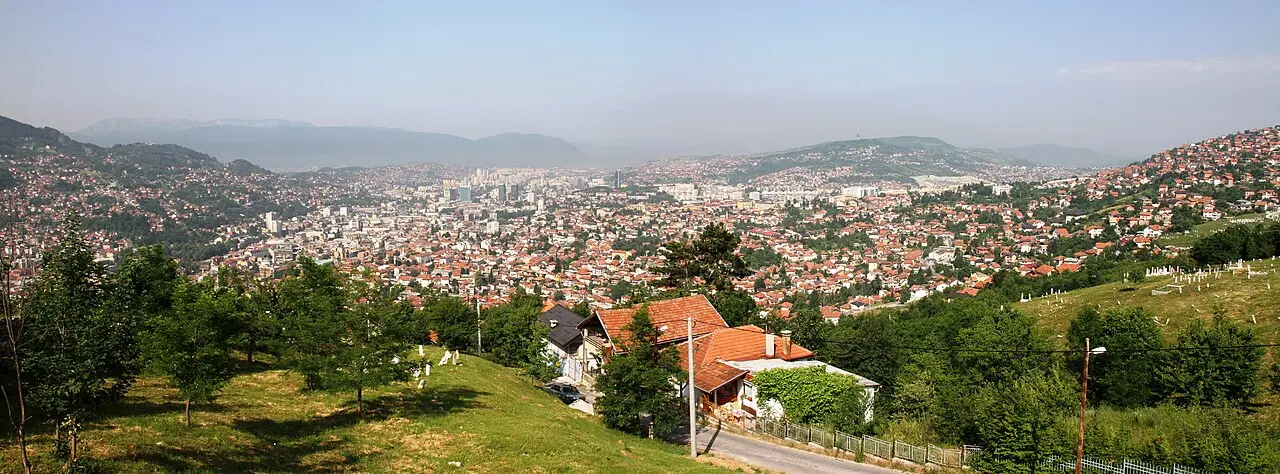
Bosnia’s post-war constitution split health care along with everything else, and the split shapes where an ambulance takes you. The Federation has a federal Institute for Health Insurance and Reinsurance in Sarajevo, which runs the solidarity fund, and beside it ten cantonal funds that do the day-to-day insuring, from Sarajevo Canton to Herzegovina-Neretva in Mostar and Una-Sana in Bihać. Republika Srpska has its own Health Insurance Fund in Banja Luka, and Brčko District a third. Each contracts its own hospitals, and a resident of one system is a visitor in the next.
The three flagship hospitals follow the same map: the Clinical Centre of the University of Sarajevo (KCUS) at Bolnička 25; the University Clinical Centre of Republika Srpska in Banja Luka, the largest in that entity; and the University Clinical Hospital in Mostar (SKB Mostar), about 800 beds and the largest in Herzegovina. A bad fall at the Kravice falls goes to Mostar, one in the Tara canyon near Foča is in Republika Srpska and a long way from any of the three, and one at Bihać is in Una-Sana canton, on the opposite side of the country from Sarajevo. The Foreign Office’s line that “medical and dental facilities, particularly outside Sarajevo and major towns, are limited” describes exactly that gap.
None of this changes what you pay: as a foreigner you’re outside every fund, so you settle at the desk and claim it back. On the same UK page, pharmacies “may not recognise prescriptions issued in the UK”, so bring enough medication and a doctor’s letter. Dial 124 for an ambulance; the US State Department lists the other two as 122 for police and 123 for fire. Mountain rescue is the volunteer GSS, reached through the 121 centre for the Sarajevo station; Jahorina’s operator publishes its own rescue number, +387 66 636 636. Your insurer’s assistance line belongs in the same list, and reaching it from a canyon needs data on your phone, which is where a local Bosnia eSIM pays for itself.
Mines: the reason evacuation cover is the whole policy
Every insurer sells “medical evacuation”; in Bosnia the phrase has a specific meaning. The Mine Action Centre, BHMAC, put the mine-suspected area at 822.87 square kilometres as of 30 January 2025, down from an estimated 4,200 square kilometres, or 8.2 percent of the territory, when clearance began; that’s still roughly 1.6 percent of the country. Between 1996 and 2023 BHMAC recorded 1,781 post-war mine and ordnance casualties, 624 of them fatal, and its 2025-2027 strategy says most new victims are adult men entering known mined areas for economic reasons.
Tourists aren’t in that pattern; the safety picture for a visitor who keeps to roads and marked trails is good. The FCDO’s rule is one sentence: “Do not step off roads and paved areas without an experienced guide.” If you do get hurt in rough country, by ordnance or by a plain fall, you’re by definition somewhere an ambulance can’t drive to. That’s what an evacuation clause is for, and why a Bosnia policy needs a high evacuation limit rather than the token figure some base plans include. Read the war-and-ordnance exclusion too: you want wording about active hostilities, not one an adjuster could stretch to a three-decade-old minefield; if it’s ambiguous, ask the insurer in writing. BHMAC’s free “BH Mine Suspected Areas” app for Android; the iOS app was pulled from the App Store, so on iPhone use EUFOR’s BHMAC minefield maps is the map to check before any walk that leaves a waymarked path.
Rafting: the Grade 3 line runs through Bosnia’s best rivers
SafetyWing’s Nomad Insurance is a useful worked example because its help centre spells the number out: the Adventure Sports add-on covers “whitewater kayaking or rafting up to Grade 3”, and “whitewater rafting above Grade 3” stays on the excluded list even after you’ve paid for the add-on. Skip the add-on and the base plan reaches only “flatwater rafting”, which isn’t a description any Bosnian operator would recognise.
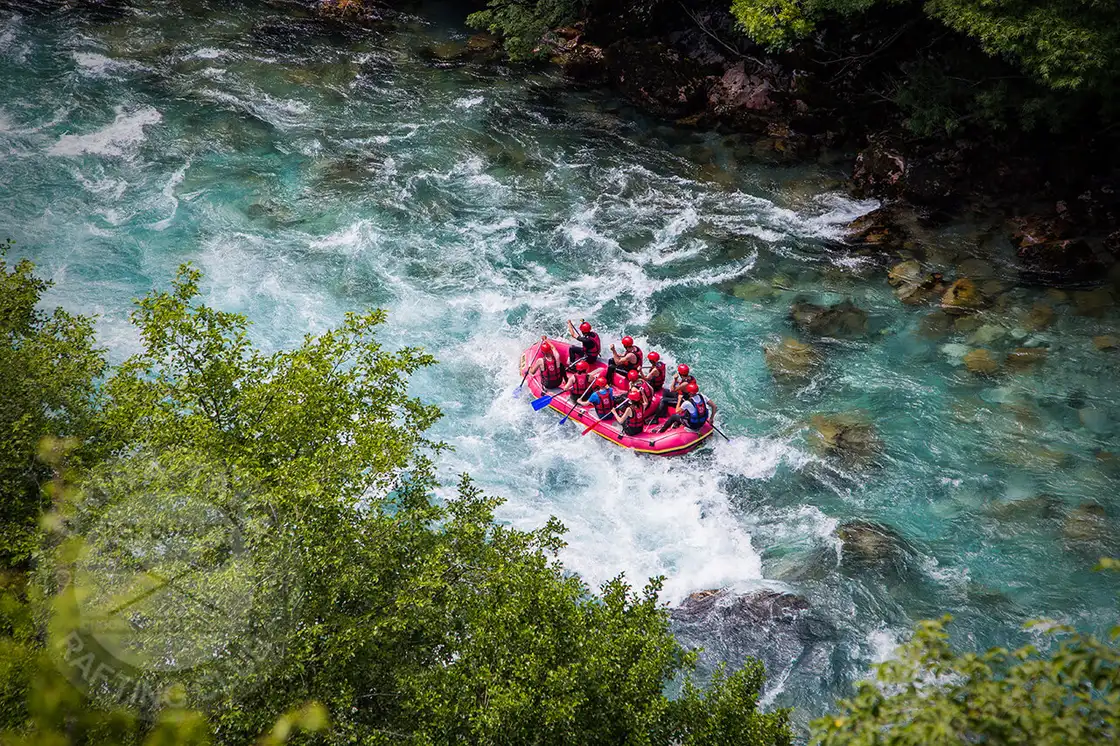
Now put Bosnia’s rivers against that number. Our rafting guide sets out the grades operators quote: the Tara below Foča runs broadly Grade III to IV at normal levels, the Vrbas above Banja Luka sits around III to IV through its two canyons, the Neretva from Konjic is a 23-kilometre run with Grade III rapids that one licensed operator sells from about €45, and the Una near Bihać is the gentle river with a wilder stretch by the Štrbački buk falls. The grades move with the water level, so a policy capped at Grade 3 covers a summer Neretva and the easy Una, and leaves a spring Tara or Vrbas outside its terms. If a harder river is on your plan, you’ll need an adventure schedule that names a higher grade, in writing.
Two Tara traps. The river is the frontier: the Tara operator whose page we checked describes Montenegro on the left bank and Bosnia on the right, with guests crossing on an ID card, so a policy that lists Bosnia but not Montenegro has a gap in the middle of the trip. And the “insurance” line on an operator’s package is a local accident policy for the day, not evacuation or repatriation - don’t treat it as cover for a medevac.
Jahorina and Bjelašnica: the piste edge is the policy edge
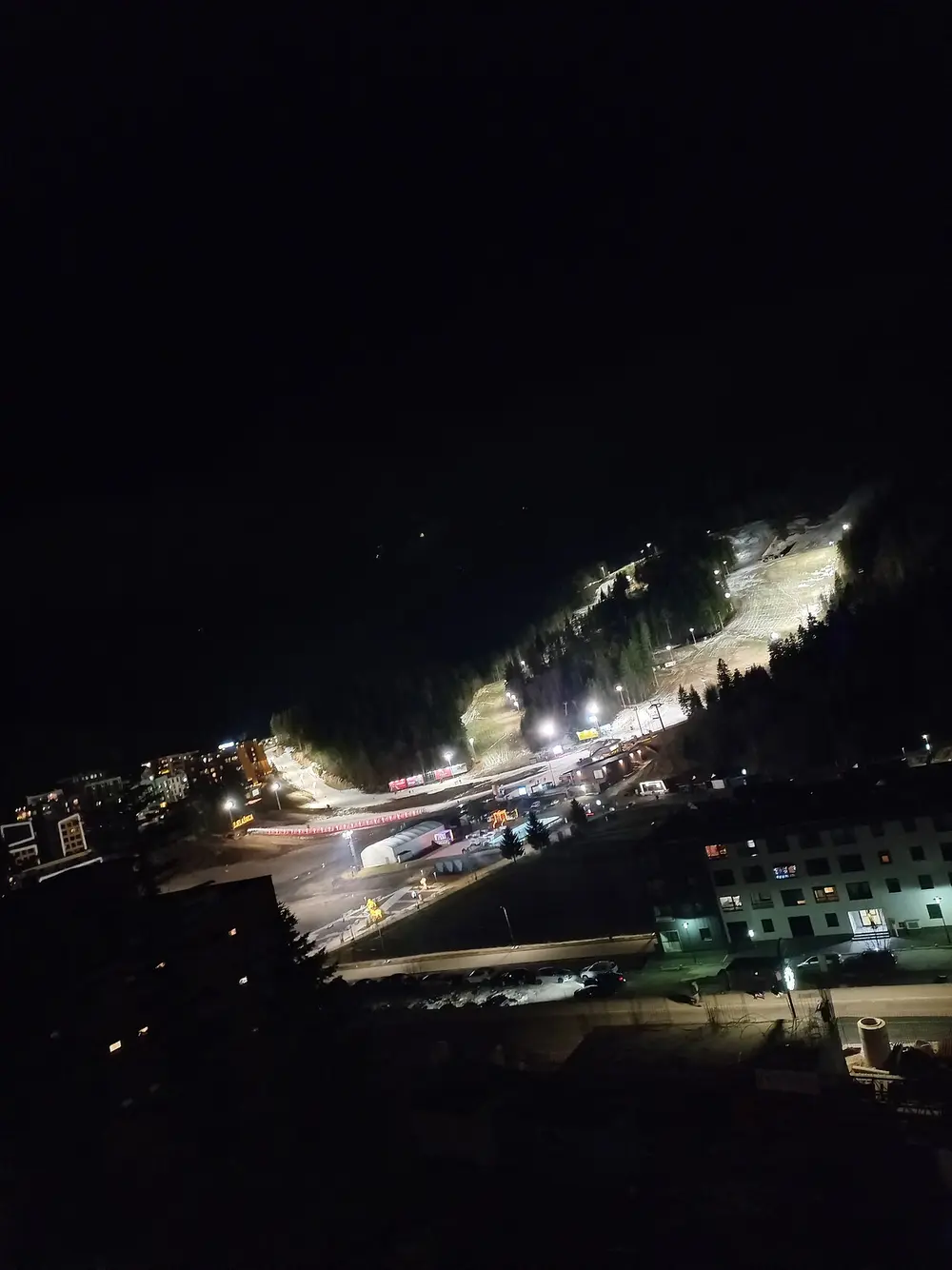
Sarajevo’s two Olympic mountains sit in different entities: Jahorina is in Republika Srpska, Bjelašnica in the Federation, and a broken wrist on each ends up in a different hospital system. Jahorina’s operator lists 35 kilometres of prepared slopes with lifts from 1,300 metres up to 1,889 metres, below a 1,916-metre summit that hosted the women’s alpine events in 1984; Bjelašnica’s summit is 2,067 metres and it took the men’s races. Our comparison of Jahorina and Bjelašnica covers passes and lifts; the insurance point is narrower than that.
Both mountains sit far below the altitude thresholds insurers use, so height doesn’t matter. The clause that matters is the piste boundary. SafetyWing’s wording excludes “skiing/snowboarding off-piste (outside marked territory or against advice of ski school/authority)”, and it excludes it even for customers who paid for the adventure add-on. The tree runs off Jahorina’s ridge and the open bowls beside Babin Do are the most tempting snow on the hill, and on most policies they’re also uninsured snow. Ski the marked piste and respect the closures and you’re inside the wording; duck a rope and you’re on your own. Many base plans treat skiing as a paid rider; our guide to Bosnia in winter tells you when the lifts run so the rider covers the right dates.
Maglić and the Via Dinarica: altitude is fine, the trail rule is not
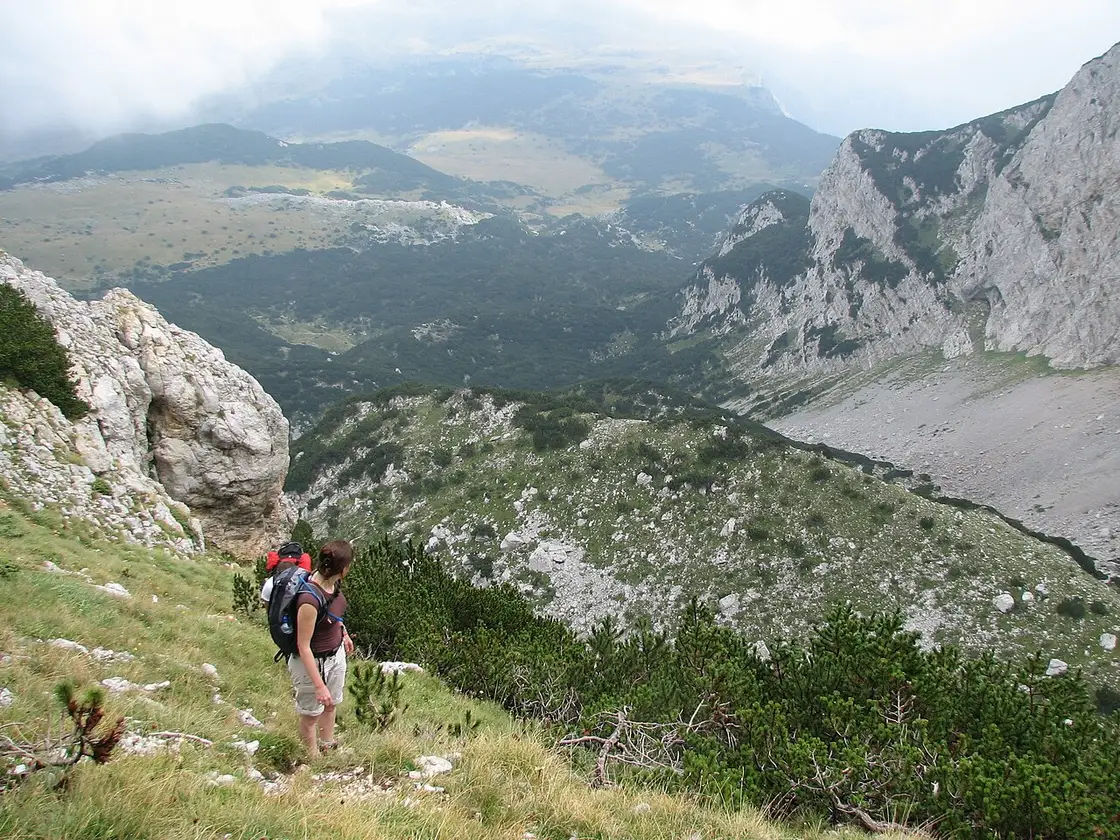
SafetyWing, again as the worked example, excludes activity at 4,500 metres or higher unless you hold the add-on, which then covers mountaineering below 6,000 metres. Maglić, Bosnia’s highest point at 2,386 metres, doesn’t come close. What does apply is the trail rule, twice over: insurers commonly restrict hiking cover to recognised routes, and Bosnia’s mine situation makes the same restriction a matter of physical safety. On the Via Dinarica and the day routes in our hiking guide, stay on the waymarked line and both the adjuster and BHMAC are satisfied.
Your rental car is a separate policy
Nothing in a travel medical plan pays for damage to a hire car. The vehicle is covered by the collision damage waiver and third-party cover that come with the rental agreement, and the deductible on that waiver, often a four-figure sum in convertible marks, is the number you either reduce at the desk or cover with a standalone excess policy; a travel policy covers the people in the car if they’re hurt, and nothing else. One Bosnian detail belongs in the same breath: winter equipment is mandatory on the roads from 1 November to 1 April, per the national motoring association BIHAMK, and a rental without it is a breach an insurer can point to. Our guides to renting a car in Bosnia and driving in Bosnia go through the waiver and the deductible before you sign.
What to check before you pay
- Evacuation limit and who arranges it. Ask whether the insurer can guarantee payment to KCUS, UKC Banja Luka or SKB Mostar directly, and whether evacuation includes a helicopter lift from terrain a road ambulance can’t reach.
- Country list. Bosnia and Herzegovina by name, plus Montenegro if the Tara is on the plan and Croatia if you’re driving in from the coast.
- Rafting grade. A written number, and one higher than 3 if the Tara or the Vrbas is booked.
Price, and why timing matters more than the premium
There’s no honest single figure for a Bosnia policy; age, trip length, limits and the adventure rider set the price. Two things about Bosnia change the decision. The first is that the adventure rider is where the value sits, since the rafting grade and the piste clause both live inside it. SafetyWing gives its add-on a maximum benefit of $100,000 and, per its own help centre, won’t attach it to a plan that’s already active, so the rider has to be chosen at purchase, not from the put-in at Foča. The second is that the evacuation limit, not the premium, is the number to compare between providers. Get a quote for your exact dates and keep the certificate, the assistance number, 124 and 121 saved offline. In Bosnia the receipt in your pocket is what the insurer reimburses, and the wording you read before you left decides whether it does.
Photos
Read also

What to see · 15 min read
Via Dinarica Bosnia: Huts, Stages & Logistics
Verified · September 12, 2026Plan the Via Dinarica White Trail in Bosnia: 12 stages, 334 km, hut booking, trailheads, closures and three workable section packages.

What to see · 10 min read
Jablanica: Neretva Bridge & Roast Lamb Stop
Verified · September 4, 2026Jablanica on the Sarajevo-Mostar road: Battle for the Wounded museum (5 KM), the 1943 bridge, roast lamb lunch. Hours, parking, how long to stop.

What to see · 8 min read
Prokoško Lake: Shepherd Huts High Above Fojnica
Verified · September 3, 2026Prokoško on Vranica at 1,636 m: katuni, gate prices for foreigners, no swimming, and the 2026 asphalt climb from Fojnica.

Entertainment · 10 min read
Best Lakes in Bosnia for Swimming & Road Trips
Verified · September 3, 2026Five Bosnian lakes for swimming and road trips: Pliva, Boračko, Blidinje, Prokoško and Pannonica - which warm up, which ban bathing, how to link them.