Bosnia and Montenegro Road Trip: 6-7 Day Loop
A 6-7 day self-drive loop through Bosnia and Montenegro: Sarajevo, Mostar, Kotor and Durmitor, with real drive times and border paperwork.
Same car, two countries, and one border crossed twice: that’s the whole idea behind this loop. Bosnia supplies the first half, Ottoman river towns strung along green canyons; Montenegro supplies the second, trading canyons for a walled bay and some of the wildest mountains in the western Balkans, before the road carries you back over the line and closes the ring at Sarajevo. The full circuit runs roughly 730 km over six or seven days, and despite crossing two countries, only two of those days are genuinely long drives. Sarajevo, Mostar, Trebinje, Kotor, Durmitor, Sutjeska, then home.
Scenery aside, what actually decides whether the week goes smoothly is a piece of paper. A hire car crossing an international border twice - out and back, not just out - needs the rental company’s written permission for both legs, sorted before you leave the pickup desk rather than argued over at a barrier in the mountains. Our dedicated Bosnia-Montenegro border crossings guide covers all four road crossings, queue ranges and the insurance rules in depth; this route uses two of them, and there’s more on exactly which crossings below. Still deciding whether splitting the week between two countries is worth it at all? Our Bosnia versus Montenegro comparison weighs coast against mountains, and if driving the whole loop isn’t the plan, Sarajevo to Kotor links the two capitals directly, no full circuit required. May, June and September hit the sweet spot - warm enough to swim, short of the worst July crowds and heat - though the high trails around Durmitor and Sutjeska genuinely want full summer to open up properly.
The pace: fast through the towns, slower once the peaks start
Overnight, the loop breaks down simply: one evening each in Sarajevo, Mostar, Trebinje and Kotor, then Žabljak for Durmitor and Foča for Sutjeska, before a short run home on day seven. That’s six nights, and it moves through Bosnia noticeably faster than a trip that stays only in Bosnia - every southern town gets one evening here, not two or three, because half the week still has Montenegro’s mountains ahead of it. Drop a night and it tightens to six days; there’s a note at the end on where to cut.
Only two of the six driving legs eat real time: the climb from Kotor up to Žabljak, and the return crossing through the Piva canyon into Sutjeska, three to four hours of mountain road apiece. Everything else runs two hours or under, several of those scenic enough that the drive counts as sightseeing rather than transit. Treat the first three days, through Bosnia, as a fast-moving warm-up; the back half of the week is where the trip actually slows down.
Day 1: Sarajevo, and only one day
This is the fast version of the capital. A trip built around Bosnia alone can give Sarajevo two full days; this loop gives it one, so the day works better as triage than as a checklist.
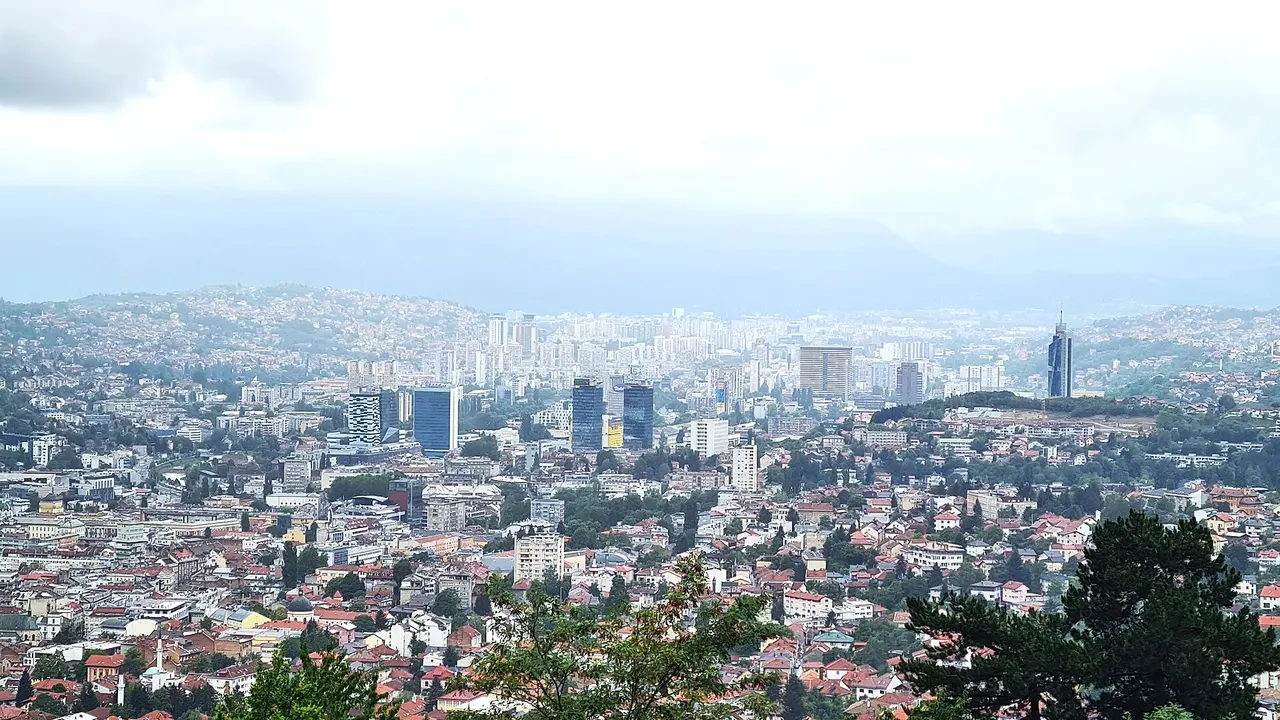
Base yourself inside or right beside Baščaršija and start walking early. The Ottoman bazaar hands off, at the brass strip set into the pavement, to a Habsburg-era boulevard, and the pockmarked walls along the route still carry the story of the 1990s siege without needing a plaque to explain it. Slow down for the Sebilj fountain and the courtyard of the mosque Gazi Husrev-beg endowed in 1531, then finish at the Latin Bridge, the unremarkable-looking corner where a single shot in the summer of 1914 tipped Europe into war. That trio is the non-negotiable core. If the afternoon still has light in it, add either the Trebević cable car for the view over the valley, or the Tunnel of Hope, the siege museum near the airport - trying to fit both on top of the old town is what turns a relaxed first day into a rushed one (the 10-day version of this trip has room for both).
Leave the rental car out of the picture until tomorrow. Parking is scarce around the bazaar, and a car earns nothing sitting at the curb while you’re still on foot - collect it the next morning instead, once you’re pointed toward Mostar. This car has to clear a border twice, not once, so get the cross-border authorisation printed on the contract before you sign for the keys - more on exactly what to ask for further down.
Day 2: the canyon road into Mostar
Collect the car first thing and point it south. The M17 run down the Neretva canyon is easily the prettiest of the loop’s short driving days: about 130 km, 2 to 2.5 hours, nowhere near long enough to justify rushing it. A brief stretch of motorway clears Sarajevo, then the road narrows to two lanes and sticks close to the river all the way down - queue up behind a truck on the tight bends rather than fight for a gap, and let the gorge do the entertaining. Konjic marks the midpoint, worth five minutes for its rebuilt Ottoman bridge if you want to stretch your legs; skip the nuclear-bunker tour here, though - it needs a pre-booked hour this pace doesn’t have.
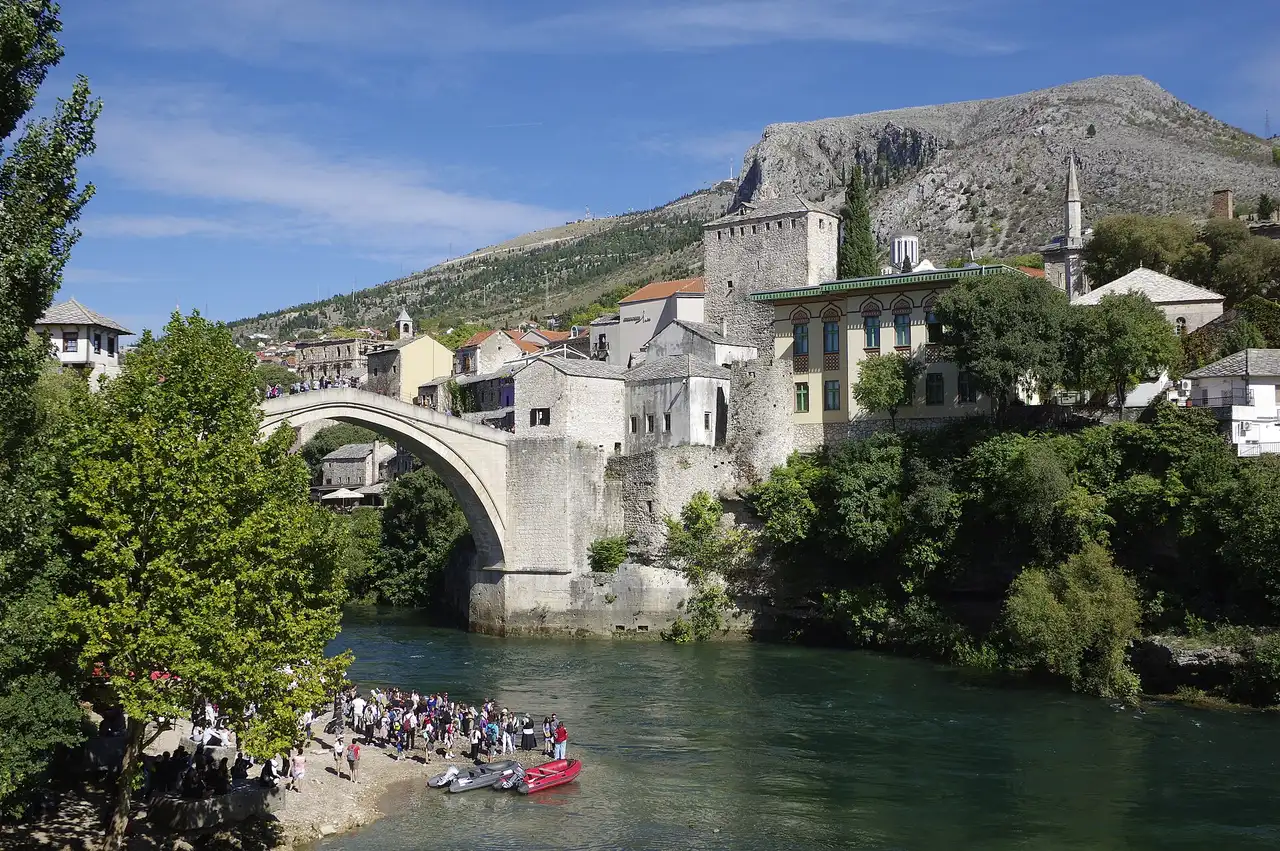
Aim to roll into Mostar in the late afternoon, once the coach groups have started thinning out. One night here means picking a lane rather than trying to do everything: cross Stari Most for the first time once evening settles and the stone turns soft underfoot, take it slowly rather than in a hurry, then give the old quarter behind it an hour before dinner, the coppersmiths’ stalls and a look from the Koski Mehmed-Paša minaret down the water both worth the climb. Sleep on the flatter edges of town where a car can actually park. If a full Mostar stay plus Blagaj and Kravice is what you’re really after, that’s a different trip - the 10-day route, not this one; here, dinner two or three streets inland, away from the bridge-view mark-up, and an early night are the better trade, because Trebinje and a border crossing are tomorrow’s job. Our Mostar guide has the fuller rundown, including the town’s still-visible wartime divide.
Day 3: to Trebinje, the night before the border
Mostar to Trebinje doesn’t take long - about 115 km, just over two hours, via Stolac - and it earns its spot on the loop as much for logistics as for scenery. Sleep here tonight and the Montenegro border sits less than an hour away come morning, instead of a full morning’s drive from Mostar. Break at the Radimlja necropolis near Stolac for its field of carved medieval tombstones, and watch for the point past town where the road signs flip to Cyrillic - you’ve crossed into Republika Srpska, same country, same currency, just the other half of Bosnia’s split administration.
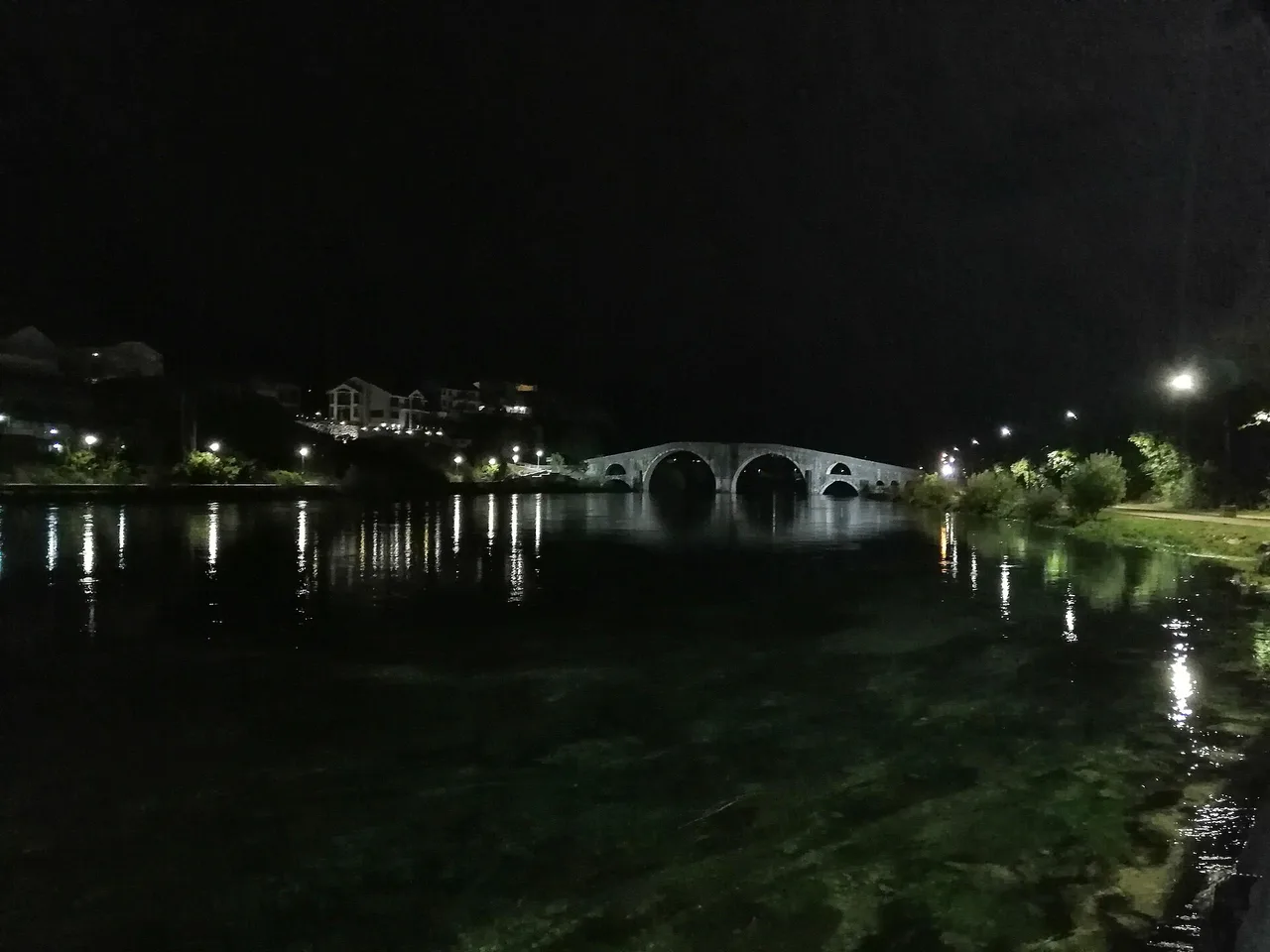
Trebinje itself rewards the detour: an 18th-century old quarter raised under Ottoman rule, built around a square shaded by plane trees, right in the middle of Herzegovina’s wine country. The town’s Arslanagić Bridge has a story worth knowing even at a glance: an Ottoman bridge traditionally dated to 1574 (some sources place its construction in the 17th century), dismantled block by numbered block and reassembled downstream in the Gradina quarter once a 1960s dam raised the water level here - so what you’re looking at is centuries old and only decades old on this exact spot. Out at the Tvrdoš Monastery the monks have been making wine since long before tourism arrived, and a small glass of the local Vranac red or Žilavka white rounds off the evening nicely - just don’t overdo it, because tomorrow starts at a border post, not a lie-in. Spend down any spare convertible marks here; euros take over from Kotor onward. Stay the night if you can - once the day-trippers from Dubrovnik leave, the square is one of the most relaxed evening spots on the whole loop - and the full wine-and-walking detail is in our Trebinje guide.
Day 4: across the border to Kotor
This is the first international crossing, and it’s a gentle one. From Trebinje you drop to the coast at the Zupci (Bosnian side) / Sitnica (Montenegrin side) border post - since spring 2025 a joint, one-stop crossing that has cut the old queues - then round the western arm of the Bay of Kotor through Herceg Novi. Reckon on about 90 km and 2 to 2.5 hours including the border and the slow, gorgeous bay road; if the far shore is busy, the Kamenari to Lepetane ferry shortcuts across the narrows for a small fare (confirm the current rate at the ramp). Note the currency switch here: Bosnia runs on the convertible mark, Montenegro uses the euro, so keep a little of each.
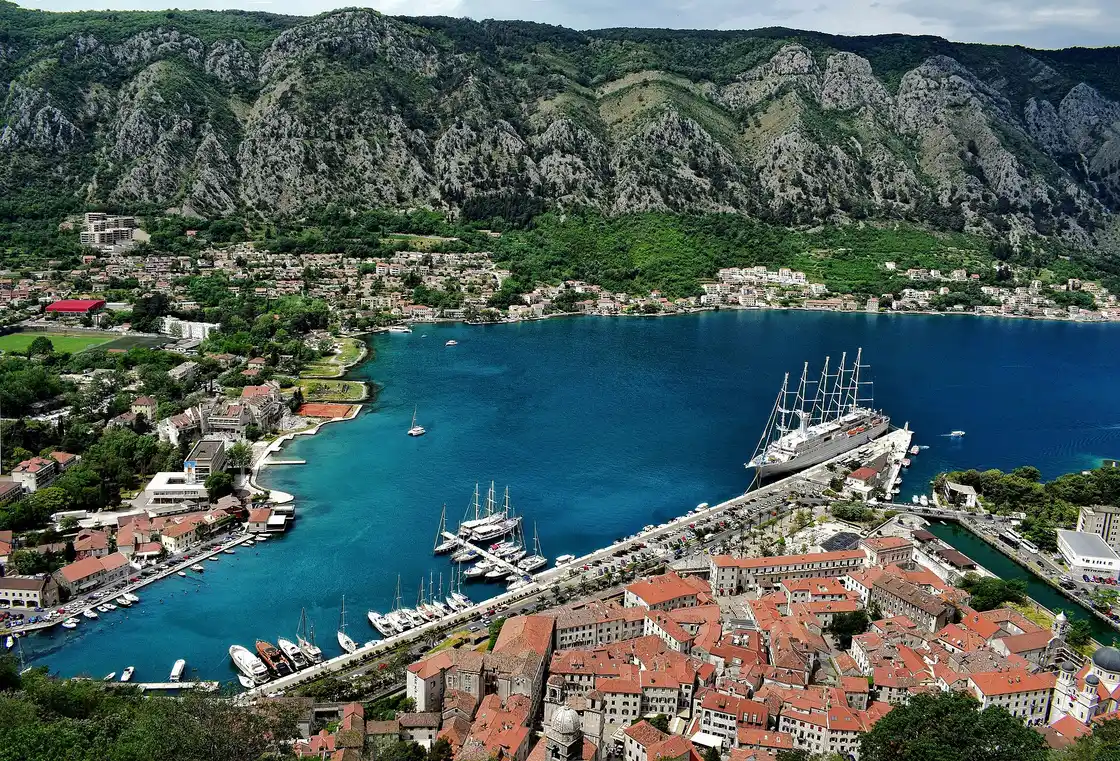
Kotor itself is a walled medieval old town crammed against a near-vertical mountain, with fortifications that zigzag up the slope to St John’s Fortress - the climb is the classic thing to do at dawn before it heats up. It’s a UNESCO-listed maze of stone lanes and small squares, best walked in the evening once the cruise crowds have sailed. Our sister site’s guide to Kotor on Montenegro Guidebook covers the old town and the fortress walk in full. Sleep inside the walls for the atmosphere, or in quieter Dobrota or Muo along the bay if you want easy parking.
Day 5: up into the mountains, Durmitor and Žabljak
Today the car earns its keep. Kotor to Žabljak is about 165 km and 3.5 to 4 hours on serious mountain roads, north through Nikšić and up onto the plateau, with the final 45 minutes climbing to the town. This is a driving day where the road is the reward: hairpins, high pasture and, if you want to add an hour, the switchback climb out of Kotor on the old Serpentine road gives one of the great views in Europe back over the bay.
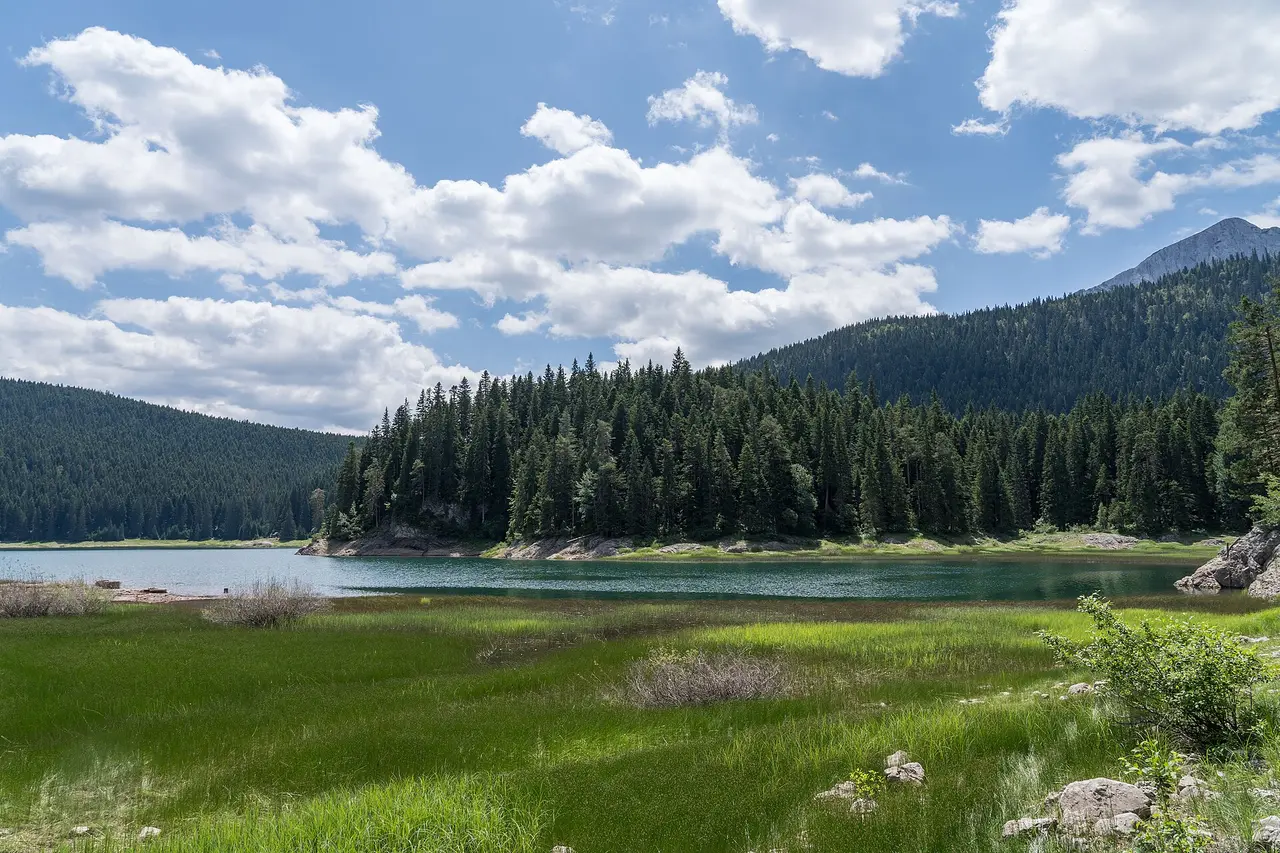
Žabljak is a plain little mountain town, the highest in the Balkans at around 1,450 m, and it exists mainly as the base for Durmitor National Park. The easy highlight is the Black Lake (Crno jezero), a glacial lake about 3 km from town ringed by pine and framed by the grey Durmitor peaks - an hour’s flat walk loops it. With more time, the Durmitor Ring road and the famous Đurđevića Tara Bridge - a graceful 1940s arch high over the Tara canyon, about 25 km northeast of town on the road toward Mojkovac - fill a full day. You’ll find the walks and practicalities on our sister site’s Durmitor National Park guide.
Day 6: the Piva canyon and back into Bosnia at Sutjeska
The second crossing is the wild one. From Žabljak you drive west to Plužine and along the turquoise Piva Lake and canyon - a spectacular stretch of tunnels blasted through the cliffs above the water - to the Šćepan Polje (Montenegrin side) / Hum (Bosnian side) border, the small crossing by the rafting camps where the Tara and Piva meet. It’s roughly 125 km and about three hours with the border, then a further half hour up to Foča and into the park. This is a quiet, remote frontier; carry your documents handy and don’t expect much in the way of facilities.
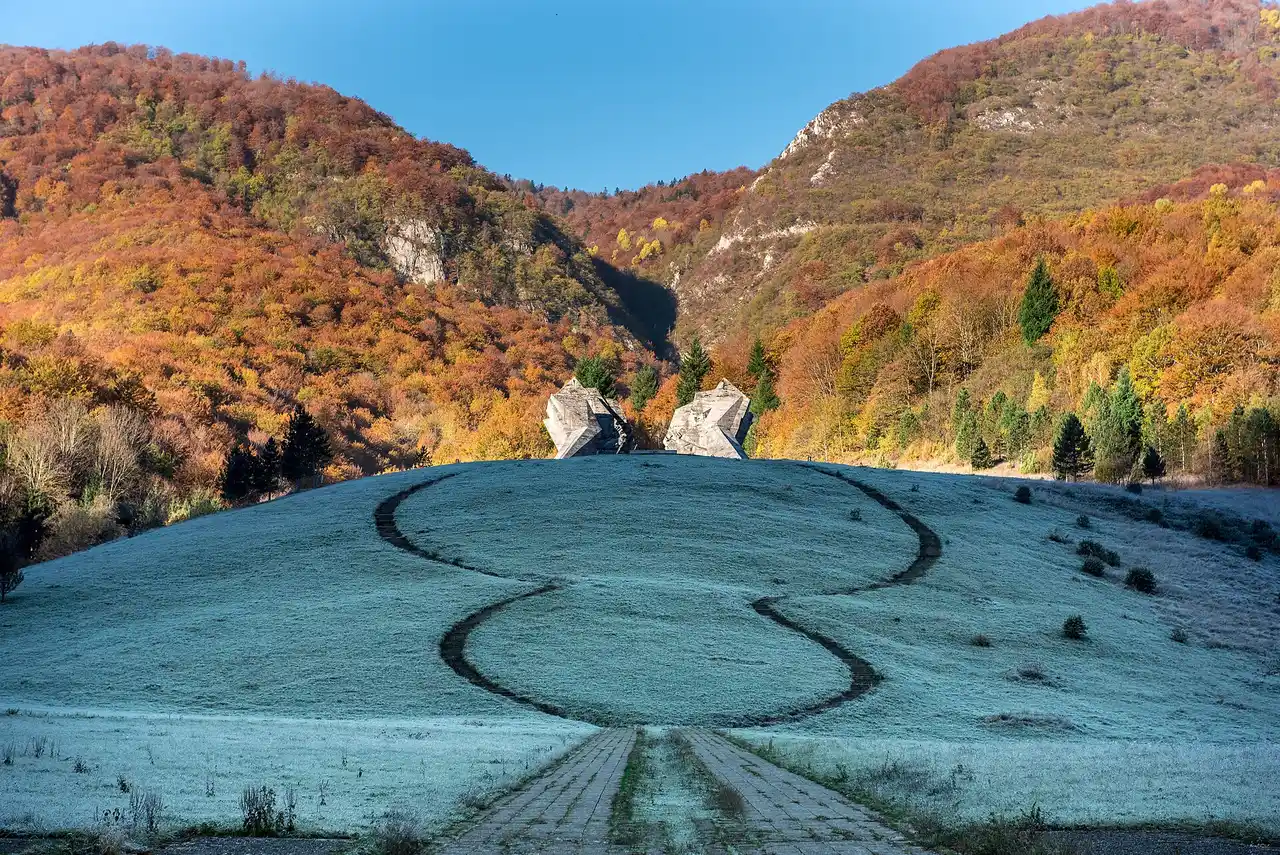
Just past Foča you reach Sutjeska National Park, Bosnia’s oldest, established in 1962. Its three headline sights are heavyweight: the vast, strange Tjentište war memorial to the 1943 battle, two great concrete wings on the hillside; Perućica, one of the last two primeval forests left in Europe, entered only with a park guide; and Maglić, at over 2,386 m the highest mountain in the country, straddling the border you just crossed. Sleep near Tjentište or Foča. Our full Sutjeska National Park and Maglić guide lays out the trails, the guide arrangements and the season - the high walks are a summer proposition and snow lingers near Maglić into early summer.
Day 7: Sutjeska to Sarajevo, closing the ring
Day seven is the easy one: Foča back to Sarajevo runs about 107 km, roughly two hours, on the M18 through the Drina and Bistrica valleys - closer to a cooldown lap than a real driving day. Work out your flight time first and count backward from it, because the car has to go back before you check in, not after. Anyone with an hour or two to spare can swing past Trnovo and the Bjelašnica olympic uplands for one last stretch of the legs before the airport queue.
The car has to survive two borders, not one
A loop is a stricter test than a one-way trip: the same car needs clearance to leave Bosnia at Zupci/Sitnica on day four and to come back in at Hum/Šćepan Polje on day six. A permission that only covers the outbound leg isn’t enough - ask for both directions in writing before you sign, not a verbal promise at the counter.
The insurance side is already solved. Bosnia and Montenegro both sit inside the Multilateral Agreement, the plate-recognition arm of the international Green Card system, so no physical Green Card changes hands at either crossing - an ordinary Bosnian plate counts as proof of cover on its own. What you’re paying the rental company for is authorisation, not insurance: expect a cross-border fee on top of the rental price, the amount set by the agency rather than fixed, and confirm your specific car is even allowed to leave the country (our Bosnia car rental guide has the wider cost picture). Push on past Montenegro toward Albania or North Macedonia and this agreement stops applying, so you’ll need a real Green Card again - the full mechanics and live queue ranges for all four crossings sit in our dedicated border crossings guide.
Money changes at the border too: Bosnia’s convertible mark (BAM or KM) has sat pegged to the euro at roughly 1.96 for years, while Montenegro simply spends euros without belonging to the eurozone - carry a little of both - don’t count on cards at the smaller border-town cafes and the Piva canyon fuel stops. The roads keep the same rhythm on both sides of the line: two-lane blacktop shared with trucks, decent surfaces, mountain hairpins on the Kotor and Piva legs. Police do run speed checks, and Republika Srpska has a reputation for them, so the posted limits aren’t decorative. Starting from the coast instead - picking the car up in Croatia and driving in - the same rule applies in reverse: declare every country before the first border, not the second.
Cutting it to six days, or stretching to eight
Six nights - Sarajevo, Mostar, Trebinje, Kotor, Žabljak, Foča - is the version with room to breathe. Squeezed for time, the cleanest cut is Trebinje: make it a long lunch and a wine stop between Mostar and Kotor instead of an overnight, and you’re down to six days without touching either of the two proper driving days. Those two, Kotor up to Žabljak and the Piva canyon crossing back into Bosnia, are the wrong place to save time; each already runs three to four hours of mountain road on its own, and stacking a rushed border crossing onto the end of one is how a good day turns into a bad evening.
Got a spare day instead of a missing one? Give it to the mountains rather than another town. A second night at Žabljak turns the Black Lake from a quick loop into a proper hike toward the Tara bridge, and a second night at Kotor means walking St John’s Fortress in the cool of the morning instead of squeezing it onto an already full driving day. Either way, the trip’s one real weak point doesn’t change with the day count: a car with the wrong paperwork, at a border post that has no interest in your travel plans. Settle that before day one, keep both currencies in your pocket, and everything else falls into place - canyon, bridge town, wine, bay, glacial lake, and a forest older than the country itself, before the ring closes back in Sarajevo.
Route day by day
- Days on the road
- 7
- Distance
- ≈730 km
- Budget from
- 90 EUR
- Best season
- May, June, July, August, September
The route at a glance
-
Sarajevo
Route startstop ≈1440 min
Day 1. One night only, so keep it tight: Baščaršija and the 1914 corner first, the Trebević cable car only if daylight allows. Collect the rental car the next morning, with Montenegro already named on the contract before you drive south.
Photo: User:Felky / Wikimedia Commons, CC BY 4.0 ( source) -
Mostar
130 km from the startstop ≈1440 min
Day 2, over the Neretva canyon on the M17 - about 130 km, 2 to 2.5 hours of driving. One evening here is enough for Stari Most and the old quarter once the coaches clear out; it is the 10-day trip that adds Blagaj and Kravice.
Photo: Berthold Werner / Wikimedia Commons, CC BY-SA 4.0 ( source) -
Trebinje
245 km from the startstop ≈1440 min
Day 3, via Stolac - about 115 km, just over two hours. Sleep here and the border is already close for tomorrow: an evening among the wine cellars, then an early run into Montenegro.
Photo: Miljan Simonović / Wikimedia Commons, CC BY-SA 4.0 ( source) -
Kotor
330 km from the startstop ≈1440 min
Day 4. Cross into Montenegro at Zupci/Sitnica, round the Bay of Kotor (about 90 km, 2 to 2.5 hours with the border). Walled UNESCO old town under the fortress climb.
Photo: Jocelyn Erskine-Kellie / Wikimedia Commons, CC BY 2.0 ( source) -
Durmitor (Žabljak)
495 km from the startstop ≈1440 min
Day 5, up through Nikšić (about 165 km, 3.5 to 4 hours of mountain road). Žabljak is the base for Durmitor: the Black Lake, the ring road and the Tara bridge.
Photo: Alexkom000 / Wikimedia Commons, CC BY 4.0 ( source) -
Sutjeska National Park
620 km from the startstop ≈1440 min
Day 6, back into Bosnia at Šćepan Polje/Hum through the Piva canyon (about 125 km, 3 hours with the border). The Tjentište war memorial, Perućica forest and Maglić.
Photo: JankoSam / Wikimedia Commons, CC BY-SA 4.0 ( source)
Route map
The map with stops loads on click - to keep the page lightweight.
The map didn’t load. Check your connection and refresh the page.